amass is the OWASP flagship project for network mapping of attack surfaces and external asset discovery, combining OSINT collection with active reconnaissance for authorized security assessments.
| Tool | owasp-amass/amass — OWASP flagship tool for attack surface mapping and external asset discovery via OSINT and active reconnaissance |
| Category | Reconnaissance / OSINT / DNS enumeration |
| Primary Use | Mapping an organization's externally visible assets — subdomains, DNS records, and network relationships — during scoped penetration testing engagements |
| Safe Use | Intended for authorized assessments, bug bounty programs with defined scopes, and defensive asset-inventory research on infrastructure you own or are contracted to test |
| Telemetry Note | Active reconnaissance modes generate observable DNS queries, scraping traffic to data sources, and direct probes against target nameservers — blue teams can detect volume anomalies and unfamiliar resolver behavior |
amass occupies a singular position in the reconnaissance ecosystem: it is an OWASP flagship project, maintained under owasp-amass/amass with roughly fifteen thousand stars, written in Go, and designed to perform network mapping of attack surfaces and external asset discovery. The README frames its mission in two complementary techniques: open source information gathering and active reconnaissance. That duality matters for professionals, because it means amass is equally at home as a passive OSINT aggregator trawling third-party data sources and as an active engine that interacts directly with the target's DNS infrastructure. Understanding which mode you are in, and what authorization covers it, is the first operational decision any user makes.
The project's pedigree is worth dwelling on. It carries the OWASP flagship badge, which is granted to a small set of mature, high-impact projects, and the copyright notice runs from 2017 through 2026 under Jeff Foley's stewardship, indicating continuous, sustained maintenance rather than a burst of activity followed by abandonment. Licensing is Apache 2.0 for the core, though the README notes some subcomponents carry separate licenses — a detail worth checking before embedding amass into a commercial toolchain or redistributing it inside a proprietary assessment platform.
Architecturally, the README is thinner than the tool itself, but what it does reveal is a layered distribution model. There are official Docker images published under owaspamass/amass on Docker Hub, prebuilt release binaries on GitHub, and a Go module path via goreportcard — meaning you can consume amass whichever way fits your pipeline. A simple installation path looks like go install github.com/owasp-amass/amass/v4/cmd/amass@latest, or, for container-first workflows, docker pull owaspamass/amass. The project also points to a dedicated documentation repository at owasp-amass.github.io/docs, which is where the real operational depth lives; the GitHub README is deliberately a landing page.
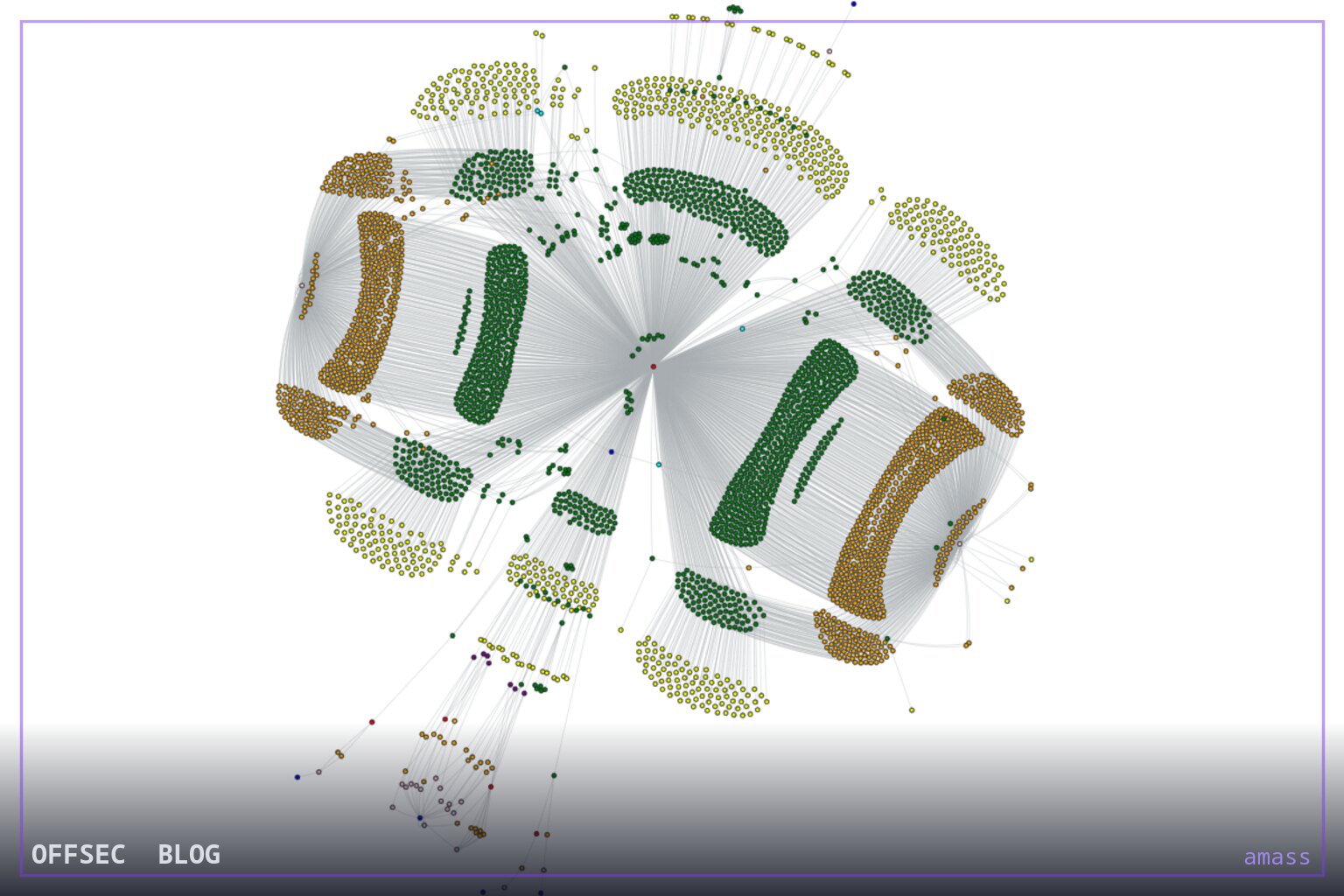
What the README's topic tags tell us about scope is substantial. The repository self-describes with attack-surfaces, dns, enumeration, osint, osint-reconnaissance, recon, and subdomain — a clear statement that amass is fundamentally a discovery engine for the externally visible namespace of an organization. The inclusion of maltego among the topics signals integration with graph-based intelligence analysis: amass doesn't just enumerate names, it models relationships between assets, and the network graph screenshot in the README visualizes exactly that — nodes and edges representing discovered infrastructure rather than a flat subdomain list.
This graph-oriented data model is the distinguishing analytical feature. Where many enumeration tools output a text file of hostnames, amass maintains an internal graph database of assets, their DNS relationships, and the sources that vouched for each discovery. The README's network mapping image is not decoration; it reflects the tool's core output format. For an authorized assessor, this means the deliverable is traceable — every discovered asset can be attributed back to the OSINT source or active query that surfaced it, which is exactly the evidentiary discipline a professional report requires.
The two operational modes deserve explicit separation because they carry different risk and different authorization requirements. OSINT gathering queries third-party sources — certificate transparency feeds, search engines, APIs — without touching the target's infrastructure directly, and is generally defensible even in narrow scopes. Active reconnaissance, by contrast, sends queries at the target's DNS nameservers and can include brute-force style enumeration of subdomain candidates. That traffic originates from your testing IP, is logged, and must fall squarely inside your engagement's written scope. Professionals should treat the mode selection as a contract question, not a convenience question.
From a defensive perspective, amass is arguably more valuable as a mirror than as a spear. Asset inventory drift — forgotten subdomains, shadow infrastructure, expired marketing sites — is one of the most common root causes of breaches discovered post-incident. Running amass against your own organization's domains from the outside gives the external attacker's view of your footprint, which is precisely the dataset your attack surface management vendor charges for. The tool's data sources and enumeration logic are transparent and open source, making it a credible baseline for validating commercial ASM coverage.
Telemetry and detection considerations follow directly from the architecture. Passive mode is nearly invisible to the target because it never contacts target infrastructure, but active mode produces characteristic signatures: high volumes of DNS queries for nonexistent subdomains, queries arriving faster than human pacing, and connections to data sources that fingerprint the tool's scraping patterns. Defenders monitoring authoritative nameservers can flag dictionary-like query distributions as reconnaissance indicators, and threat intelligence teams can correlate bursts of NXDOMAIN responses with pre-attack mapping activity.
The community infrastructure around the project signals its maturity: a Discord server for support, an explicit policy directing users away from GitHub issues for support requests, contribution guidelines in CONTRIBUTING.md, continuous integration badges including GitHub workflow tests and codecov coverage tracking, and a CodeFactor code-quality badge. Corporate support from WhoisXML API is disclosed transparently in the README, suggesting commercial data-source integrations are part of the ecosystem — relevant because richer OSINT often requires API keys from third-party providers, a supply-chain consideration when choosing what data feeds your assessments touch.
Where amass fits in an authorized workflow is at the very top of the kill chain, during scoping and information gathering. It is a discovery tool, not an exploitation tool; it surfaces names, addresses, and relationships but does not attack them. That positioning makes it appropriate for bug bounty preparation within defined program scopes, for the reconnaissance phase of contracted penetration tests, and for continuous external asset inventory on owned infrastructure. What operators should watch for is mode discipline — running active enumeration against out-of-scope assets is both a contractual violation and, in many jurisdictions, a legal exposure — and data-source hygiene, since API credentials embedded in configuration files have leaked from engagement workstations before.
For teams building automation, the Go implementation and container distribution make amass pipeline-friendly: it can be scheduled as a recurring Docker job to diff an organization's external footprint over time, alerting on newly appeared subdomains that may indicate provisioning drift or a staged intrusion precursor. That continuous-discovery pattern is where the tool's graph model pays off most, because diffs over a persistent graph are far more meaningful than diffs over flat lists. The project's longevity — nearly a decade of development under the same maintainer and OWASP governance — makes it a defensible long-term dependency rather than a throwaway script.
In sum, amass is the reference implementation of open-source attack surface mapping: a Go engine that fuses OSINT collection with active DNS reconnaissance into a relationship graph of external assets. The README itself is compact — installation pointers, licensing, community links, and a network graph image — but the topics, governance, and documentation repository it references describe a tool with a clear mission and serious institutional backing. For authorized professionals, it belongs in the standard kit; for defenders, it is a free instrument for seeing your perimeter the way an adversary's mapping phase sees it.
owasp-amass/amass.Educational analysis for authorized security professionals. Use only in controlled, authorized environments.


0 comentários:
Post a Comment
Note: Only a member of this blog may post a comment.