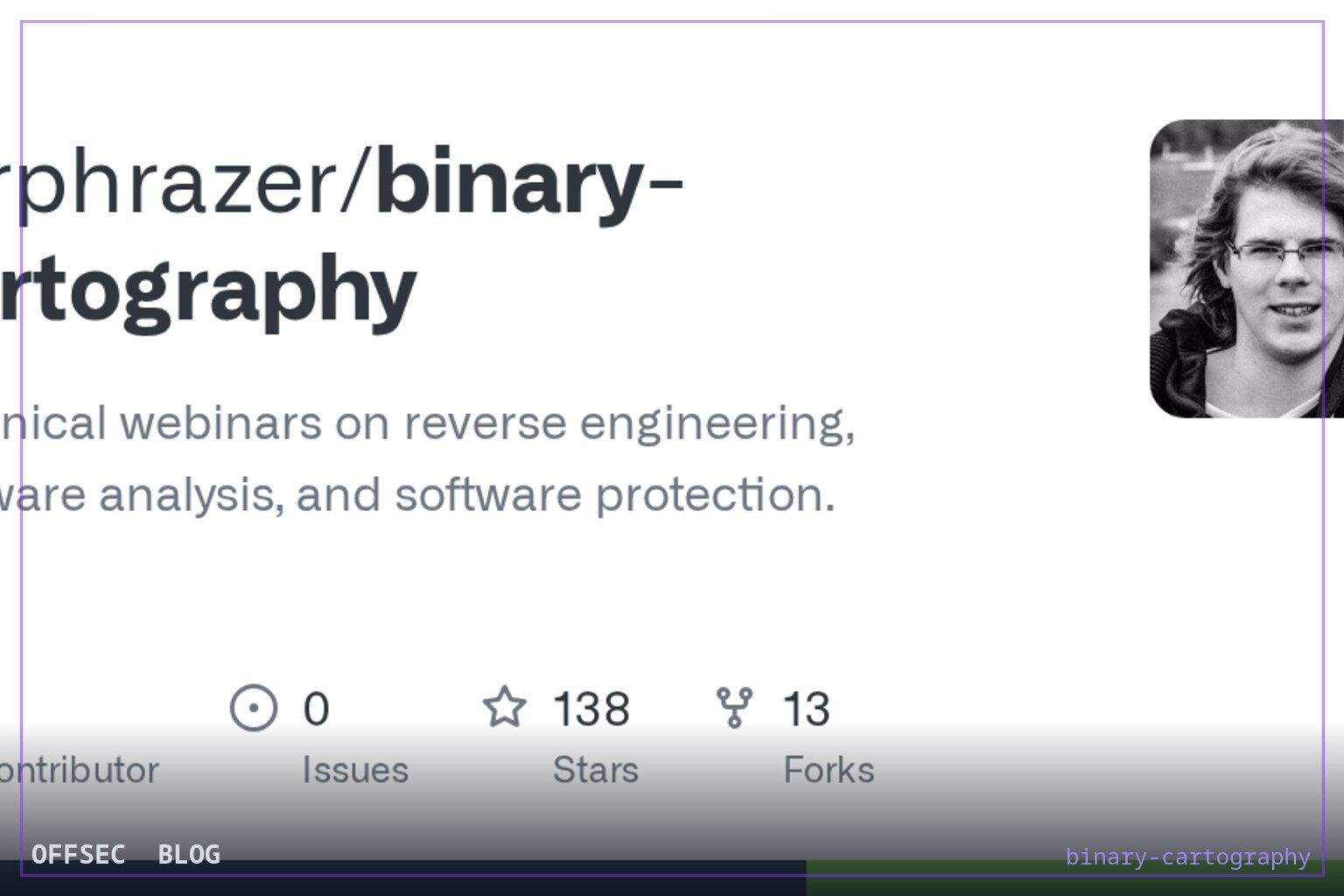
binary-cartography is an open collection of technical webinar materials covering agent-assisted reverse-engineering, malware-analysis, and software protection for security professionals.
| Tool | mrphrazer/binary-cartography — webinar material repository on reverse engineering, malware analysis, and software protection |
| Category | Educational binary-security resource collection |
| Primary Use | Learning practical reverse-engineering and malware-analysis workflows, including agent-assisted techniques using MCP tooling, in authorized lab and training environments |
| Safe Use | All material is training-oriented, for analysts and researchers working on samples they own or in controlled labs and authorized engagements; the deobfuscation webinar is explicitly framed for defenders and researchers understanding attacker techniques |
| Telemetry Note | As a passive educational repository it generates no telemetry; defenders benefit directly because the heuristics and agent workflows documented help identify obfuscated logic, hidden state machines, and crypto in suspicious binaries |
mrphrazer/binary-cartography is not a conventional executable tool but something arguably more durable: a curated repository of technical webinar materials from Tim Blazytko, an independent binary-security researcher with a PhD in program analysis. Hosted on GitHub under a GPL-2.0 license and accumulating 138 stars, the repo gathers slides, code, sample binaries, references, and recording links from an ongoing series on reverse-engineering, malware-analysis, and software protection. For professionals who prefer learning from structured primary material rather than fragmented blog posts, this is a genuinely useful resource, because each session folder is self-contained and follows a consistent layout.
The README describes the intended audience precisely: technical security professionals, reverse engineers, and analysts working on real binaries in practice. That framing matters. This is not beginner content about what a disassembler is; each webinar targets a specific advanced workflow, and the accompanying code and samples are meant to be worked through hands-on. The repository's declared language is Dockerfile, which suggests the environments for at least some sessions ship as reproducible containers — a sensible choice for malware-analysis material where analysts want an identical sandbox every time.
The webinar list is organized chronologically, starting with 2026-03-agentic_reverse_engineering, a practical introduction to how autonomous agents are reshaping binary-analysis workflows. The abstract mentions integration through MCP — the Model Context Protocol that lets language-model agents call external tools — and covers tool integration, patching, cracking-style tasks, and structured analysis. The inclusion of cracking-style exercises is worth noting: in a training context these are classic pedagogical devices for teaching control-flow and patching fundamentals, and the material is framed for analysts building skill, not for attacking third-party software.
The second session, 2026-04-agentic_malware_analysis, moves from generic reversing into defensive territory: agent-assisted analysis of malicious samples covering string decryption, API-resolving logic (the classic dynamic-import technique packers use to frustrate static analysis), multi-stage samples, and deeper structured-analysis workflows. For incident responders and malware analysts, this is the most operationally relevant session, because string decryption and import resolution are exactly the bottlenecks that consume analyst hours when triaging packed families.
The third session, 2026-07-code_identification, addresses a problem every reverser knows: large binaries where 99% of the code is boring library boilerplate and the interesting 1% is hidden somewhere in the middle. The material walks through heuristic and statistical detections for locating relevant code — state machines, cryptography, and other structural patterns — combined with agents to prune false positives and guide analysis. This aligns with the author's academic background in program analysis, and it is the kind of technique that transfers directly to both defensive triage and authorized vulnerability research.
The fourth session, 2026-09-agentic_deobfuscation, is titled from an attacker's playbook perspective but the content is clearly double-sided: recovering hidden logic, building reusable deobfuscation tooling, and verifying results with agents across progressively more complex obfuscated binaries. Verification is the detail that stands out — agent-assisted analysis is notoriously prone to confident hallucination, and a workflow that explicitly includes result verification reflects a mature, skeptical approach rather than hype.
Taken together, the four sessions trace a coherent curriculum arc: general agentic reversing, applied malware analysis, code-location heuristics, and deobfuscation with verification. The unifying theme is that language-model agents are becoming practical analysis accelerators in binary security, and that their value depends on disciplined tool integration (MCP), good heuristics to point them at the right code, and verification steps to catch when they go wrong. Professionals evaluating whether to introduce agentic workflows into their own analysis pipelines will find the material a useful reference architecture.
From a defensive standpoint, the repository deserves a place on the reading list of any blue-team analyst or threat researcher. Understanding how agents automate string decryption, API-resolution tracing, and deobfuscation translates directly into anticipating how adversaries may automate the same tasks — the deobfuscation session's attacker framing is exactly the kind of offensive-knowledge-for-defense material the industry needs. Similarly, the heuristics for pinpointing crypto and state machines help defenders characterize unknown samples faster.
The author's credentials provide additional confidence in the material's quality. Tim Blazytko maintains a presence at synthesis.to, publishes research papers and conference talks, and offers professional trainings in the same domains the webinars cover. The repo functions in part as an open companion to that commercial training, which is a healthy model: the fundamentals are free and reproducible, while deeper instruction is paid. Nothing in the README gates the webinar materials behind payment — recordings are linked publicly on YouTube, and slides and code live in the repo itself.
There is little to criticize here, other than the obvious caveat that webinar repositories age: recordings of tool-integration material built around MCP and agent frameworks can date quickly as those ecosystems churn. The value that persists is the methodology — the heuristics, the statistical code-location techniques, and the verify-everything stance toward agent output. Analysts who clone the repo should treat the container environments as the stable substrate and expect to refresh the agent-side tooling periodically.
In short, mrphrazer/binary-cartography is a high-quality, actively maintained educational resource for the agentic era of binary analysis. Clone it, work through the samples in the provided Dockerfile environments, and treat it as a structured on-ramp to agent-assisted reverse-engineering and malware-analysis in authorized settings — whether your goal is faster triage in a SOC, sharper skills in a research lab, or simply understanding where the discipline is heading.
mrphrazer/binary-cartography.Educational analysis for authorized security professionals. Use only in controlled, authorized environments.


0 comentários:
Post a Comment
Note: Only a member of this blog may post a comment.