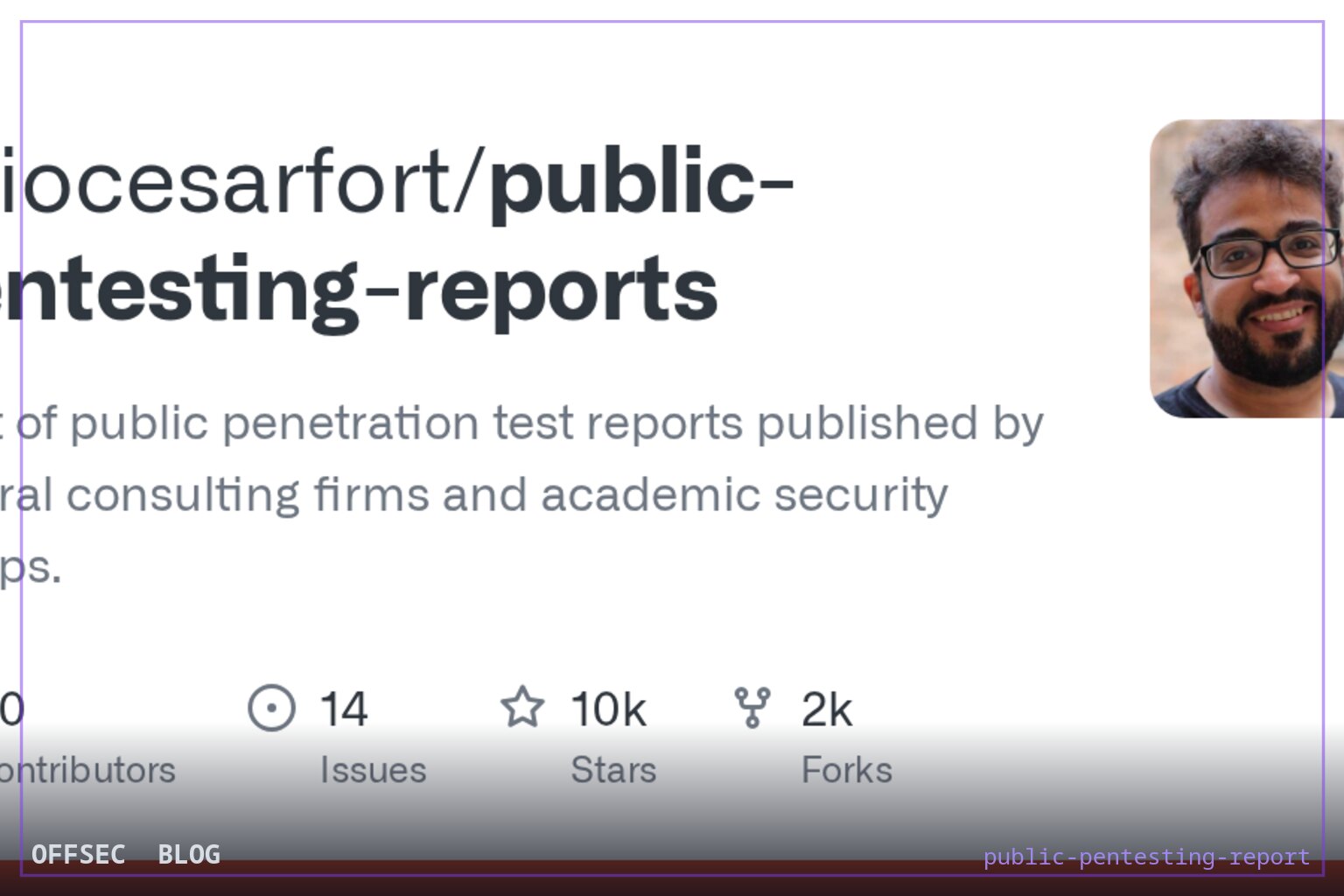
public-pentesting-reports is a curated corpus of real penetration test reports published by consulting firms and academic security groups, intended for professionals studying report structure and disclosure practice in authorized engagements.
| Tool | juliocesarfort/public-pentesting-reports — a curated list of public penetration test reports from consultancies and academic security groups |
| Category | Reference repository / professional documentation corpus |
| Primary Use | Studying anonymized, publicly released pentest deliverables to learn report structure, findings classification, and remediation phrasing for authorized engagements |
| Safe Use | Purely documentary: these are documents already released publicly by their publishers; use for training, template design, and defensive benchmarking in authorized assessment contexts |
| Telemetry Note | Not applicable — this is a passive reading list; it executes nothing, contacts nothing, and leaves no artifacts on any system |
Not every repository worth studying contains code. juliocesarfort/public-pentesting-reports is a curated index of penetration test reports that consulting firms and academic security groups have voluntarily published, and its value lies precisely in that: it aggregates the final deliverable of an authorized engagement — the document clients actually pay for — rather than the tooling that produced it. For professionals who want to understand how findings are articulated, risk-rated, and remediated in writing, this corpus is one of the few places where you can compare dozens of real-world examples side by side. The repo has accumulated roughly 9.7k stars on GitHub, which tells you the demand for this kind of material is substantial and enduring.
The repository is maintained by Julio of Blaze Information Security, a consultancy, and the README is explicit about the project's lineage: it is based on a list started in 2015 by Arne Padmos, originally hosted at roselabs.nl and preserved via the Internet Archive. That provenance matters. Curated lists decay when maintainers lose interest, and this one has already survived one host migration — from roselabs.nl to GitHub — which suggests active stewardship rather than a one-time dump. The README also points to a sibling effort by the same original author, arnepadmos/threats, for readers interested in threat modelling resources, hinting at a broader tradition of community-maintained professional reading lists in security.
It is worth being precise about what this resource is not. It is not a tool, an exploit framework, or anything executable — the primary language marker on the repo is HTML, which simply reflects that GitHub renders the list as a structured page of links to hosted PDFs and documents. There is no installation, no invocation, no attack surface. The only command you will ever run against it is the standard git clone https://github.com/juliocesarfort/public-pentesting-reports if you want a local snapshot, or you can simply browse the rendered page on the master branch. Everything in the index points to reports the original publishers chose to release.
From an analyst's perspective, the interesting question is what you can actually extract from a corpus like this. Real pentest reports follow recognizable conventions — executive summaries, scope statements, methodology descriptions, findings with severity ratings tied to frameworks like CVSS, evidence sections, and remediation guidance — but the execution varies enormously between a boutique consultancy, a Big Four firm, and an academic CTF-adjacent security group. Reading across the collection lets you observe that variance directly: how different organizations phrase the same class of vulnerability, how much technical detail they include, and where they draw the line on disclosure.
For consultants building or refining their own deliverable templates, this is benchmarking material. If you are drafting a findings section and want to see how mature firms structure exploitability narrative versus business impact, you have dozens of published exemplars to calibrate against. The corpus is equally useful for internal security teams on the receiving end of pentest reports: understanding how a well-written report is supposed to read helps you evaluate whether the deliverable you just paid for meets professional standards, and gives you vocabulary for pushing back when severity claims are unsupported or remediation guidance is generic filler.
The defensive research angle is just as strong. Incident responders and detection engineers rarely see attack tradecraft described in clean prose with evidence attached — telemetry logs and packet captures are the usual medium. Published reports, by contrast, walk through how a vulnerability was chained, what the impact was, and how the client remediated it. That makes the corpus a legitimate source for understanding attacker methodology at the narrative level, which in turn informs prioritization decisions: if certain finding classes appear repeatedly across firms and industries, that is empirical signal about what authorized adversaries actually find in production environments.
There is also a documentary dimension worth respecting. Every report in this list represents an engagement where a client agreed — for reasons of transparency, regulation, or marketing — to make the results public. Government agencies, for example, frequently publish pentest reports as part of transparency initiatives, and those documents often reveal scope constraints, rules of engagement, and organizational risk framing in ways commercial reports do not. Reading them as historical artifacts tells you something about how the practice of penetration testing has professionalized over the past decade, which is partly why the list's continuity since its 2015 origin is meaningful.
Caveats for the careful reader: because the list aggregates external documents, quality is heterogeneous and the curator's standards should not be assumed to be your own. Some reports are heavily redacted, some are marketing-adjacent case studies dressed as technical deliverables, and the age of individual documents varies — a report from the mid-2010s may describe tooling and infrastructure that has since evolved considerably. Verify any technical claim against current knowledge before treating a report's methodology section as contemporary practice. The value is in the aggregate pattern, not in any single document's authority.
Operationally, the safest way to use the repository is read-only. Browse the rendered README on GitHub, follow links to the publishers' own sites, and if you want durability against link rot — a real risk with a list of externally hosted PDFs — a periodic git clone plus your own archiving of the referenced documents is prudent. Treat defunct links as expected attrition rather than a defect; curated external-link collections inevitably lose entries as consultancies restructure their websites or withdraw old publications.
In an ecosystem obsessed with shiny new offensive tooling, public-pentesting-reports is a reminder that the report is the product. Tools find vulnerabilities; documents change what clients do about them. This repository lowers the cost of studying the second half of that equation, and its longevity — maintained since its 2015 antecedent, now stewarded by Blaze Information Security with nearly ten thousand GitHub stars — indicates the community agrees that reading other people's deliverables is one of the most efficient ways to learn to write better ones. For authorized professionals on either side of an engagement, it belongs on the shortlist of reference material.
juliocesarfort/public-pentesting-reports.Educational analysis for authorized security professionals. Use only in controlled, authorized environments.


0 comentários:
Post a Comment
Note: Only a member of this blog may post a comment.