 Home
Home Privacy Center
 Data Protection
 Community
 Digital Policy
 Security Tools
 Online Utilities
 Resources
 Search Operators
 Library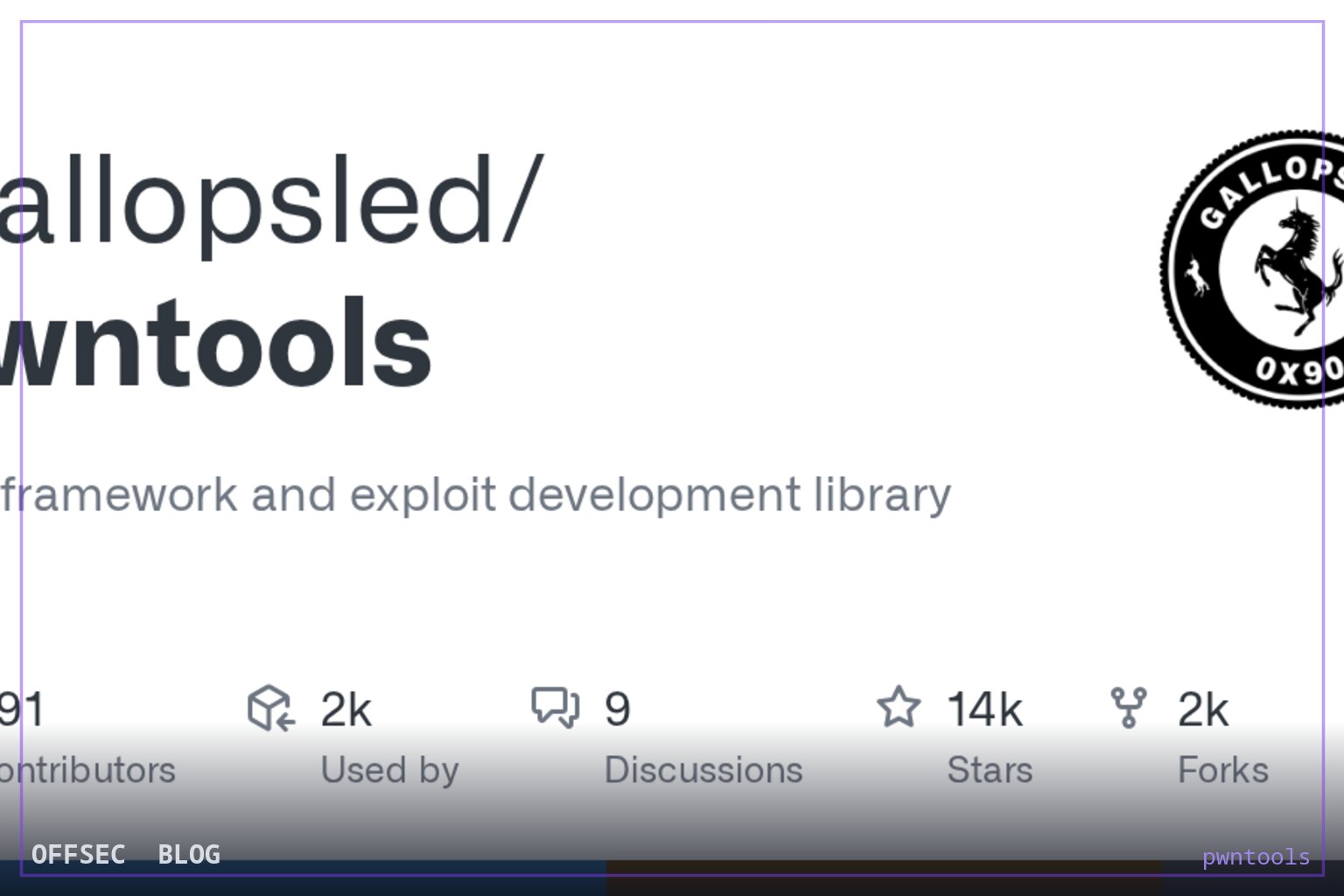
Pwntools is a Python framework that turns exploit development into rapid prototyping, wrapping process control, assembly, and network I/O into one library for CTF players and authorized security professionals.
| Tool | Gallopsled/pwntools — Python CTF framework and exploit development library for rapid prototyping |
| Category | Exploit development library / CTF framework |
| Primary Use | Rapid prototyping of exploits for CTF challenges and wargames, using primitives like remote(), asm(), and shellcraft |
| Safe Use | Intended for CTF competitions, wargames, lab environments, and authorized engagements against systems you own or have permission to test |
| Telemetry Note | As a client-side library it leaves no beaconing infrastructure; its network connections to challenge targets appear as ordinary TCP sessions, so defenders observe it only through target-side service logs and process behavior |
Pwntools occupies a singular position in the security tooling ecosystem: it is the de facto standard library for anyone who writes exploits by hand, and it has held that position for over a decade. The repository, Gallopsled/pwntools, sits at roughly 13,700 stars with Python as its primary language, and its topic list reads like a map of the binary exploitation world: ctf-framework, rop, shellcode, shellcode-development, wargame, pwnable, and assembly. The project self-describes as a CTF framework and exploit development library designed for rapid prototyping, intended to make exploit writing as simple as possible. That framing matters for how you should read the tool: this is not a scanner or an automated attacker, it is a workshop bench for a human who is thinking through a memory corruption problem.
The README's canonical example is worth unpacking because it reveals the entire architecture in four lines. After from pwn import *, the user sets context(arch = 'i386', os = 'linux'), opens a session with remote('exploitme.example.com', 31337), and then sends r.send(asm(shellcraft.sh())) before dropping into r.interactive(). Each of those tokens is a subsystem. context is a global configuration object that every downstream component reads, so setting architecture once makes assembly, ELF parsing, and packing primitives all agree. remote is a socket wrapper tuned for exploit work, with conveniences for sending and receiving until markers. shellcraft is a shellcode generator that knows dozens of architecture and OS combinations, and asm assembles that generated source into raw bytes.
What this example demonstrates is the library's core design philosophy: composability. An exploit script becomes a short linear narrative — connect, build payload from primitives, send, interact — rather than a pile of boilerplate. The r.interactive() call is characteristic of the CTF mindset: it forwards your terminal to the remote process so that once a payload lands you get a shell prompt rather than a wall of socket plumbing. Everything is arranged so that the expensive part of exploitation, the actual reasoning about the bug, stays front and center while the tooling friction drops to near zero.
Installation is deliberately painless for the common case. The README states that Pwntools is best supported on 64-bit Ubuntu LTS releases, currently 22.04 and 24.04, and that most functionality works on any POSIX-like distribution including Debian, Arch, FreeBSD, and OSX. The core is self-contained Python: python3 -m pip install --upgrade pwntools gets you running after installing the usual build prerequisites such as python3-dev, libssl-dev, libffi-dev, and build-essential. The README does note an important caveat: assembling and disassembling foreign architectures requires non-Python dependencies, so users working across multiple CPU architectures should consult the full installation documentation rather than relying on the pip path alone.
Versioning is documented clearly and matters to anyone maintaining old exploit scripts. Since version 5.0.0, Pwntools supports Python 3.10 and newer; the 4.x line covers older interpreters including legacy Python 2.7. The topic list still carries python2 and python3 tags, reflecting the long migration period the project shepherded its user base through. The default development branch is dev, with continuous integration running against it, and the README badges show CI status and Coveralls coverage tracking, which signals an actively maintained engineering process rather than an archival project.
The documentation ecosystem is unusually deep for an open source security tool. The primary reference lives at docs.pwntools.com on Read the Docs, a separate tutorial repository Gallopsled/pwntools-tutorial walks newcomers through the library progressively, and a dedicated write-ups repository Gallopsled/pwntools-write-ups collects example solutions for past CTF challenges. For a professional evaluating whether to invest time in this tool, that triad matters: the library's API surface is large, and having graded tutorials plus annotated competition solutions means the learning curve, while real, is well signposted.
The topic tags also sketch the internal feature set. rop points to the framework's return-oriented programming helpers, which automate the tedious construction of gadget chains once you have a leak or a corruption primitive. shellcode and shellcoding point at the shellcraft subsystem mentioned above, which generates shellcode templates for many target environments. assembly and bsd and linux together suggest cross-platform assembly support, which the README confirms indirectly when it says foreign-architecture assembly needs extra dependencies — implying a capstone-and-keystone-style backend for architectures beyond the host's native one. None of this is described in granular detail in the README itself, which is thin by design, but the structure is legible to anyone who has used the library.
For the defensive side of the house, Pwntools is equally worth understanding, and arguably more so. Blue teamers and detection engineers who spin up CTF practice do it to learn what attacker tooling looks like from the inside: how a remote() connection behaves from the target service's perspective, what a successful interactive() session looks like in process logs, and what patterns of repeated connections during exploit iteration look like. Because Pwntools is a client-side library, it leaves no beaconing infrastructure behind; it is invisible except through the traffic and log artifacts it generates on the systems it talks to. That makes it a clean, controllable instrument for lab-based detection development.
The authorized-use boundary is central to how this tool should be discussed and deployed. Pwntools is built for CTF competitions, wargame platforms, and lab binaries — the pwnable and wargame topics name that ecosystem directly. It is also a legitimate fixture in professional penetration testing and vulnerability research, where consultants write one-off exploit scripts against in-scope targets with written authorization. What it is not is a mass-scanning or automated compromise tool; every exploit it helps build requires a human to have already found and understood a vulnerability. That property keeps it firmly in the educational and professional-research category.
From a project health perspective, the signals are strong. Beyond the star count and CI coverage, the README points to an active Discord community, a contributing guide in CONTRIBUTING.md, participation in hacktoberfest, and distribution across numerous package repositories per the Repology badge. The license badge indicates MIT, though GitHub metadata reports NOASSERTION, a minor discrepancy likely stemming from license file detection across the multi-branch structure. The maintenance cadence implied by the branch setup and docs pipeline suggests this is a project with institutional momentum, not a personal repository in maintenance mode.
Where Pwntools fits in a professional workflow is best understood as the scripting layer between discovery and reporting. When a researcher confirms a crash in a lab binary, Pwntools is what turns that crash into a repeatable, demonstration-grade proof of concept; when a CTF player solves a challenge, the solve script is usually a Pwntools script worth keeping as a personal pattern library. Paired with a debugger and a disassembler, it completes the classic exploit development triad. Watch for the usual operational caveats: pin your version across a long engagement so behavior does not shift mid-project, and keep the foreign-architecture dependencies in mind before you are on a time-locked competition box. Within those bounds, it remains the reference implementation of what an exploit development library should be.
Gallopsled/pwntools.Educational analysis for authorized security professionals. Use only in controlled, authorized environments.




0 comentários:
Post a Comment
Note: Only a member of this blog may post a comment.