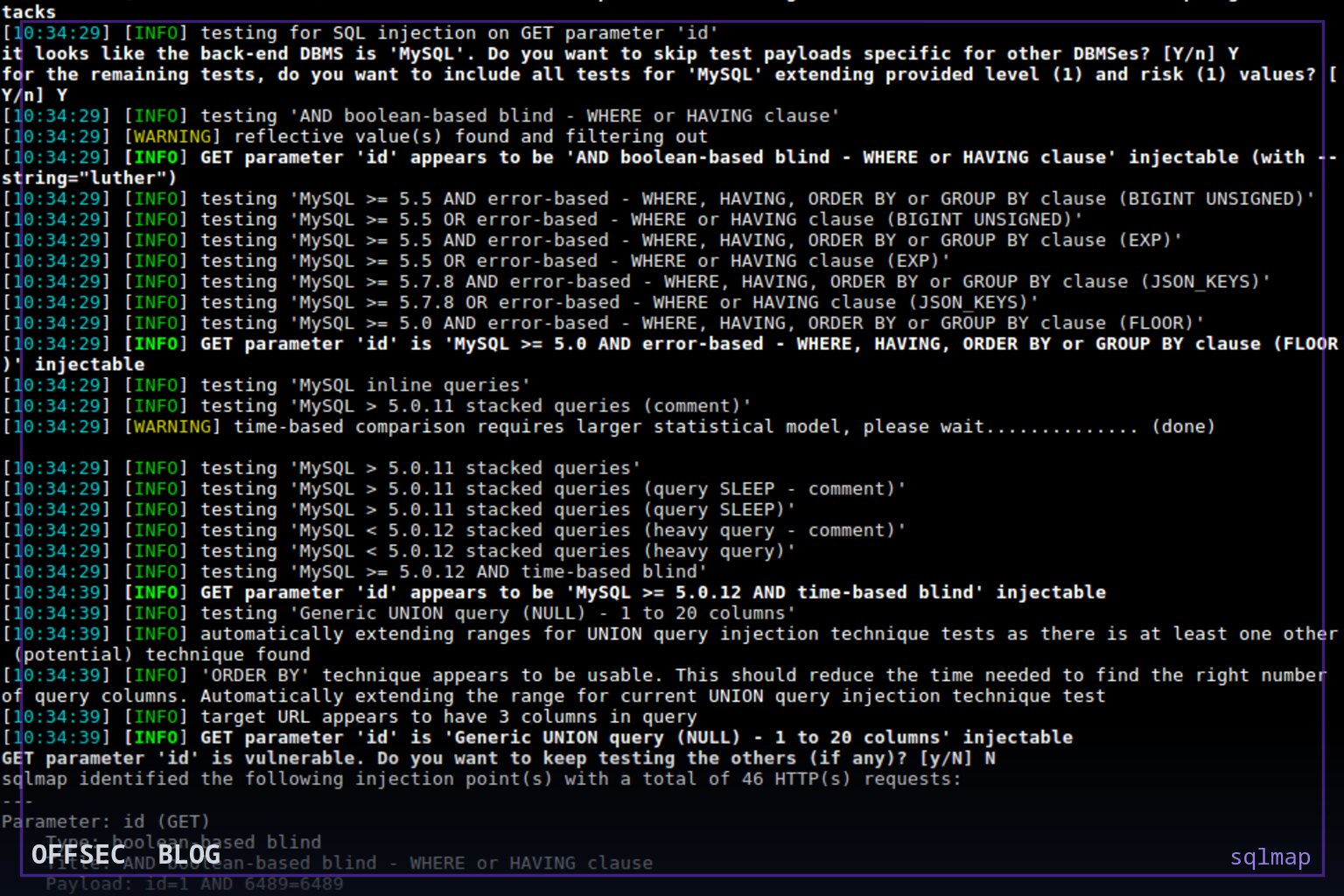
sqlmap is a mature open-source penetration testing tool that automates detection and exploitation of SQL injection flaws against targets, used by professionals in authorized assessments and lab environments.
| Tool | sqlmapproject/sqlmap — automatic SQL injection detection and database takeover tool for penetration testers |
| Category | Web application security testing / database exploitation automation (Python) |
| Primary Use | Detecting and validating SQL injection flaws, fingerprinting the backend DBMS, and demonstrating data exposure during authorized web app assessments |
| Safe Use | Use only against systems you own or have explicit written authorization to test, such as internal engagement scopes, CTF labs, and the project's own playground environment |
| Telemetry Note | sqlmap generates high volumes of distinctive malformed queries and error-based probes that WAFs, IDS signatures, and database audit logs readily flag; its scanning traffic is a classic SOC detection pattern |
Few tools in the offensive security world carry the institutional weight of sqlmap. Hosted at sqlmapproject/sqlmap and sitting at roughly 38,000 stars, it is the de facto standard for automating the detection and exploitation of SQL injection vulnerabilities. The project describes itself as an open source penetration testing tool whose detection engine automates finding injection flaws and, where authorized, demonstrating takeover of the underlying database server. Written in Python, it runs on version 2.7 and 3.x on any platform, which is a notable engineering commitment in an ecosystem that has largely abandoned the 2.7 interpreter.
The README is characteristically terse for a project of this maturity — it doesn't need to sell itself. What it does spell out is the capability surface: a powerful detection engine, database fingerprinting, over-the-wire data fetching from the database, access to the underlying file system, and command execution on the operating system via out-of-band connections. Read carefully, that list is a taxonomy of SQL injection impact classes. Fingerprinting answers 'what DBMS is this', data fetching answers 'what can be read', file system access answers 'can we escape the database context', and out-of-band execution answers 'does this reach the OS'. An assessor uses these capabilities to quantify the severity of a finding, not merely to confirm it exists.
Installation is deliberately minimal. The README suggests cloning with git clone --depth 1 https://github.com/sqlmapproject/sqlmap.git sqlmap-dev, a shallow clone that pulls only the latest state of the master branch without history — appropriate for a tool you want current and disposable inside a scoped engagement VM. Alternatively, tarball and zipball archives are available directly from the repository. There is no pip package, no dependency manifest dance; the tool works out of the box with a stock Python interpreter, which simplifies reproducibility when you need to stand up a testing rig quickly.
Invocation follows the same minimal philosophy. Running python sqlmap.py -h prints the basic option set, while python sqlmap.py -hh prints the full switch list — and that second help screen is famously long. The README directs users to the wiki's user manual for a complete description of every option and switch with examples, plus an asciinema sample run demonstrating typical output. This two-tier help structure tells you something about the audience: -h is for orientation, -hh is for operators who already know what they're looking for and need the exact flag name.
Architecturally, the repo's metadata reinforces the project's seriousness. A CI badge points at .github/workflows/tests.yml, meaning every commit to master is exercised against an automated test suite — rare discipline for offensive tooling, and a meaningful signal that regressions in the detection engine get caught before shipping. The licensing is flagged as NOASSERTION in GitHub's metadata, though the README badges point to GPLv2, so downstream users verifying license compatibility should read the LICENSE file in the master branch directly rather than trusting the badge alone.
The topic list on the repository is a good map of where the maintainers see the tool sitting: sql-injection, pentesting, appsec, database-security, webapp-security, detection, and notably api-security, acknowledging that modern injection surface is increasingly in JSON-over-HTTP endpoints rather than classic form parameters. The presence of both security-testing-tool and exploitation as labels reflects the dual identity — it is simultaneously a validation instrument for defenders reproducing findings and an exploitation platform for penetration testers.
The README's link section is unusually rich and worth an operator's attention. Beyond the homepage at sqlmap.org and the wiki with its user manual and FAQ, the project maintains a public playground environment for legal practice, links demo videos, and points to a research page under sekuripy.hr where the team's own published injection research lives. For anyone learning the tool, the playground and the FAQ are the responsible path: hands-on reps against infrastructure that exists to be tested, rather than pointing scanners at systems without authorization.
Community reach is another striking data point. The README ships with translations into more than two dozen languages, from Arabic and Bengali to Vietnamese and Ukrainian. That translation effort is not cosmetic — it signals a global user base that includes educational institutions and certification programs, where sqlmap is often the first injection tool a student encounters. It also means documentation drift across translations is a real possibility, so English-language wiki pages remain the authoritative reference for behavior questions.
From a defensive standpoint, sqlmap is arguably as valuable to blue teams as to red teams. Its traffic profile is loud and well-studied: the detection engine emits large volumes of syntactically malformed requests, boolean-based differentials, time-based delay probes, and error-based payloads that correlate strongly with WAF and IDS signature sets. Database audit logs show the queries the tool succeeds in executing, and out-of-band interaction produces DNS and HTTP egress patterns that network monitoring can catch. Defenders who understand how the tool fingerprints and iterates can tune alerting to distinguish a single curious request from a systematic enumeration campaign.
Where does it fit in a professional workflow? In a typical authorized web assessment, manual review identifies suspicious parameters, and sqlmap then confirms exploitability, enumerates the backend DBMS version, and demonstrates the extent of data access so the finding carries concrete business impact in the report. It is a confirmation and impact-quantification tool, not a replacement for understanding the application — an assessor who can only run the scanner and not read the resulting SQL context will misreport findings. The tool's niche switches, referenced in the README's 'many niche features for the ultimate penetration tester' line, reward exactly that deeper fluency.
The project's activity pattern also matters for tooling decisions. Active maintenance is implied by the commits RSS feed the README links, the running CI badge, and the live X account at @sqlmap; injection techniques and DBMS behaviors evolve, and a stale scanner rapidly loses detection coverage against modern frameworks and WAFs. An operator evaluating whether to include it in a kit should clone fresh before each engagement rather than caching an old copy.
Ultimately, sqlmap earns its place in the canon through a combination of engineering discipline, capability breadth, and community investment. For authorized professionals it remains the reference implementation of what automated injection testing looks like, and for defenders it is the canonical threat model for what an attacker's first serious attempt against a vulnerable parameter will resemble. Understanding both sides of that coin is the real value of studying the tool.
sqlmapproject/sqlmap.Educational analysis for authorized security professionals. Use only in controlled, authorized environments.


0 comentários:
Post a Comment
Note: Only a member of this blog may post a comment.