 Home
Home Privacy Center
 Data Protection
 Community
 Digital Policy
 Security Tools
 Online Utilities
 Resources
 Search Operators
 Library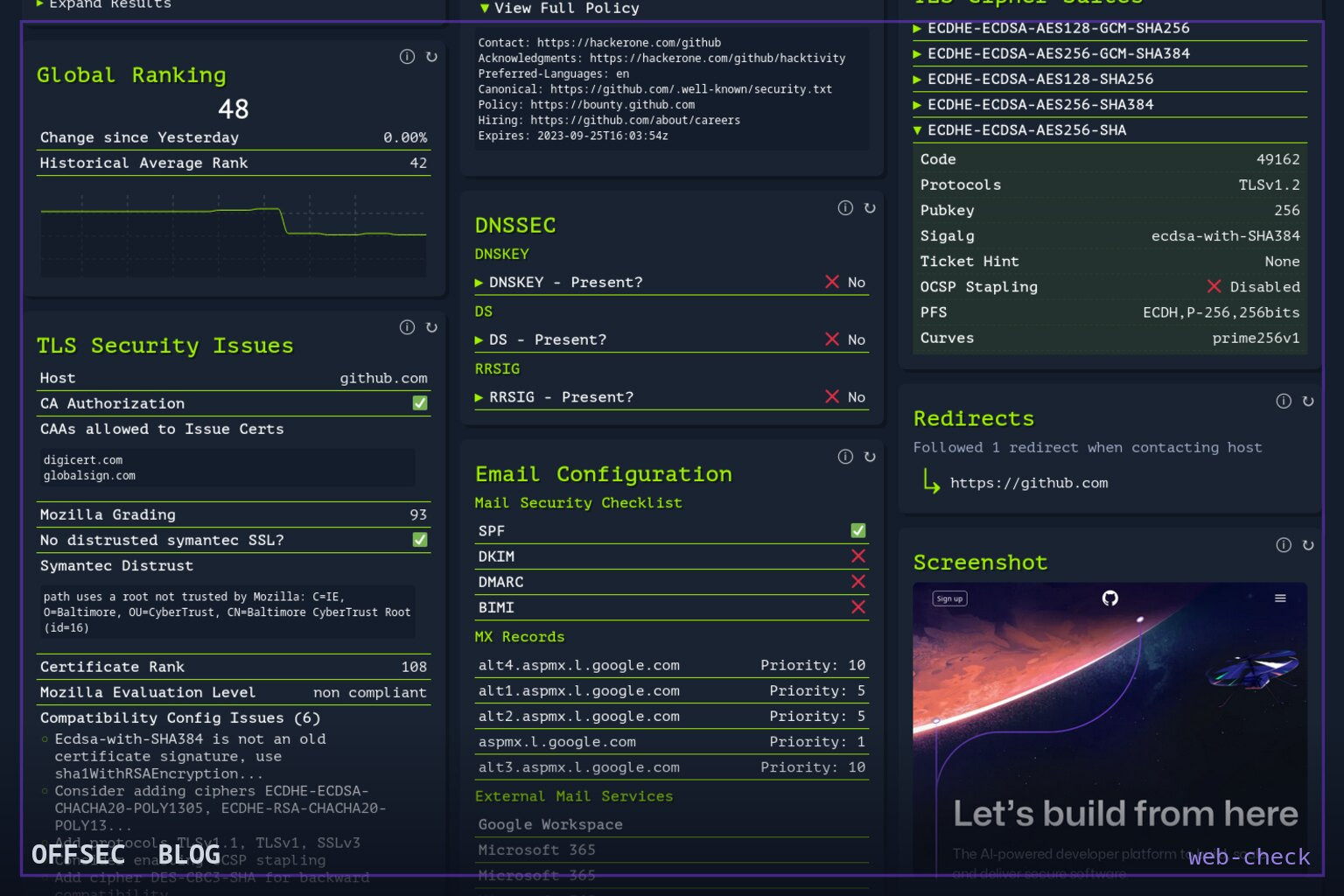
web-check is a TypeScript-based OSINT dashboard that aggregates passive reconnaissance about any website into a single interface, intended for authorized security assessments and defensive research.
| Tool | lissy93/web-check — all-in-one OSINT web application for analyzing websites from a single dashboard |
| Category | OSINT / passive reconnaissance tooling |
| Primary Use | Aggregating passive, publicly available information about a target domain — DNS, infrastructure, and metadata — during OSINT phases of authorized assessments |
| Safe Use | Use only against domains you own or have written authorization to assess; equally valuable for defenders auditing their own organization's external footprint |
| Telemetry Note | Because it relies on passive OSINT sources rather than direct scanning, its use is largely indistinguishable from normal API queries to public data providers; site owners will typically see no anomalous traffic from the tool itself |
web-check, hosted at lissy93/web-check, positions itself as an all-in-one OSINT solution for analyzing any website. With roughly 34.8k stars on GitHub, it sits firmly in the popular tier of security tooling, and its TypeScript codebase signals a browser-delivered experience rather than a traditional CLI scanner. The repository's topics — osint, privacy, security, security-tools, and sysadmin — frame it as a dual-purpose instrument: reconnaissance for offensive assessments, and external footprint auditing for defenders and administrators. It is released under the permissive MIT license, which matters for teams that want to self-host, audit the source, or embed it into internal workflows without licensing friction.
The core concept behind web-check is aggregation. Passive reconnaissance has always suffered from fragmentation: an investigator consulting DNS records, certificate transparency logs, IP geolocation databases, and archive services typically juggles half a dozen tabs and CLI utilities. A dashboard-style tool collapses those lookups into a single query surface, which reduces both the time cost and the operational sloppiness that comes from manual copy-paste between tools. For an authorized assessor in the information-gathering phase, that consolidation is the entire value proposition — not new capability, but better ergonomics around existing public data sources.
Because the repository's README content was not available in the metadata at the time of this writeup, this analysis is derived from the repository's own descriptive framing — "all-in-one OSINT tool for analysing any website" — plus its metadata and topic taxonomy. That framing, combined with the osint and privacy labels, tells us the tool leans on passive collection: querying public records and third-party data providers rather than sending intrusive probes at the target itself. This distinction matters operationally, because passive collection minimizes the footprint an assessor leaves and correspondingly reduces the chance of tripping a target's monitoring during the pre-engagement research window.
The choice of TypeScript is architecturally significant. A web-based implementation means the analysis interface runs in a browser, with lookups presumably brokered through public APIs and serverless functions. This lowers the barrier to entry dramatically compared with Python-based recon frameworks that demand a configured environment: a consultant can pull up the dashboard, enter a domain, and read the results. The tradeoff is worth noting for professionals — any hosted instance you did not deploy yourself becomes a trust boundary, since the domains you query pass through someone else's infrastructure. For sensitive engagements, the correct move is a local or self-hosted deployment from the master branch, audited against your own supply-chain standards.
For blue teams and sysadmin audiences — explicitly named in the topic list — web-check inverts neatly into a defensive lens. The same aggregation that helps an attacker profile your external surface helps you see what your organization leaks passively: stale DNS entries, subdomains exposed through certificate transparency, metadata that maps your infrastructure to hosting providers, and historical records preserved by archive services. Running your own domains through a passive OSINT aggregator on a schedule is a cheap, low-noise way to catch drift between what you believe is exposed and what is actually observable from the outside. That privacy topic tag suggests the author sees this defensive framing as a first-class use case, not an afterthought.
Where does it fit in an authorized workflow? In a standard engagement, tools like this occupy the earliest phase — open-source intelligence gathering before any active scanning or exploitation begins. The output of a passive sweep feeds target scoping discussions, informs the attack-surface inventory, and often surfaces forgotten assets that the client did not include in scope but that an adversary would find trivially. Because the queries are passive, this phase typically falls outside rules-of-engagement restrictions on intrusive testing, though professionals should still confirm that even passive enumeration of third-party-hosted assets is acceptable under the engagement letter. Good tradecraft treats scope as a legal boundary, not just a technical one.
The popularity figure deserves a moment of interpretation. Thirty-four thousand stars is not just vanity; it is a signal about maintenance pressure and community trust. Widely-starred recon tools tend to receive rapid issue triage, community contributions that keep upstream API integrations working when data providers change their interfaces, and scrutiny that surfaces malicious contributions quickly. For an assessor choosing tooling, that ecosystem effect often matters more than feature lists — a less popular tool with rotting API integrations produces silently wrong results, which is worse than no results at all. Still, verify the commit cadence and dependency posture before relying on any third-party recon tool for client work.
The MIT license also deserves emphasis in a procurement context. Security teams that want to embed web-check into an internal portal — say, as the frontend for a continuous external-footprint monitoring program — can fork, modify, and redistribute it freely, subject only to license attribution. The TypeScript stack makes that integration realistic for the web developers most enterprises already employ, in contrast to niche tooling written in languages that security engineering teams must maintain themselves. Self-hosting also resolves the data-exfiltration concern raised earlier: queried domains never leave infrastructure you control.
The obvious caveat is scope discipline. A tool described as analyzing "any website" is exactly as ethical as the hand that drives it. Pointing an aggregator at infrastructure you do not own, without authorization, converts a passive research aid into a reconnaissance instrument for unauthorized access planning, with legal exposure in most jurisdictions. The professional pattern is simple: use web-check against your own domains, your lab environment, or targets covered by an executed engagement agreement. Within those boundaries, it is a capable consolidation layer that turns a tedious morning of tab-juggling into a single readable report, and that alone justifies a place in the modern assessor's and defender's toolkit alike.
lissy93/web-check.Educational analysis for authorized security professionals. Use only in controlled, authorized environments.




0 comentários:
Post a Comment
Note: Only a member of this blog may post a comment.