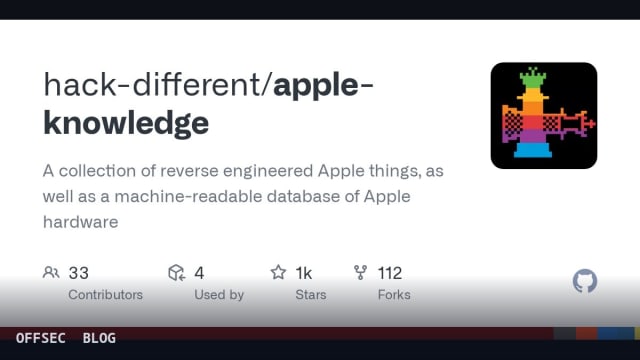
hack-different/apple-knowledge is a curated, machine-readable knowledge base of reverse engineered Apple formats, protocols, and boot-chain components for authorized researchers and security educators.
| Tool | hack-different/apple-knowledge — community-maintained collection of reverse engineered Apple data formats and protocols |
| Category | Reverse engineering knowledge base / research corpus |
| Primary Use | Reference corpus for understanding Apple formats like img4, NVRAM, Mach-O, and APFS during authorized research and education |
| Safe Use | Intended for authorized security research, jailbreak development, academic study of platform internals, and defensive analysis of Apple ecosystems in labs and owned hardware |
| Telemetry Note | Purely a documentation and data repository; its YAML files and docs consume no telemetry and leave no runtime footprint on any system |
apple-knowledge describes itself as a collection of reverse engineered Apple formats, protocols, and other interesting bits, and that framing is precise. This is not an executable tool in the conventional sense but a structured knowledge base — closer in spirit to papers-we-love/papers-we-love, which the README explicitly cites as inspiration — except that its payload is Apple platform internals rather than academic papers. The repository sits under the hack-different organization, carries an MIT license, is written primarily in Ruby, and at time of writing holds roughly 1,398 stars, which signals substantial community traction for a documentation-heavy project. Topics tagged on the repo include apple, apple-silicon, ios, macos, jailbreak, and reverse-engineering, mapping cleanly onto its audience: jailbreak developers, hobbyist researchers, and professional reverse engineers working on Apple platforms in authorized contexts.
The most architecturally interesting decision documented in the README is the separation of machine-readable data from human-readable prose. The project derives its content from machine sources and stores it as YAML under the _data directory, with documents automatically reflecting updates made there. This is a Jekyll-style pipeline — the jekyll topic tag confirms it — which means the rendered documentation is a build artifact of the underlying structured data. For a professional, this matters: you can consume the YAML directly in your own tooling, scripting, or analysis pipelines without scraping HTML, and the data format itself is documented under docs/Data_Formats so contributors can extend it consistently. That dual-format design makes the repo far more durable than a typical markdown dump.
Provenance and legality are treated unusually seriously. The README states plainly that pull requests based on AppleInternal or other DMCA-protected copyrighted works will not be accepted, and it directs contributors who are unsure to tag a PR with license help and ask a #Legit or higher role on the project's Discord server. The maintainers position the collection explicitly as something intended to persist for new jailbreakers and hobbyists for years, which explains both the contribution hygiene and the preference for machine-derived sources. As authoritative references, the README points to Apple's own open source releases at opensource.apple.com, the apple and apple-oss-distributions GitHub organizations, and a GIFTS document, grounding the corpus in legally obtainable material.
The tooling section functions as a curated map of the Apple reverse engineering ecosystem. For Mach-O binary analysis it highlights mootool, a free and open source Ruby tool from the same organization aiming to replicate the jtool2 feature set, alongside ktool, a Python equivalent, and checkra1n/toolchain. Emulation receives strong coverage through alephsecurity/xnu-qemu-arm64 — the well-known effort to boot iOS on QEMU — plus its companion tools repository and build wiki. The list then sprawls into disassembler plugins: for IDA there is ida_kernelcache, PacXplorer, and FunctionInliner from cellebrite-srl, plus iBoot-IDA loaders; for Binary Ninja there is bn-dyldsharedcache, ObjectiveNinja, and binja_kc; for Ghidra there is ghidra_kernelcache. The breadth here is the point — it is a vetted index, not a vanity list.
The bootloader and firmware documentation is where the repo earns its name. Dedicated documents cover EFI, NVRAM, the SEP_memmap Secure Enclave memory layout, kernel caches, factory firmware payloads, iBoot, and SecureROM. Each entry is cross-linked with external deep research — the iBoot section references the Firebloom analysis and OpenJailbreak/iBootRE, while kernel security research links include Siguza's KTRR work, xerub's Tick Tock, Brandon Azad's KTRW debug-engine writeup, and Stefan Esser's iOS kernel heap materials. A section on TXM and SPTM covers the newer trusted execution monitors introduced in iOS 17, showing the collection tracks current platform evolution rather than only legacy hardware.
Filesystem and format coverage is similarly dense. The APFS section links Apple's official file system reference PDF alongside practical tooling: sgan81/apfs-fuse, libyal/libfsapfs, and a Kaitai Struct definition in cugu/apfs.ksy for declarative parsing. Additional formats include LwVM, the lightweight volume manager; the NeXT-era bom bill-of-materials format used in pkg installers; pbzx stream compression; dmg disk images with node-udif, encrypteddmg, and darling-dmg; and Signed System Volumes with the root_hash concept. Serialization formats get their own section covering property lists via libplist, iTunes databases via libitlp and titl, and the iDevice backup format through rickmark/libibackup and horrorho/InflatableDonkey — the latter pair being directly relevant to forensic analysts doing authorized examinations of backups.
Code signing and image formats receive some of the most practically useful treatment. The Mach-O document covers file types, signing, and entitlements, cross-referencing sbingner/ldid and ProcursusTeam/ldid for codesigning work, Levin's entitlements database, and his code signing paper. The img4 section — Apple's signed image format, version 4 — links xerub/img4lib, m1stadev/PyIMG4 as a Python library and CLI parser, and tihmstar tooling, plus TheiPhoneWiki's format documentation. For anyone analyzing firmware update chains in a lab, these sections effectively short-circuit hours of searching for format references and working parsers.
Hardware-specific resources round out the corpus. The devices section includes a device list document plus dedicated material on the Apple T2 chip and bridgeOS, linking the t8012.dev team resources, Duo Labs' XPC research, and t2linux/apple-bce-drv for running Linux on T2 hardware. Wireless research is served by seemoo-lab/frankenstein and seemoo-lab/internalblue for Wi-Fi and Bluetooth experimentation, while pre-T2 SMC work is covered through acidanthera/VirtualSMC and t8012/smcutil for building SMC binaries from update payloads. Guides on prototypes and CPFM, the Kernel Debug Kit (KDK), and the Apple 4CC four-character-code registry add breadth for platform archaeologists.
From a defensive perspective, this repository is valuable precisely because it indexes the same knowledge attackers study, in a form defenders can consume systematically. Understanding NVRAM variables, img4 signing structures, Mach-O entitlement semantics, and kernel cache layout is directly applicable to malware triage on macOS and iOS, forensic parsing of APFS volumes and backup formats, and reviewing the attack surface documented in Project Zero's remote attack surface analysis linked from the guides section. An incident responder who can parse an img4 container or read entitlements fluently will triage Apple-platform threats measurably faster than one who cannot.
Operationally, there is essentially nothing to install — the repository is documentation plus data — though the organization also maintains a Homebrew tap installable with brew tap hack-different/homebrew-jailbreak that packages their tooling. The practical workflow is to clone or browse the repo, mine the _data YAML files for machine-readable facts, and follow links out to the specific tools and papers relevant to your task. Pull requests are welcome subject to the strict DMCA policy described above, and the maintainers' Discord, with its role-gated #Legit channel for licensing questions, provides the community glue. For anyone doing authorized Apple platform research — academic, forensic, or jailbreak-oriented — apple-knowledge is one of the better-maintained entry points into the ecosystem, and its data-first architecture suggests it is built to stay that way.
hack-different/apple-knowledge.Educational analysis for authorized security professionals. Use only in controlled, authorized environments.
Related coverage


0 comentários:
Post a Comment
Note: Only a member of this blog may post a comment.