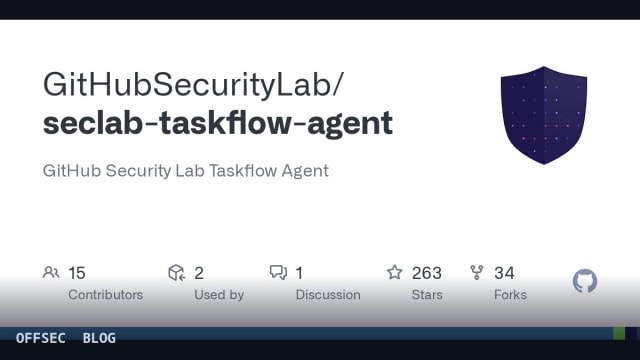
GitHubSecurityLab/seclab-taskflow-agent is a Python CLI framework that runs declarative, YAML-defined multi-agent workflows over MCP tool servers for authorized code auditing and vulnerability triage.
| Tool | GitHubSecurityLab/seclab-taskflow-agent — MCP-enabled multi-agent framework for declarative YAML agentic workflows |
| Category | AI-assisted static analysis and agentic workflow automation |
| Primary Use | Scripting AI-assisted code audits and vulnerability triage via YAML taskflows, MCP toolboxes, and CodeQL integration |
| Safe Use | Intended for authorized security research, code review of codebases you own or are contracted to assess, and defensive alert triage in security operations |
| Telemetry Note | Purely client-side analysis tool: writes run manifests and session checkpoints to platform data directories; contains no endpoints or tokens, leaves no network artifacts beyond model API and MCP server traffic |
seclab-taskflow-agent is the GitHub Security Lab's answer to a recurring pain in AI-assisted security work: orchestrating large language models across multi-step analysis without writing bespoke glue code each time. The framework, written in Python and released under the MIT license with roughly 263 stars, positions itself as a CLI tool where entire agentic workflows are expressed as declarative YAML documents rather than scripts. Its value proposition is compression — if your code-audit loop consists of loading a CodeQL database, asking a model to explore suspicious paths, then escalating findings to a second reviewer model, all of that becomes a taskflow file you can lint, run, checkpoint, and resume. The project is built on the OpenAI Agents SDK, uses Pydantic v2 for grammar validation, and renders prompts through Jinja2 templates, which tells you immediately that the authors cared about correctness of the declarative layer as much as the agent layer.
The core mental model is simple and worth internalizing before touching the grammar. Agents are defined through personalities — persona files living under examples/personalities/ — that receive a task and are given a set of tools drawn from toolboxes in src/seclab_taskflow_agent/toolboxes/. Agents cooperate across sequences of tasks through taskflows, with the full grammar documented in doc/GRAMMAR.md and worked examples in examples/taskflows/. This separation of persona, capability, and orchestration mirrors how mature automation platforms evolve: the personality decides how the model reasons, the toolbox decides what it can touch, and the taskflow decides in what order things happen. For an authorized auditor, that decomposition is what makes the difference between a repeatable review process and a chat window.
Architecturally, the README describes a clean four-layer stack. A Typer-based CLI in cli.py exposes flags such as -p, -t, -l, -g, -m, --resume, and --lint, and hands off to a Runner in runner.py that owns the taskflow execution loop, model resolution, template rendering, and session checkpointing. Below that sits the MCP lifecycle module managing server connections, cleanup, and process management, and finally the Agent layer that wraps the SDK's TaskAgent with hooks. Supporting modules include models.py for grammar validation, session.py for checkpoint/resume, available_tools.py as a cached YAML resource loader, template_utils.py for the Jinja2 environment, and mcp_transport.py implementing stdio and streamable transports. This is a thoughtfully layered design where each concern has a named home.
One of the more interesting engineering decisions is the multi-backend support. The runner can drive three SDKs behind a common interface: openai_agents as the default with multi-personality handoffs, both chat_completions and responses API types, and MCP over stdio, SSE, and streamable HTTP; a copilot_sdk backend offering streaming, reasoning_effort, and per-tool permission gating; and an anthropic_sdk backend hitting the native Messages API with configurable reasoning.effort at low, medium, high, or max. Selection follows a sane precedence chain — per-task backend: overrides, then per-model, then document-level default, then the SECLAB_TASKFLOW_BACKEND environment variable, then openai_agents. Critically, backends that lack a capability fail loudly: a taskflow using unsupported fields raises a BackendCapabilityError naming the offending field at load time, which is exactly the fail-fast behavior you want when a three-hour audit run depends on YAML you wrote yesterday.
Model configuration lives in its own YAML document type where model_settings blocks can set api_type, endpoint, and a token naming an environment variable holding the API key — never a literal secret in the file, a detail worth appreciating. The README shows configurations pointing at https://api.githubcopilot.com with CAPI_TOKEN, meaning GitHub's internal CAPI proxy is a first-class target. A practical requirement to note: the documented configuration path expects a GitHub token entitled to GitHub Copilot, supplied via the AI_API_TOKEN environment variable. Python 3.10 or Docker is the baseline. A minimal invocation pattern looks like python -m seclab_taskflow_agent -t examples.taskflows.echo, which is the module-style entry point used throughout the documentation.
Operational resilience is treated seriously. Taskflow runs are automatically checkpointed at the task level, and when a task exhausts its retries — up to three attempts with increasing backoff — the session is saved with an ID and can be resumed via --resume, as in python -m seclab_taskflow_agent --resume abc123def456. The checkpoint persists the original --model-config value so resumes stay consistent, though you can override it with -m at resume time. Every run also emits a machine-readable manifest capturing per-task status (ok, failed, skipped), the models used, timing, and named outputs including per-model fan-in records — and the README is explicit that it contains no endpoints or tokens. For teams treating AI-assisted review as a pipeline stage rather than a one-off, that manifest is the audit trail.
Quality-of-life features suggest real production use rather than a research artifact. The --lint flag validates a taskflow offline without any model calls, resolving every referenced document — personalities, toolboxes, model configs, nested taskflows — and flagging unknown fields that are likely typos. With --strict, unknown fields become errors, and since lint exits non-zero on failure it can gate CI, which is a strong hint about how GitHub Security Lab uses it internally. A --schema flag prints the JSON Schema for each grammar document type for editor integration. Debugging follows the same philosophy: errors default to concise one-liners, with --debug or TASK_AGENT_DEBUG=1 enabling full tracebacks.
The security-relevant use cases are where the tool earns its name. The README states the framework was designed for the iterative feedback loops of agentic security research and vulnerability triage, with a stated philosophy that capturing vulnerability patterns at the prompt level will scale research results as frontier models improve. The flagship integration is a CodeQL MCP server: rather than having the model generate CodeQL queries itself, the server exposes CodeQL-query-based MCP tools backed by templated queries, letting the agent navigate and explore code with targeted context. The bundled CVE-2023-2283 example taskflow demonstrates an agent reviewing C code against a CodeQL database — a documentary example of analyzing a publicly known, already-fixed vulnerability, exactly the kind of authorized, educational workflow this framework targets. GitHub Security Lab also uses the framework for automated code-scanning alert triage.
Beyond auditing, the framework doubles as an evaluation harness. A taskflow can fan the same prompt out across multiple models, capture each model's prose answer with capture: response, and then run a judge task that reads all captured answers by name via outputs.answers and selects the best one. The README walks through this with examples.taskflows.example_model_comparison.yaml and a use-after-free explanation comparison — a genuinely useful pattern for teams deciding which model to standardize on for triage work, and a good illustration of how task-level output capture composes into higher-order reasoning steps.
Security hygiene around MCP subprocesses deserves a mention because it is unusually thoughtful for this genre. By default, MCP servers inherit the parent environment, which is a real credential-exposure risk when you attach third-party tool servers. The TASKFLOW_ENV_DENYLIST variable takes a comma-separated list of environment variable names to strip from child processes, while toolbox-level env: declarations still inject exactly what each declared server needs. Anyone composing taskflows from community MCP servers should treat that denylist as mandatory configuration, not an optional nicety.
For defenders and blue teams, the framing matters: this is an analysis and triage instrument, not an attack tool. It runs against codebases and CodeQL databases you already have legitimate access to, its outputs are findings and triage decisions, and its footprint is limited to model API calls and local artifacts — session checkpoints and run manifests in platform-specific data directories. Detection of its use in an enterprise is correspondingly boring: watch for unusual GitHub Copilot API token usage and outbound connections from build machines to model endpoints. The interesting defensive angle is the opposite direction — a tool like this, pointed at your own code, is how you find the use-after-free before someone else's agent does.
Caveats are the usual ones for fast-moving agentic infrastructure: the README references model names like gpt-5.1 and claude-opus-4.7 that reflect its internal development cadence, and the backend capability matrix means taskflows are not fully portable across SDKs. But the fundamentals — declarative YAML grammar with Pydantic validation, offline linting, checkpointed resumable runs, manifest-driven observability, and CodeQL-backed agentic code exploration — make seclab-taskflow-agent one of the more coherent public examples of how professional security teams are industrializing LLM-assisted code audit. For authorized assessors and research groups already invested in MCP, it is worth reading doc/GRAMMAR.md even if you never run it, simply as a reference design for agentic workflow orchestration in security.
GitHubSecurityLab/seclab-taskflow-agent.Educational analysis for authorized security professionals. Use only in controlled, authorized environments.
Related coverage


0 comentários:
Post a Comment
Note: Only a member of this blog may post a comment.