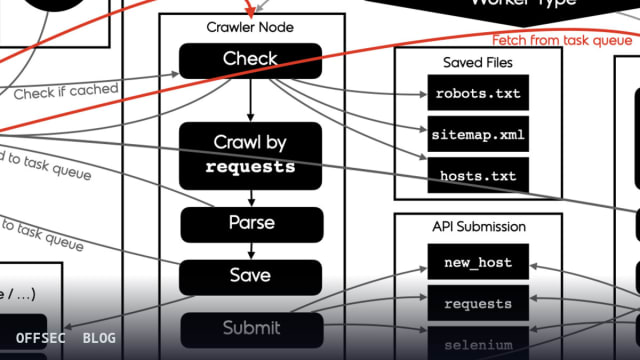
darc is a Python-based dark web crawler that combines requests workers with Selenium rendering to fetch pages, capture headers and cookies, and archive screenshots for authorized OSINT research.
| Tool | JarryShaw/darc — dark web crawler combining requests and Selenium workers for page fetching and rendering |
| Category | Web crawler / OSINT collection framework |
| Primary Use | Automated crawling of .onion and dark web sources, collecting headers, cookies, extracted links, and rendered screenshots for threat intelligence |
| Safe Use | Intended for authorized threat intelligence and OSINT research, such as analysts monitoring criminal forums or researchers studying dark web ecosystems in compliance with applicable law |
| Telemetry Note | As a crawler, darc generates observable traffic patterns (headless browser fingerprints, cookie handling, sequential link discovery) that site operators and hosting providers can log and correlate |
darc, hosted at JarryShaw/darc, positions itself as a dark web crawler built for collectors who need more than raw HTML. The project's core premise is that dark web content is frequently JavaScript-heavy, ephemeral, and hostile to naive scrapers, so a single fetching strategy is insufficient. Rather than relying on one HTTP client, darc runs parallel workers split between lightweight requests calls and full browser sessions driven by Selenium. This dual-track design lets the crawler handle both static pages that need speed and dynamic pages that need a real rendering engine to produce meaningful content and screenshots.
The repository metadata tells us the practical basics: it is written in Python, carries a permissive BSD-3-Clause license, and sits at roughly 239 stars — modest but respectable traction for a niche collection tool. The declared topics are simply crawler and darkweb, which accurately describes the scope. The project targets the master branch as its default, and installation follows the standard pip-centric workflow typical of Python collection frameworks: pip install darc gets you the package, and from there the framework is driven through its own entry points rather than ad-hoc scripts. The dependency footprint is nontrivial — expect Selenium, a browser binary such as chromium or geckodriver-backed Firefox, and requests — because rendering dark web pages is the whole point.
Internally, the architecture the project describes is a worker-based pipeline. One set of workers uses requests for fast, cheap fetches: retrieving the page body, capturing response headers, and recording cookies. A second set drives Selenium to render pages in a real browser context, which matters on the dark web where many sites gate content behind JavaScript challenges, redirects, or interstitials that a plain HTTP client cannot execute. When a page needs rendering, the Selenium worker produces a full-page screenshot, giving analysts a visual artifact rather than just a pile of markup. That distinction — rendered evidence versus raw source — is what makes the output usable as OSINT material rather than just crawl data.
Link extraction is another first-class function. As each page is processed, darc parses out embedded links and feeds them back into its crawl queue, subject to the framework's own proxy and routing configuration. Because dark web crawling typically requires routing through Tor or similar anonymity networks, the framework's proxy handling is effectively a load-bearing component: workers must push their traffic through the configured proxy stack or every fetch fails. The crawl therefore behaves as a breadth-managed graph traversal across .onion services, with each discovered URL queued for either a requests fetch or a Selenium render depending on what the framework decides the page needs.
The output side is where darc earns its keep for intelligence workflows. Every crawled URL yields a bundle of artifacts: the fetched page content, the captured response headers, the cookies set and observed, extracted links, and — for rendered pages — screenshot images. Organizing collection this way gives researchers a per-URL evidence package that can be replayed and audited later. For threat intelligence teams tracking criminal marketplaces, vendor shops, or forum migrations, that per-URL archival model is exactly what long-duration monitoring projects require, since dark web content is notorious for disappearing without warning.
Where does this fit in an authorized workflow? The legitimate use case is defensive and analytical: threat intelligence analysts monitoring dark web sources for stolen credentials, leaked documents, or planned campaigns against their organization; researchers studying dark web ecosystem dynamics; and brand-protection teams watching for counterfeit or fraud infrastructure. All of these are passive, observation-oriented activities. What darc is not, and should not be used as, is an attack tool — it fetches and renders pages, it does not exploit anything. Anyone operating it must still respect the legal ambiguities of dark web access in their jurisdiction and organizational policy, including rules on interacting with criminal infrastructure.
From a defender's perspective, it is worth understanding what a tool like darc looks like from the other side of the wire. A crawler of this type produces a distinct footprint: sequential link discovery, headless browser characteristics in the Selenium sessions, cookie jar behavior that mirrors a real client, and screenshots taken at page-render time. Tor-facing site operators and criminal forum administrators actively fingerprint and block this pattern, which is one reason crawling frameworks invest so heavily in browser realism. For blue teams, the same signals — automation-consistent timing, headless browser indicators, systematic path enumeration — are detectable anomalies when someone points a crawler at infrastructure you control.
There are operational realities to keep in mind before deploying darc at scale. Rendering every page through Selenium is expensive in CPU, memory, and time, so a crawl of a large .onion graph will be bottlenecked by the rendering workers long before the requests workers saturate. Storage is the other constraint: full-page screenshots and page bodies accumulate quickly, and a serious collection run needs a deliberate data retention and indexing strategy from day one. The BSD-3-Clause license permits commercial and organizational use, so teams can embed darc into larger collection pipelines without licensing friction.
In summary, darc is a specialized collection framework for a problem that general-purpose scrapers handle poorly: dark web content that demands both speed and real browser rendering. Its worker architecture, artifact-per-URL output model, and link-discovery loop make it a credible foundation for authorized OSINT and threat intelligence programs. Operators should budget for its rendering costs, configure proxy routing correctly, and treat the resulting archive as sensitive intelligence material. For analysts who need defensible, screenshot-backed evidence of what a dark web page said and when, that combination of requests speed and Selenium fidelity is the core value proposition.
JarryShaw/darc.Educational analysis for authorized security professionals. Use only in controlled, authorized environments.
Related coverage


0 comentários:
Post a Comment
Note: Only a member of this blog may post a comment.