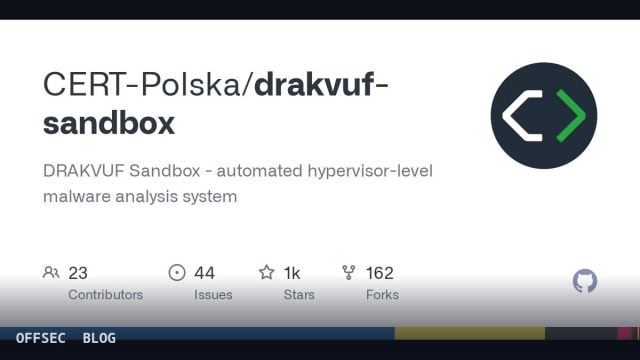
drakvuf-sandbox wraps the DRAKVUF hypervisor-based introspection engine in a web interface for automated black-box malware analysis, letting authorized researchers detonate suspicious files without guest agents.
| Tool | CERT-Polska/drakvuf-sandbox — automated hypervisor-level black-box malware analysis system built on the DRAKVUF engine |
| Category | Malware analysis sandbox / dynamic analysis platform |
| Primary Use | Uploading suspicious files to an isolated Xen-based sandbox and reviewing automated analysis reports to triage whether samples are malicious |
| Safe Use | Intended exclusively for defensive malware research, CERT/CSIRT triage, and authorized laboratory analysis of samples you have the right to examine |
| Telemetry Note | Analysis runs inside an isolated hypervisor on your own hardware; artifacts are confined to the sandbox host and guest snapshots, making it a defensive research tool rather than an attack tool |
drakvuf-sandbox is an automated black-box malware analysis system maintained by CERT Polska, the Polish national CSIRT, and built on top of the DRAKVUF introspection engine. What immediately distinguishes it from agent-based alternatives like classic Cuckoo deployments is that it requires no agent inside the guest operating system. The hypervisor itself observes everything the sample does, which removes the classic cat-and-mouse problem of malware detecting or tampering with an in-guest monitoring component. For defenders and authorized malware researchers, this architectural choice is the whole point: instrumentation lives below the VM, at a layer most commodity malware cannot easily enumerate.
The project presents itself as a friendly web interface layered over the analysis engine. You upload a suspicious file through the UI, the sandboxing job runs, and then you explore the result through the same interface to form a judgment on whether the file is actually malicious. This is a triage tool first and foremost: it does not promise to replace a reverse engineer at IDA or Ghidra, but to filter and enrich the queue of samples arriving at a CERT or an enterprise IR team. The report-centric workflow means analysts who are not hypervisor experts can still benefit from introspection-grade telemetry.
Under the hood, the system depends on the DRAKVUF engine, an open-source dynamic binary analysis framework that uses hardware virtualization extensions to trap and inspect guest activity. The README notes that guests supported include Windows 10 x64 (build at least 2004, recommended 22H2) and Windows 7 x64 — a deliberately narrow matrix covering the bulk of malware targets in the wild. Because monitoring is done from the hypervisor via memory introspection rather than injected DLLs or kernel drivers in the guest, the analysis footprint inside the guest is minimal, and guest state can be reverted between runs via snapshots.
The hardware requirements tell you a lot about how the system works internally. You need an Intel processor with VT-x and Extended Page Tables (EPT), because DRAKVUF relies on EPT-based memory trapping to intercept guest execution invisibly. The host should run Debian 12 Bookworm or Ubuntu 22.04 Jammy, booted via GRUB, with at least 2 CPU cores and 5 GB of RAM. GRUB matters because Xen-based setups typically require kernel command-line and bootloader configuration that the installer manages for you. AMD processors are conspicuously absent from the requirements, reflecting the engine's Intel-centric introspection techniques.
Nested virtualization support is documented with unusual honesty. Xen works out of the box, which is expected given DRAKVUF's heritage. KVM works and the team uses it for development, though they ask users to report bugs encountered there. VMware Workstation Player works only if you enable the Virtualize EPT option on the VM, still on EPT-capable Intel silicon. On the negative side: Hyper-V, VMware Fusion on Mac, and the major clouds (AWS, GCP, Azure) are explicitly unsupported, because those platforms do not expose the raw CPU features the engine needs. This is the single most common deployment pitfall — you cannot lift this into a stock cloud instance.
The team is candid about operational difficulty, opening the README with a warning that maintaining your own sandbox is hard and that the project uses technology that is not user-friendly. Bugs may be reproducible only on your specific configuration, so they direct users to the source code and issue trackers of both drakvuf-sandbox and the DRAKVUF engine as the primary support resources. That warning is worth taking seriously: this is a production-grade system, not a toy, but the underlying stack — Xen, LibVMI-style introspection, custom kernel handling — sits far from typical DevOps territory.
To soften that learning curve, the project ships an installer application that guides you through the necessary steps and applies settings recommended for beginners, while leaving advanced users free to tweak options or replace parts of the infrastructure entirely. That split personality — sensible defaults with swappable components — is characteristic of CERT Polska tooling, which is built by practitioners running real sample pipelines. Documentation is hosted on readthedocs with a dedicated getting-started page, and releases are published through the GitHub releases channel.
Governance and provenance are strong for a tool in this niche. The author list includes Michał Leszczyński, Adam Kliś, Hubert Jasudowicz, Paweł Srokosz, and others at CERT Polska, with general contact via info@cert.pl and a Discord community for discussion. The project acknowledges funding and contributions from the Connecting Europe Facility of the European Union, The Honeynet Project, and CERT Polska itself. With roughly 1,350 stars and a Python codebase, it has a credible community footprint for specialized infrastructure software. The license is marked NOASSERTION, so teams adopting it commercially should verify licensing terms before redistribution.
In an authorized workflow, drakvuf-sandbox slots in as the automated first stage of sample triage. A mail gateway or incident responder flags a suspicious binary, submits it to the sandbox, and receives a structured report of behavior observed during execution — without an analyst having to manually infect a VM. Because the guest is reverted from snapshots and monitored externally, the same Windows image can be reused across many samples with consistent, low-tamper telemetry. It complements rather than replaces static tooling and interactive reversing; its value is throughput and stealth-resistant observation.
Defenders should also understand what this tool is not. It is not offensive tooling: it contains no exploitation capability and exists to observe malware in isolation on hardware you control. Its telemetry concern is inverted from most tools we cover — the interesting artifacts are the analysis reports themselves, plus whatever network connections the detonated samples attempt. Responsible operation means pointing any simulated internet or network simulation at infrastructure you own, and treating all uploaded samples as hostile until proven otherwise, with the analysis host fully isolated from production networks.
Comparing it to the broader sandbox landscape: agentless introspection is the differentiator. Agent-based sandboxes are easier to deploy anywhere, including the cloud, but trade stealth and integrity; drakvuf-sandbox demands dedicated Intel hardware and a Unix host but gains observation that is substantially harder for malware to detect or subvert. For research into anti-sandbox techniques, anti-debugging, and environment-aware malware, that trade is often decisive. The trade-off is operational burden, which the README's dragons warning makes explicit.
For teams considering deployment, the practical checklist from the README: an Intel CPU with VT-x and EPT, Debian 12 or Ubuntu 22.04 with GRUB, at least 2 cores and 5 GB RAM, prepared Windows 10 or Windows 7 x64 guest images, and preferably bare-metal or Xen hosting rather than cloud. Start with the readthedocs getting-started guide, use the installer's recommended settings first, and only customize once a baseline analysis pipeline is working. Used that way, drakvuf-sandbox is one of the few genuinely agentless, production-proven open-source options for authorized malware analysis.
CERT-Polska/drakvuf-sandbox.Educational analysis for authorized security professionals. Use only in controlled, authorized environments.
Related coverage


0 comentários:
Post a Comment
Note: Only a member of this blog may post a comment.