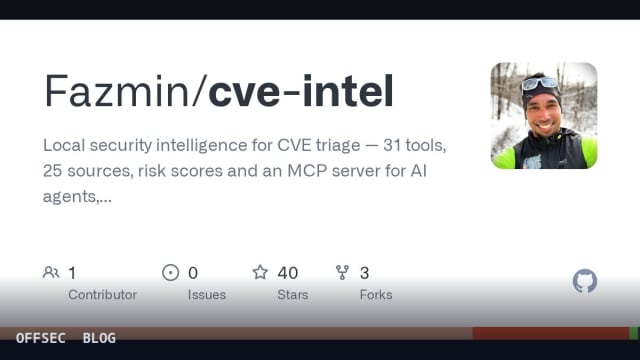
cve-intel is a privacy-first, Rust-native local intelligence workbench for triaging CVEs across 25 sources, built for authorized defenders and security teams.
| Tool | Fazmin/cve-intel — local-first CVE triage and intelligence workbench written in Rust |
| Category | Vulnerability intelligence / defensive research tooling |
| Primary Use | Correlating and scoring CVEs from 25 sources via 31 built-in tools, with an MCP server for AI agents |
| Safe Use | Intended for authorized vulnerability management, patch prioritization, and defensive research on systems you own or are contracted to assess. |
| Telemetry Note | Local-first by design; queries hit public CVE data sources from your own IP, and defenders monitoring egress will see routine lookups against public vulnerability APIs rather than any exploitation traffic. |
Most vulnerability triage workflows still depend on someone else's cloud: you paste a CVE into a web console, the console logs it, and your organization's exposure posture leaks one identifier at a time. cve-intel, published at Fazmin/cve-intel, takes the opposite position. It is a native Rust application that brings CVE intelligence, enrichment, and risk scoring onto the local machine, private by default, and it ships with an MCP server so that AI agents can consume that intelligence through a standardized tool interface.
The project's own description is unusually specific about its scope: 31 tools, 25 sources, risk scores, and an MCP server for AI agents. Read together, those numbers sketch an architecture that is broader than a simple NVD wrapper. Twenty-five sources implies aggregation across public vulnerability feeds — the kind of dispersion that normally forces analysts to keep a dozen browser tabs open — consolidated into a single local query surface. Thirty-one tools suggests each source or analytical function is exposed as a discrete, composable operation rather than one monolithic lookup command.
The choice of Rust is doing real work here. Native compilation means no Python runtime to provision, no dependency conflicts with other tooling on an analyst workstation, and a single binary that can be dropped onto a hardened jump host or an air-gapped triage VM. For a tool whose entire value proposition is privacy, eliminating the sprawling dependency trees that script-based alternatives drag along is not cosmetic — it reduces both the attack surface of the analyst's own machine and the number of third-party packages that could exfiltrate the very data you are trying to keep local.
The privacy framing deserves scrutiny, because it is the project's central claim. The repository topics include local-first and privacy alongside cybersecurity and cve-search, and the summary describes the intelligence as local. In practice, a tool querying 25 external sources must still reach out to those feeds — cve-intel's privacy argument is that no intermediary analytics platform sits between you and the sources, so what you research and when stays on your machine rather than being profiled by a SaaS vulnerability console. That is a meaningful distinction for organizations whose vulnerability inventory is itself sensitive.
The MCP server is arguably the most forward-looking component. MCP, the Model Context Protocol, has quickly become the standard way for LLM-based agents to call external tools. By exposing its 31 operations as MCP tools, cve-intel turns a local intelligence corpus into something an agent can query autonomously: an analyst can ask an AI assistant to compare two CVEs, pull their scoring context, and summarize remediation priority without the raw identifiers ever leaving the local environment for a hosted model. Notably, the project's own illustration shows a comparison between CVE-2024-3400 and CVE-2024-... style identifiers driven by a local Qwen model — reinforcing that even the language-model layer can run on-device.
Risk scoring is the third pillar. Raw CVSS alone is a poor triage signal; every mature program layers exploitability signals, affected-product context, and KEV-style known-exploitation data on top. A tool that computes composite risk scores across 25 sources locally gives defenders a consistent, reproducible prioritization signal without the per-seat pricing of commercial vulnerability intelligence platforms. The exact weighting scheme is not documented in the material available, so operators should treat the scores as a triage heuristic to be sanity-checked against their actual asset inventory rather than an authoritative ranking.
Where this fits in an authorized workflow is straightforward: patch management and vulnerability management programs. A defender reconciling this week's scanner output against public advisories, a consultant preparing a remediation roadmap under contract, or a CTF participant researching disclosed flaws for a lab exercise all operate in the same legitimate lane — gathering and prioritizing public information. cve-intel contains no exploitation capability; it is an intelligence aggregation and scoring layer, which places it firmly on the defensive side of the tooling spectrum, closer to cve-search successors than to anything offensive.
The licensing and community signals are reasonable for a young project. It is released under Apache-2.0, which permits commercial use inside enterprise security teams without negotiation — a sensible choice for infrastructure tooling. At roughly 40 stars and written in Rust, it is early-stage: expect rough edges, evolving source coverage, and the usual caveats of a maintainer-driven project rather than a product with SLA backing. The misspelled vulnaribility topic tag is a harmless tell of a solo developer moving fast.
Deployment is conventional for a Rust project: git clone https://github.com/Fazmin/cve-intel followed by a cargo build --release should produce the native binary, and the MCP server component is then available to any MCP-capable client. As with any local-first tool, review the source list configuration before pointing it at production networks so egress to public feeds matches your organization's data handling policy.
Operationally, defenders observing this tool in use will see nothing suspicious — outbound HTTPS to public vulnerability data sources, which blends into normal analyst research traffic. The telemetry footprint is benign by construction, and that is precisely the point: cve-intel treats the analyst's research pattern as information worth protecting. For teams whose triage currently flows through third-party consoles, it offers a credible path to keeping vulnerability context in-house while still aggregating the public record.
The obvious caveats remain: verify source freshness, validate the risk scoring against your own incident history, and do not mistake aggregation for ground truth. But as a statement of direction — local, agent-ready, privacy-conscious vulnerability intelligence — Fazmin/cve-intel is a project worth watching, and worth a slot in a defender's toolkit evaluation queue.
Fazmin/cve-intel.Educational analysis for authorized security professionals. Use only in controlled, authorized environments.
Related coverage


0 comentários:
Post a Comment
Note: Only a member of this blog may post a comment.