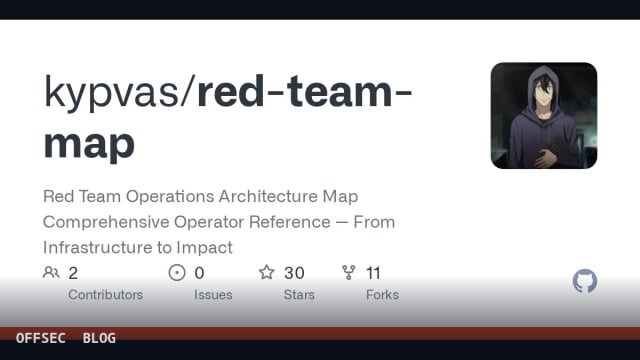
red-team-map is a documentation-style HTML project that organizes the full lifecycle of authorized red team operations into a navigable reference map for professional operators.
| Tool | kypvas/red-team-map — an architecture map and operator reference covering red team operations from infrastructure through impact, built as an HTML documentation project |
| Category | Reference documentation / knowledge map for offensive security training |
| Primary Use | Study aid and planning canvas for authorized red teamers mapping operational phases such as infrastructure, tradecraft categories, and impact objectives during engagement scoping |
| Safe Use | Strictly educational: use in authorized penetration testing engagements, internal training programs, certification study, and purple-team workshops with written permission |
| Telemetry Note | Pure documentation with no runtime component — it generates no network traffic and leaves no footprint; defenders benefit from it only as a mental model of adversary phase progression |
kypvas/red-team-map is not a scanner, a C2 framework, or an exploit toolkit — it is something rarer in the offensive security ecosystem: a structured, visual reference that lays out the entire architecture of a red team operation in one navigable artifact. The repository, written primarily in HTML, positions itself as a comprehensive operator reference that walks from infrastructure at the very beginning of an engagement all the way through to impact, the moment an operation demonstrates a concrete business consequence. For teams that struggle to keep the full operational picture in their heads — operators and leads alike — this kind of map functions as a shared vocabulary and a planning checklist rolled into one.
What makes a project like this worth an operator's attention is the framing. Most public offensive resources are tool-centric: a repo for phishing, a repo for C2, a repo for cloud enumeration. A map-first resource inverts that. Instead of asking which tool solves a problem, it forces the question of where a problem sits within the overall engagement lifecycle, and only then which capability fills that slot. The title of the repository itself — describing a path from infrastructure to impact — signals that the author thinks in operational phases rather than in tool lists, which is the same mental model used by mature adversary emulation frameworks and by defensive taxonomies such as MITRE ATT&CK.
The README for this repository is notably sparse, and that is worth being transparent about. What the repository metadata does tell us is concrete: the project lives at kypvas/red-team-map, it is written in HTML, it sits on the main branch, and it carries roughly 30 stars at the time of this writing — modest traction, consistent with a niche reference document rather than a viral utility. The original description is in Portuguese (Mapa de Arquitetura de Operações de Red Team), which tells us the author is documenting red team tradecraft for a Lusophone audience, and the project has been surfaced to an international audience through aggregation channels. There is no license declared, so anyone intending to reuse or adapt the map in corporate training materials should treat it as all-rights-reserved until confirmed otherwise.
Because the HTML implementation is the only code here, the deployment model is trivially simple: the map is a set of static pages that can be browsed directly in a browser, hosted locally, or served from any static file host. That matters for a specific professional niche — consultants who cannot pull up arbitrary external websites inside a client's restricted environment can clone the repository with git clone https://github.com/kypvas/red-team-map and open the pages offline during engagement planning sessions. Nothing phones home, nothing is dynamic, and nothing requires an install chain beyond a browser. In an industry where tool hygiene and supply-chain provenance are increasingly scrutinized, a dependency-free reference document is about as low-risk as an operational resource gets.
The structure implied by the title deserves closer analysis. An architecture map that starts at infrastructure is acknowledging a truth that many junior operators learn the hard way: the operational backbone — redirectors, domains, staging, attribution management — is decided before a single payload is written, and mistakes there are the most expensive to fix mid-engagement. Ending at impact is equally deliberate. Modern authorized red teaming is measured not by shells popped but by demonstrated business effect, whether that is domain compromise, access to a crown-jewel system, or a simulated ransomware-ready position. A map that binds those two extremes together teaches the discipline of thinking end-to-end.
For the authorized professional, the practical use cases fall into three buckets. First, engagement scoping: walking the map with a client or internal stakeholder to agree on which phases are in scope, which are out, and what the rules of engagement say at each stage. Second, training and onboarding: junior operators get a scaffold onto which they can attach tools and techniques they learn, rather than accumulating a disconnected pile of GitHub links. Third, purple-team exercises: defenders can mirror the same phase structure when designing detection hypotheses, asking what telemetry should exist at each stage of the adversary's progression. That last use is the one most often overlooked — a good offensive architecture map is, read in reverse, a defensive coverage checklist.
It is worth being explicit about what this resource is not, because the category invites misuse by the careless. A map of red team operations architecture is not a set of instructions for attacking anyone, and it contains, as far as the repository indicates, no operational tooling at all. Treating it as a shortcut to conducting unauthorized intrusion would be both a category error and a legal exposure. The document's entire value is as an educational organizing framework for people operating under contracts, letters of authorization, and defined rules of engagement — or for defenders and students building a structural understanding of how organized adversary operations are architected.
From a defensive perspective, the existence and popularity of references like red-team-map is itself a signal worth reading. The offensive community invests heavily in operational architecture because real adversaries do too; the phases a map like this enumerates — infrastructure standing, capability staging, action-on-objective, impact — map cleanly onto what threat intelligence teams describe in intrusion reporting. Defenders who skim such maps gain nothing operationally dangerous but a great deal conceptually: an understanding of which attacker decisions are long-lead-time and infrastructure-dependent, and therefore which of them are the most detectable early. Registrar-age anomalies, freshly minted certificates, and staging behaviors tied to pre-engagement infrastructure are the defensive mirror of the map's opening chapters.
Maturity-wise, a 30-star documentation project should be evaluated on content quality rather than community metrics. The questions to ask when reviewing it are simple: does the map's phase model align with how your team actually runs engagements, is the vocabulary compatible with your reporting templates, and does it cover the domains your practice cares about — on-prem, cloud, identity, physical, social? Since the README is thin, those judgments require opening the HTML pages themselves, which is the appropriate next step for any operator considering adopting it as an internal reference. Forking it and adapting the structure to your own methodology is the natural evolution, subject to the licensing question raised earlier.
In sum, kypvas/red-team-map occupies a small but genuinely useful niche: a browser-based, dependency-free architectural map of red team operations spanning infrastructure to impact, authored for a Portuguese-speaking audience and now circulating internationally. It is not going to pop a shell, and it is not meant to. Its contribution is pedagogical — giving authorized operators, trainers, and defenders a shared structural picture of how professional offensive operations are organized. For teams that prefer curated frameworks over scattered bookmarks, it is worth a look; for everyone else, it is a reminder that in offensive security, the architecture matters as much as the ammunition.
kypvas/red-team-map.Educational analysis for authorized security professionals. Use only in controlled, authorized environments.
Related coverage


0 comentários:
Post a Comment
Note: Only a member of this blog may post a comment.