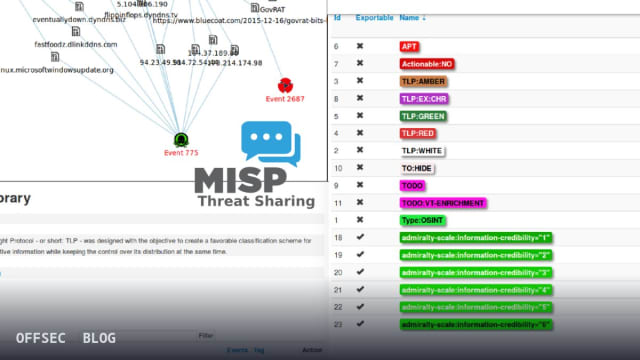
MISP is an open source threat intelligence platform for collecting, correlating, and sharing indicators and malware analysis within authorized security teams and trusted communities.
| Tool | MISP/MISP — open source threat intelligence collection, correlation, and sharing platform written in PHP |
| Category | Threat intelligence platform (TIP) / information sharing |
| Primary Use | Centralizing indicators, STIX events, and malware analysis, then distributing them to NIDS, SIEM, and partner MISP instances |
| Safe Use | Designed for incident analysts, malware reversers, and authorized security teams sharing defensive intelligence within trusted communities and labs |
| Telemetry Note | MISP is itself a defensive tool; its sightings, ZMQ/Kafka feeds, and flexible logging subsystem provide a full audit trail of all user actions for defenders |
MISP occupies a rare position in the security tooling landscape: it is infrastructure rather than an instrument of attack. The README describes it as an open source solution for collecting, storing, distributing, and sharing cyber security indicators and threats, built by and for incident analysts, security and ICT professionals, and malware reversers. With roughly 6,500 stars, an AGPL-3.0 license, and a default branch of 2.5, this is a mature, community-governed project rather than a weekend repository, and the codebase is written primarily in PHP. For teams that have outgrown spreadsheets and chat pastes as their intelligence pipeline, MISP is the canonical answer.
The core data model is what makes the platform durable. MISP stores everything from atomic data points and indicators to complex objects and selectors, in what the README calls a fast and efficient database, covering both technical and non-technical intelligence — including fraud indicators relevant to the financial sector. Complex objects can be linked together to express incidents, campaigns, or connected elements, and threat intelligence can be described anywhere on the spectrum from machine-readable actionable data to detailed Markdown reports with cross-references to the underlying objects and attributes. This dual representation — human narrative plus machine-consumable indicators — is the design decision that separates MISP from simpler indicator databases.
The automatic correlation engine is arguably the platform's signature feature. It reveals relationships between attributes and indicators across malware, attack campaigns, and analyses, and it goes beyond exact matching: the README highlights fuzzy hashing overlaps via ssdeep and CIDR block matching as advanced correlation patterns. Correlation can be enabled or disabled at different levels of granularity, which matters in practice because a busy community instance will otherwise drown analysts in low-value matches. Paired with the event graph functionality and the graphical correlation navigation in the UI, this lets an analyst pivot from a single hash to a campaign picture without leaving the interface.
Sharing is the other half of the platform's identity. MISP instances synchronize events, attributes, and higher-level intelligence with each other automatically, using customizable distribution models and sharing groups with granularity that extends down to the individual atomic attribute. The README also describes delegation of sharing, a pseudo-anonymous mechanism for delegating publication of data to communities — a thoughtful touch for organizations that want to contribute intelligence without attaching their name to it. Notifications can be encrypted and signed via GnuPG or S/MIME, and information signing and validation is available for more sensitive sharing communities.
Consumption of the intelligence is where MISP earns its place in an operational workflow. The README emphasizes support for feeding Network Intrusion Detection Systems, LIDS, log analysis tools, and SIEMs. Export formats include native IDS outputs for Suricata, Snort, and Bro/Zeek, plus OpenIOC, plain text, CSV, MISP JSON, STIX in both XML and JSON for versions 1 and 2, RPZ zones, and cache formats for forensic tools. Additional formats such as PDF can be added through the misp-modules extension system, meaning the platform can be adapted to whatever downstream detection stack an organization runs.
Import is equally flexible. Beyond structured formats like STIX 1.x/2.0 and CSV, MISP ships a free-text import tool that parses unstructured reports — including fetching a provided URL — and automatically converts external reports into MISP reports, objects, and attributes. Bulk and batch import paths exist for higher-volume operations. This matters because the honest bottleneck in most intelligence programs is not storage but the labor of turning a prose threat report into structured, queryable data, and MISP attacks that problem directly.
The taxonomy and galaxy system gives the data its vocabulary. Events can be tagged with adjustable local or shared classification schemes from misp-taxonomies, while MISP galaxy clusters bundle existing vocabularies for threat actors, malware, RATs, ransomware, and MITRE ATT&CK, all linkable to events, reports, and attributes. Warning lists from misp-warninglists help analysts limit false positives — for example, flagging attributes that are well-known benign infrastructure before they are published as indicators. Together these constructs make MISP data consistently machine-filterable across organizations that have never met.
Automation and integration are first-class concerns. Everything accessible through the UI is also exposed via an extensive ReST API described as OpenAPI, and the platform bundles PyMISP, a Python library to fetch, add, or update events and attributes, handle malware samples, and search attributes. The restSearch API enables indicator queries with export into every supported format. A comprehensive workflow system supports automatic, customizable data pipelines covering data qualification, automated analysis, modification, and publication control — effectively an approval chain for intelligence before it propagates to peers.
Real-time distribution is handled through a publish-subscribe channel: all changes, including new events, indicators, sightings, and tagging, can be streamed over ZMQ or Kafka, with tools like SkillAegis consuming the feed. Sighting support lets organizations report back observations about shared indicators via the UI, the API, or STIX sighting documents, closing the feedback loop on whether an indicator actually fired in someone's environment. For governance, MISP provides customizable RBAC spanning permissive in-house deployments to tightly regulated community instances, flexible logging subsystems with multiple output formats and transports for centralized audit, and a dashboard feature with drag-and-drop composite monitoring views.
Deployment flexibility is explicitly addressed: the README states MISP can be deployed on-premise, in the cloud, or consumed as SaaS, suitable for organizations of all sizes. The batteries-included claim is backed by tooling for backups, identity provider and authentication system integration, system monitoring, and information leakage prevention safety nets such as MISP-Guard. The project also participates in the CLA-free initiative and uses an interlocked license structure across all contributors, which the README presents as a guarantee that the project can never be relicensed into a closed or semi-open proprietary model — a meaningful commitment for organizations betting their intelligence pipeline on it.
For a professional evaluating adoption, the practical entry points are the ecosystem rather than the core alone: PyMISP for scripting, misp-modules for import/export expansion, misp-taxonomies and misp-galaxy for vocabulary, and misp-warninglists for hygiene. A minimal start looks like git clone https://github.com/MISP/MISP.git followed by the documented installation path, with PyMISP installable via pip for API-driven work. Given its purely defensive purpose — centralizing and sharing indicators so that SIEMs and IDS platforms can detect and block threats — MISP carries essentially no offensive risk; the main operational considerations are the usual ones for any internet-reachable sharing platform: RBAC discipline, encryption of notifications, and audit logging, all of which the platform provides natively.
In sum, MISP is less a tool than a foundation. Its correlation engine, granular sharing groups, STIX interoperability, and extensive API make it the connective tissue between malware analysis, incident response, and detection engineering in authorized environments. For blue teams that need structured intelligence to flow between analysts, tools, and trusted partners without losing fidelity, it remains the reference implementation against which commercial TIPs are measured.
MISP/MISP.Educational analysis for authorized security professionals. Use only in controlled, authorized environments.
Related coverage


0 comentários:
Post a Comment
Note: Only a member of this blog may post a comment.