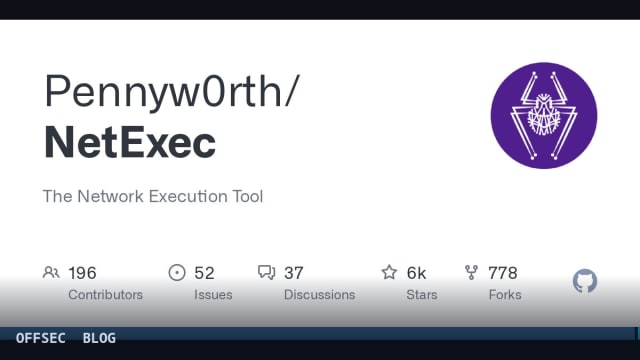
NetExec is a community-maintained Python network execution and validation tool, descended from CrackMapExec, built for authorized penetration testers assessing Windows and Active Directory networks.
| Tool | Pennyw0rth/NetExec — community-driven network execution tool and continuation of CrackMapExec |
| Category | Network security assessment / post-exploitation validation framework |
| Primary Use | Validating credentials, protocols, and privilege levels across Windows networks during authorized engagements, invoked via the nxc command |
| Safe Use | Intended strictly for authorized penetration tests, red-team engagements with written scope, and internal security assessments of networks you own or are contracted to test |
| Telemetry Note | Because it interacts with standard Windows services like SMB, WinRM, LDAP, and MSSQL, its activity generates authenticable Windows event log entries, which defenders can correlate for detection of credential-validation sweeps |
NetExec occupies a storied place in the offensive security tooling ecosystem, and understanding its provenance matters as much as understanding its capabilities. The project was originally created in 2015 by byt3bl33d3r under the name CrackMapExec, a tool that effectively defined the genre of network execution utilities — tools that let an operator validate credentials and execute actions across many hosts in a Windows environment in a single, scriptable pass. In 2019, mpgn_x64 took over maintenance for four years, adding substantial functionality before retiring from the role in September 2023. The README frames the current project explicitly as a community fork: the most active contributors — NeffIsBack, Marshall-Hallenbeck, and zblurx — decided to continue the work collectively under the new name NetExec.
What makes the rename more than cosmetic is the governance story the README tells. The maintainers describe a period during which CrackMapExec existed simultaneously as a private and a public repository, with a six-to-eight-month discrepancy between the two code bases. That gap, they write candidly, caused development friction and suppressed community-driven contribution, since external pull requests were difficult to merge against a diverging internal tree. NetExec is positioned as a corrective: a fully free and open source project under the BSD-2-Clause license, with regular updates intended for everyone. For professionals who depend on this class of tool, that commitment to a single public codebase and community maintenance model is a meaningful supply-chain consideration.
The repository metadata reinforces that positioning. Pennyw0rth/NetExec is written in Python, targets Python 3.10+ per the badge in the README, and carries an extensive topic list including active-directory, pentest-tool, red-team, windows, and security-tools. With roughly 5.8k stars, the project has clearly carried its predecessor's user base forward rather than starting cold. The topic taxonomy signals exactly where the tool fits: it is an Active Directory–centric assessment utility for penetration testing and red team work, not a general network scanner. The windows and python3 topics confirm the two pillars of its identity — Windows-focused targeting and a Python implementation that keeps it portable and extensible.
The invocation story is deliberately minimal in the README: the tool is referenced by its short command name nxc, which will be immediately familiar to anyone who ran CrackMapExec as cme. The README's installation section is the most operationally concrete part of the document, and it reflects modern Python packaging practice. Rather than pip installs into a shared interpreter, the recommended path uses pipx, which installs each CLI tool into an isolated virtual environment and puts its entry point on your PATH. On Linux, the documented sequence is sudo apt install pipx git, then pipx ensurepath, then pipx install git+https://github.com/Pennyw0rth/NetExec. Installing directly from the git URL means you are tracking the default main branch, which is worth noting for reproducibility — pinning to a specific release tag is a reasonable hardening step for engagement documentation.
Beyond the source install, the README highlights distribution availability through repology, showing a packaging-status badge for netexec across Unix distributions. This is a small detail but a telling one: presence in distribution repositories means the tool has passed upstream packaging review and can be installed through a system package manager, which simplifies setup on assessment workstations built on Debian-family, Arch-family, or similar distributions. For teams that build standardized engagement images, having netexec available natively reduces friction versus maintaining custom pipx bootstrap scripts.
The README is upfront about what it does not yet contain: documentation, tutorials, examples, development guidelines, and installation details are all delegated to a project wiki at netexec.wiki, explicitly marked as in development. This is a thinner README than the tool's maturity would suggest, and an analyst reading it should calibrate accordingly — the document is primarily a governance and provenance statement, not a capability reference. The wiki is the authoritative usage resource, and the community channels — GitHub Issues, Pull Requests, Discussions, and an official Discord server — are where troubleshooting actually happens. The Discord invite is published directly in the README, which lowers the barrier for users without GitHub accounts to get support.
Placing NetExec in an authorized workflow requires understanding what this category of tool fundamentally does: it automates interaction with Windows network protocols at scale so that an operator with a foothold or a set of credentials can enumerate where those credentials work, what privileges they confer, and what services are exposed, all without manually touching each host. The topic list — SMB-adjacent Active Directory work implied by active-directory and windows — situates it squarely in the credential-validation and lateral-movement-assessment phase of a penetration test. In a properly scoped engagement, that means answering concrete questions for the client: which accounts are local administrators on which machines, where service credentials are reused, and which hosts expose management surfaces that should not be exposed.
From a defensive research perspective, the tool matters to blue teams as much as red. Because it speaks native Windows protocols rather than exotic channels, its usage patterns are observable in standard telemetry, and studying how tools like nxc behave helps defenders tune detection rules for credential spraying, pass-the-hash validation, and mass enumeration behavior. The existence of a well-maintained, open, BSD-licensed implementation is a genuine asset here — detection engineers can read the source, understand exactly which API calls and logon types it triggers, and build detections against ground truth rather than folklore. This dual-use value is one of the strongest arguments for the project's insistence on staying fully open source.
What to watch going forward: the README's honest acknowledgment of the private/public split that plagued the predecessor is a credibility signal, but the community now has to deliver on regular updates and wiki completion. The contributor gallery — including names like mpgn, Hackndo, and XiaoliChan alongside the three current maintainers — shows real depth of institutional knowledge behind the project. For authorized professionals, NetExec is the legitimate continuation of one of the most important assessment utilities of the last decade, and its health as a community project is worth tracking as closely as its feature set.
For anyone adding it to a toolkit, the practical guidance is straightforward: install via pipx from the repository or your distribution's package manager, read the wiki for current protocol modules and options, and operate it only within environments you own or are contractually authorized to assess. The tool's power is proportional to the scope of the network it is pointed at, which is exactly why scope discipline, logging of your own activity, and clean engagement documentation are non-negotiable parts of using it responsibly.
Pennyw0rth/NetExec.Educational analysis for authorized security professionals. Use only in controlled, authorized environments.
Related coverage


0 comentários:
Post a Comment
Note: Only a member of this blog may post a comment.