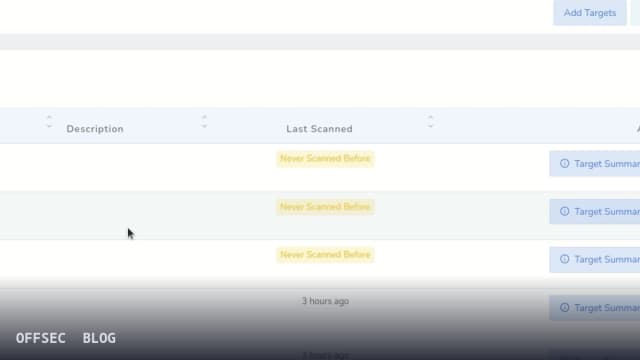
reNgine is a highly configurable, database-backed reconnaissance framework that orchestrates subdomain discovery, port scanning, and vulnerability assessment for authorized pentesters and bug bounty hunters.
| Tool | yogeshojha/rengine — automated web reconnaissance and vulnerability scanning suite with YAML-configurable scan engines |
| Category | Web application reconnaissance / attack surface management |
| Primary Use | Automating end-to-end recon — subdomain enumeration, port scanning, endpoint collection, fuzzing, screenshots, and nuclei-based vulnerability scans — during authorized engagements and bug bounty programs |
| Safe Use | For penetration testers and security teams with written authorization against in-scope assets only, or against lab environments and sanctioned bug bounty programs |
| Telemetry Note | reNgine generates significant scan traffic (DNS queries, HTTP probes, fuzzing requests) that will be visible in WAF logs, SIEM anomaly alerts, and rate-limiting controls; defenders should see structured, engine-driven recon patterns from the scanner's IP |
reNgine, hosted at yogeshojha/rengine with roughly 8,800 stars and a GPL-3.0 license, positions itself as an all-in-one web application reconnaissance suite aimed squarely at professional operators: penetration testers, bug bounty hunters, and corporate security teams. Rather than being yet another wrapper around a single enumeration tool, it is a framework that orchestrates an entire recon pipeline — from subdomain discovery through vulnerability scanning and report generation — with every stage's output persisted in a database and correlated against prior results. The project carries serious community credibility: it has been presented at BlackHat Arsenal in the USA, Europe, and Asia across 2020–2023, at HITB Armory 2021, and at Defcon Demolabs 29, which is an unusually strong conference track record for an open-source recon tool.
The current release, version 2.2.0, is actively developed and the README documents a meaningful changelog: a bounty hub that syncs and imports HackerOne programs, in-app notifications, chaos as an additional subdomain enumeration source, the ability to upload multiple nuclei and gf patterns, regex support in the out-of-scope subdomain configuration, and an additional PDF report template. That last feature cluster matters more than it sounds — the ability to load custom nuclei template sets means operators can tailor detection coverage to their engagement scope instead of relying on a bundled default, and regex-based out-of-scope exclusions are essential for avoiding assets that fall outside the authorization boundary during automated scans.
Architecturally, what distinguishes reNgine from a shell script chaining subfinder, amass, and nuclei is its data model. The README emphasizes that all reconnaissance output — subdomains, resolved IP addresses, open ports, endpoints, directories, screenshots — flows into a database rather than scattered json, txt, or csv files that you later grep by hand. On top of that datastore sits a custom query language described as natural-language-like: the README gives the examples http_status=200 to filter live subdomains and http_status=200&name=admin to narrow that to hosts containing admin in the name. For anyone who has spent an afternoon reconciling tool outputs after a week-long engagement, this is the feature that changes the workflow, turning recon data into something you can interrogate rather than archive.
Scan execution is driven by YAML-based scan engines, and the configurability is granular: thread counts, timeouts, and rate limits are all exposed per engine. Ship-with defaults include a Full Scan engine, a passive engine, a screenshot-gathering engine, and an OSINT engine, so a fresh installation is usable without authoring configuration first. This design acknowledges the reality that recon against a fragile production target and recon against a hardened lab require very different aggression profiles, and the operator — not the tool — decides where the dial sits. That is also where the authorization discipline lives: rate limits and out-of-scope rules are the primary mechanisms for keeping automated scans inside the boundaries a client has actually signed off on.
A genuinely differentiating capability is what the project calls Subscan. Instead of waiting for a full pipeline run to finish before acting on an interesting discovery, a user can trigger a targeted re-scan of a single finding — for example, running a focused port scan or vulnerability assessment against one newly discovered subdomain. The README claims it is the only open-source tool in its class offering this, and it addresses a real pain point: in traditional pipelines, the interesting host you found at minute two waits until minute forty for deeper inspection. Operationally, this lets an analyst triage in near-real-time while the broader crawl continues in the background.
The tooling underneath the engine layer is deliberately open-source and recognizable: reNgine harnesses existing community tools for subdomain discovery, IP and open-port identification, endpoint and directory/file fuzzing, screenshot capture, and vulnerability scanning, with nuclei and gf patterns explicitly named. Beyond the standard web attack surface, the README highlights WHOIS identification, WAF detection, misconfigured S3 bucket identification, and keyword-based filtering to surface interesting subdomains and URLs. The S3 angle deserves attention from defenders too — misconfigured bucket discovery is a common authorized-engagement finding, and it is a data-exposure class that blue teams can proactively audit themselves.
Reporting is treated as a first-class feature rather than an afterthought. reNgine generates customizable PDF reports in several flavors — full scan reports, vulnerability reports, and concise recon summaries — with adjustable colors, executive summaries, company names, and footers. The 2.0 release line added GPT-powered report generation: via OpenAI's GPT, vulnerability descriptions, remediation strategies, and impact assessments are drafted automatically, and the feature claims to pull related news articles and references for context. For consultants, this compresses the least-loved part of the job; it also means reviewers should still verify AI-drafted remediation text before it reaches a client, since generated guidance can lag current best practice.
Team workflows are supported through two organizational constructs. Projects, introduced in 2.0, give each engagement or bug bounty effort its own isolated dashboard and scan results, while scan engines and configurations remain shared across projects. Role-based access control defines three personas: Sys Admin (full superuser control over system configuration, scan engines, and user creation), Penetration Tester (can modify and launch scans and subscans and manage targets, but not system configuration), and Auditor (view and download reports only, with no ability to launch scans). The Auditor role is a thoughtful addition — it lets a client liaison or quality reviewer receive deliverables without holding operational capability, which maps cleanly onto how many assessment firms separate execution from review.
Version 2.2.0's bounty hub tightens the bug bounty loop considerably: syncing HackerOne programs into the tool means scope definitions can be imported rather than retyped, reducing the risk of manual transcription errors that lead to out-of-scope scanning. Combined with the regex-based out-of-scope subdomain exclusions, this gives bounty hunters programmatic guardrails that match the program's actual rules — a control that benefits both the hunter and the platform's defenders.
Installation is documented at the project wiki (rengine.wiki) and follows the standard pattern for this class of tool: clone the repository with git clone https://github.com/yogeshojha/rengine.git and run the included install.sh script on a dedicated Linux host, since the framework orchestrates dozens of underlying tools that the installer provisions. Running it in an isolated VM or container dedicated to the engagement is the sensible posture, both for dependency hygiene and for keeping scan traffic attributable to a known source.
From a defensive standpoint, reNgine is instructive to study even if you never point it at anything. Its traffic profile is exactly what modern detection engineering trains against: high-volume DNS enumeration, systematic HTTP status probing, directory fuzzing, and template-driven vulnerability checks. Blue teams can use it in a lab to validate that their WAF rules, rate limiting, and SIEM correlation alerts actually fire against a realistic, structured recon campaign — arguably the most legitimate and useful application of a tool like this on the defense side.
The overall picture is of a mature, actively maintained framework that treats reconnaissance as a data problem rather than a scripting problem. The combination of database-backed correlation, a query language over results, YAML-configurable engines, subscans for rapid triage, role-based team workflows, and automated reporting puts reNgine in direct competition with commercial attack-surface platforms, while remaining fully open source under GPL-3.0. For authorized professionals drowning in tool output, it is one of the strongest open attempts yet at making recon data manageable.
yogeshojha/rengine.Educational analysis for authorized security professionals. Use only in controlled, authorized environments.


0 comentários:
Post a Comment
Note: Only a member of this blog may post a comment.