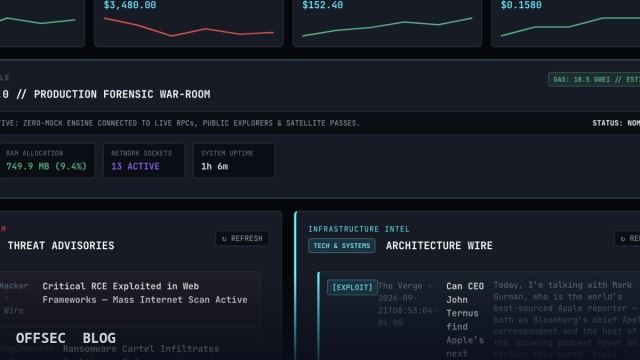
TheBigBrother is a Python-based OSINT workbench packing 52 reconnaissance and forensic engines into a single browser console, aimed at authorized investigators and defenders.
| Tool | chadi0x/TheBigBrother — Python/docker OSINT framework with 52 dual-engine modules across 26 workspace tabs |
| Category | OSINT / threat intelligence / forensics framework |
| Primary Use | Consolidating OSINT, breach auditing, GEOINT, steganalysis, and infra recon into one console for authorized engagements |
| Safe Use | Intended for authorized red-team engagements, SOC analysis, and investigative research on assets you are permitted to examine; many modules touch third-party data and must not be pointed at private individuals without lawful basis |
| Telemetry Note | Heavy outbound footprint: queries to Holehe, XposedOrNot, OpenSky, Sentinel-2, Hudson Rock, and DNS/RDAP endpoints will be logged by those services; crawls and port scans originate from your docker host IP, so scope egress carefully |
TheBigBrother (V7.0, codenamed NEXUS) is an ambitious open-source OSINT framework written in Python 3.10+ and delivered as a docker-compose stack serving a browser console on http://localhost:8000. What distinguishes it from the usual aggregator scripts is its dual-engine architecture: the README describes 26 workspace tabs, each hosting a primary reconnaissance tool and a companion power engine, for a total of 52 modules reachable without page reloads via a .subtool-switcher-bar. The repo sits at 769 stars with an MIT license, which suggests genuine community traction rather than a weekend toy, though the sheer breadth of the module matrix means maturity varies widely between engines.
Architecturally, the project leans on a client-side results cache — window.recordModuleResult() — that feeds a Cytoscape.js graph canvas. The README is explicit that the Nexus Graph Canvas (#btn-mode-nexus) contains zero mock data: topological nodes and edges are constructed live from actual scan payloads, and the canvas is deliberately restricted to the 12 relationship-centric tabs such as Chain Tracer, Breach Vault, and Code Hunter, auto-reverting when an operator navigates to an ineligible single-asset tab. This is a thoughtful design choice, since forcing graph views onto scalar tools like image analysis would produce meaningless visual noise. Operators can switch between Force-Directed (COSE), Concentric, and Circle layouts for entity-link analysis.
A second architectural claim worth noting for defenders evaluating supply-chain risk is that all 22 new companion modules are pure-Python, depending only on standard libraries — urllib, ssl, math, struct, wave, socket, hashlib. For an authorized assessment environment this reduces dependency-audit surface considerably, and the README pitches it as crash-proof in containers or bare metal. The primary engines, by contrast, do consume third-party services and presumably external libraries (Holehe for email enumeration, exiftool-style metadata work, docker for orchestration), so the zero-dependency claim applies only to the companion tier.
The module matrix reads like a curriculum of modern investigative tradecraft. Identity-focused tabs include Shadow Clone, which generates 40+ username mutations and typosquat variants and sweeps them across 80+ platforms, and Target Profiler, claiming enumeration across 200+ social enclaves plus a pure-Python facial landmark vector hash comparison for perceptual similarity scoring. Stylometry Profiler fingerprints writing style through punctuation and vocabulary patterns — a genuinely niche capability rarely seen bundled in OSINT suites. Deep Identity adds synthetic-avatar forensics with a StyleGAN/diffusion detector and cross-platform timeline synthesis, which has obvious defensive applications in influence-operation analysis.
Defensive practitioners get several modules that cut both ways. Breach Vault performs keyless breach auditing via XposedOrNot with an optional HIBP/DeHashed key vault, and its companion Hashcat Fast De-Hasher auto-identifies hash types and runs dictionary lookups — legitimate for auditing your own credential dumps post-incident, but the same code serves credential-stuffing preparation if misused against third-party data. Similarly, Hudson Rock Cavalier queries infostealer compromise data via the Hudson Rock API, and its companion parses raw RedLine, Vidar, Raccoon, and Lumma archives. In an incident-response context that parsing capability is valuable; outside it, possessing stealer logs is a legal minefield. Authorized teams should treat these tabs as read-only intelligence and never as an acquisition pipeline.
Media forensics is well represented. Pixel Forge runs nine-engine error-level analysis and clone detection with LSB steganography detection and embedded PKZip/ELF/PE payload carving, while Doc Autopsy extracts Office/PDF revision histories and metadata and its Document Detonator companion flags malicious VBA macros, shellcode NOP sleds, and risky PDF streams. Voice Print attempts AI voice-deepfake vocoder analysis alongside ENF extraction — the 50Hz/60Hz electrical network frequency grid-hum technique used in audio authentication — plus acoustic room-size estimation. These are documentary analysis features, not attack tools, and they are the modules most defensible in a pure research lab.
The infrastructure-facing tabs are where authorized-scope discipline matters most. Network Mapper is an async port scanner with PyVis topology output and a TLS cipher auditor flagging RC4, 3DES, and CBC weaknesses; Domain Oracle does RDAP/WHOIS history with an AXFR zone-transfer prober and dangling-CNAME takeover scanning across 15+ cloud services; Spider Crawl recursively crawls with 25+ API-key regexes and Swagger/OpenAPI manifest discovery. Cam Vector and its SCADA/ICS companion locate exposed RTSP cameras and probe industrial ports (Modbus 502, S7 102, BACnet 47808, MQTT 1883). Pointing any of these at infrastructure you do not own or have written permission to test crosses from reconnaissance into unauthorized access in most jurisdictions.
On the blue-team side, the tool includes genuinely defensive modules that deserve their own mention. Canary Sentinel generates zero-pixel web bugs, decoy AWS credentials, Kubeconfigs, and SQL honeytokens with webhook alerting; the AI Analyst tab maps findings to the Diamond Model and MITRE ATT&CK and claims automated Sigma and YARA-L rule generation. The Command Center aggregates a CISA KEV zero-day feed, and Ransom Disclose monitors extortion-site disclosure feeds with a catalog of known public decryptors. Shadow AI probes LLM prompt-injection and training-data memorization risk, an emerging area where tooling is still scarce.
Deployment is straightforward: git clone https://github.com/chadi0x/TheBigBrother.git, then docker-compose up --build -d inside the directory, with logs via docker-compose logs -f. A bare-metal path requiring Python 3.10+ and optional Node.js is also documented. Before running it, audit the docker-compose file and note that the README aggressively promotes a commercial portal (thebigbrother[.]cloud) offering paid dossiers on named individuals using an unreleased private engine — treat that announcement as advertising, not something the open-source code depends on, and exercise the same skepticism you would toward any service monetizing deep reconnaissance on third parties.
As an overall assessment, TheBigBrother is best understood as a workbench that replaces a bookmark folder of scattered scripts with one console, at the cost of uneven per-module depth. The pure-Python companions, the Cytoscape.js relationship canvas, and the honeytoken/AI-analysis modules show real engineering; the breadth, marketing tone, and the mix of defensive and clearly dual-use capability mean it belongs in a scoped lab environment with documented authorization, egress logging, and a hard rule against unconsented targeting of private individuals. Used that way, it is a genuinely interesting consolidation of 2026-era investigative technique.
chadi0x/TheBigBrother.Educational analysis for authorized security professionals. Use only in controlled, authorized environments.
Related coverage


0 comentários:
Post a Comment
Note: Only a member of this blog may post a comment.