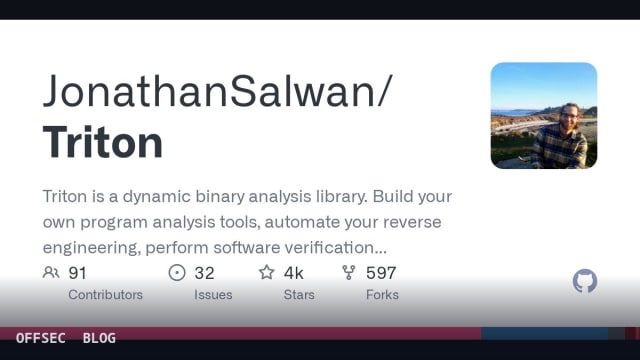
Triton is a dynamic binary analysis library for authorized reverse engineering and software verification, combining symbolic execution, taint analysis, and multi-architecture emulation behind C++ and Python APIs.
| Tool | JonathanSalwan/Triton — dynamic binary analysis library for building program analysis tools and automating reverse engineering |
| Category | binary analysis / symbolic execution framework |
| Primary Use | Building custom dynamic symbolic execution, taint analysis, and emulation tooling on x86, x86-64, ARM32, AArch64, and RISC-V binaries |
| Safe Use | Authorized reverse engineering, malware analysis in isolated labs, software verification, and defensive security research on software you own or are licensed to assess |
| Telemetry Note | As a passive analysis library Triton generates no network traffic; defenders observe it only indirectly through instrumented debuggers or emulation harnesses in analyst workstations |
Triton, hosted at JonathanSalwan/Triton with roughly 4,300 stars and an Apache-2.0 license, is a dynamic binary analysis library written in C++ that lets you build your own program analysis tooling rather than handing you a finished product. The README positions it as a foundation for automating reverse engineering, performing software verification, or simply emulating code. That framing matters for professionals: instead of a monolithic GUI, you get composable internal components — a symbolic engine, a taint engine, an instruction semantics layer, and solver bindings — exposed through both a C++ and a Python API. The topics list on the repository (symbolic-execution, taint-analysis, lifter, deobfuscation, emulator) reads like a syllabus for modern binary analysis, and it accurately reflects the architecture.
The core capability set is broad. Triton performs dynamic symbolic execution (DSE), where concrete runtime values and symbolic expressions are tracked simultaneously through each processed instruction, and dynamic taint analysis, which propagates data-flow markers from chosen sources. It provides an AST representation of instruction semantics for five architecture families: x86, x86-64, ARM32, AArch64, and RISC-V 32/64. Beyond raw semantics it adds expression synthesis, SMT simplification passes, and lifting to LLVM, Z3, and back. Solver integration covers both Z3 and Bitwuzla, which is a pragmatic touch — solver performance characteristics differ meaningfully depending on constraint shape, and being able to swap backends is a real operational advantage.
The getting-started example in the README is instructive about the mental model. You instantiate a TritonContext with a defined architecture via ARCH.X86_64, optionally seed concrete register values with ctx.setConcreteRegisterValue, symbolize inputs with ctx.symbolizeRegister, then feed raw instruction bytes through ctx.processing(Instruction(...)). The engine returns symbolic expressions per register — the example shows getSymbolicRegister(ctx.registers.rcx) producing an SMT-LIB definition for the mov result — and you can then ask the solver for a model with ctx.getModel, deriving the input 0xcc99 that satisfies an XOR constraint. This is concolic reasoning in miniature: concrete execution driving symbolic path conditions, and inversion through an SMT solver.
Architecturally, the README's dependency table reveals the design. libcapstone (>= 5.0.x) is the mandatory disassembly backbone; libz3 (>= 4.6.0), libbitwuzla (>= 0.4.x), llvm (>= 12), libboost, and libpython are optional interfaces. The build flags make the modularity explicit: a default cmake build omits LLVM and Bitwuzla, and enabling the full power requires cmake -DLLVM_INTERFACE=ON -DBITWUZLA_INTERFACE=ON ... This layered approach means a minimal Triton install is a semantics and taint engine, while the full build adds compiler-level lifting and a second solver.
Installation is refreshingly simple for a project of this complexity: pip install triton-library gets you the Python bindings precompiled. Source builds on Linux and macOS follow the standard git clone, cmake, make sequence, and the README documents Windows builds via cmake -G "Visual Studio 14 2015 Win64" plus a vcpkg install triton path maintained, as the README notes, by Microsoft team members and community contributors. There is also a macOS M1 note about pointing cmake at the correct PYTHON_LIBRARIES and PYTHON_INCLUDE_DIRS from Homebrew, with a sysconfig.get_paths() snippet to discover them — a small but telling detail about how actively maintained the cross-platform story is.
The ecosystem section is arguably the strongest signal of Triton's maturity. Tools listed as built on it include Ponce (an IDA plugin that won the 2016 plugin contest, putting one-click symbolic execution inside the disassembler), Pimp (a concolic execution plugin for radare2), QSynthesis (a greybox synthesizer for instruction-level deobfuscation from Quarkslab), TritonDSE (a DSE library with loading and exploration capabilities), Titan (a VMProtect devirtualizer), and Exrop (automatic ROP chain generation). For an analyst, this tells you Triton functions as infrastructure — the semantics and solver layer underneath specialized frontends — and that learning its API transfers across several tools you may already use.
The academic footprint reinforces that reading. The README cites a 2022 Ivannikov ISP RAS paper on Sydr-Fuzz, a continuous hybrid fuzzing pipeline that integrates a Triton-based DSE tool called Sydr with libFuzzer and AFL++, plus security predicate checkers and the Casr crash triage tool. The abstract reports the approach outperforming coverage-guided fuzzing and contributing to the discovery of dozens of real-world flaws. There is also a paper on strong optimistic solving for DSE, addressing how to explore complex branches during hybrid fuzzing. This is exactly the pattern you expect from a research-grade engine: papers extend the core, and the improvements land back in the library.
Where does this fit in an authorized workflow? The canonical uses are software verification and test generation on your own code, license-permitted auditing of third-party binaries, and malware deobfuscation inside an isolated lab — the QSynthesis and Titan use cases being the flagship examples of symbolic-driven deobfuscation of protected or virtualized code. Triton itself is analysis-only; it processes instructions you feed it and returns expressions, models, and taint states. It does not target networks or remote systems, so its risk profile is entirely about what the analyst does with its output in environments where the reverse engineering is contractually and legally authorized.
A few operational observations are worth flagging. First, the maintainers candidly describe Triton as a part-time project and ask for issues and pull requests rather than complaints — an honest reliability caveat when you are building production analysis pipelines on it. Second, symbolic execution is computationally expensive; expect solver time and path explosion to dominate on anything but targeted code regions, which is precisely why the ecosystem tools layer heuristics and greybox strategies on top. Third, the documentation split between the Python API pages and the C++ doxygen, plus a repository of Python examples under src/examples/python, gives you two entry points depending on whether you are scripting or embedding.
For defenders, Triton is interesting from both sides. Malware analysts use it to unwrap obfuscation and recover original semantics from virtualized payloads; threat researchers use its taint engine to trace how attacker-controlled inputs propagate through parsed structures. On the blue side, understanding that attackers' tooling increasingly relies on concolic engines clarifies why obfuscation alone is not a durable defense — semantics can be recovered mechanically. That makes Triton a tool worth studying even if you never run it, and a dependable foundation if you do, inside authorized assessment and research environments.
In sum, JonathanSalwan/Triton remains one of the reference open-source implementations of dynamic symbolic execution. Its multi-architecture semantics, dual solver bindings, LLVM lifting, and clean dual-language API explain both its longevity and its ecosystem gravity. For professionals building deobfuscation, verification, or hybrid fuzzing capability in authorized contexts, it is the library other libraries are built on, and the pip install triton-library entry point makes evaluating it against your own binaries a low-friction exercise.
JonathanSalwan/Triton.Educational analysis for authorized security professionals. Use only in controlled, authorized environments.
Related coverage


0 comentários:
Post a Comment
Note: Only a member of this blog may post a comment.