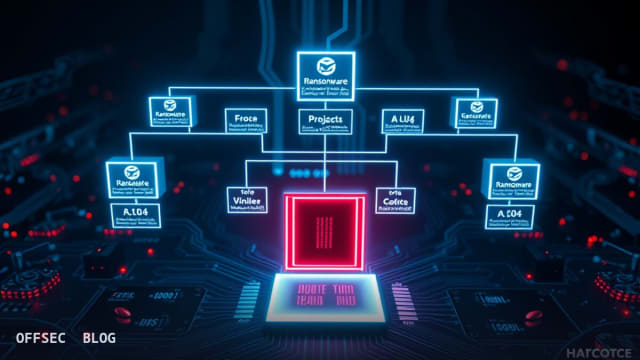
Modern ransomware operations run as franchise-like businesses where RaaS developers lease payloads and infrastructure to affiliates, a structure documented extensively in leak-site and attribution research for defensive professionals.
| Topic | Ransomware-as-a-Service (RaaS) affiliate ecosystems — the business structure behind modern extortion campaigns |
| Category | Threat intelligence and criminal-economics analysis |
| Primary Use | Understanding affiliate-tiering, initial-access-broker handoffs, and leak-site behavior to inform threat modeling and CTI programs |
| Safe Use | Educational, documentary analysis for defenders and authorized security teams building detection strategies and executive risk briefings |
| Telemetry Note | Defenders observe this ecosystem through public leak-site monitoring, OSINT cryptocurrency-flow analysis, and shared TI feeds rather than operational interaction |
The dominant structural shift in the extortion economy over the past several years is not technical but organizational: the mature ransomware operation no longer resembles a tight hacker crew and instead looks like a franchised business. Under the RaaS model, a core team develops and maintains the payload, the panel that manages victims, and the negotiation infrastructure, then licenses that capability to third-party affiliates who actually conduct intrusions. This division of labor mirrors legitimate software markets — a platform vendor, a reseller channel, and end customers — and it explains both the volume and the consistency of modern campaigns far better than any single-actor theory. For defenders, the practical consequence is significant: the group name on a leak site entry tells you who built the toolkit, not necessarily who was in your network.
The economics of the affiliate arrangement are well documented in published research on leak sites and underground forums. Commissions typically follow a revenue-share structure, with splits historically reported in the range of 70/30 to 80/20 in the affiliate's favor for high performers, and richer cuts offered to affiliates with proven access or a history of large payments. Some programs have been observed inverting the relationship entirely: rather than affiliates bringing victims to a brand, initial-access-brokers sell footholds — VPN credentials, exposed RDP, unpatched edge-device access — on dedicated markets, and ransomware operators or their affiliates purchase those footholds as raw material. This creates a supply chain in the criminal sense, with specialization, price discovery, and reputational feedback loops that closely track what security economists have long predicted about illicit markets.
Leak sites themselves are the most externally visible component of this ecosystem and the primary data source for the research this analysis draws on. A TOR-hosted or mirrored .onion-style site lists victims who declined to pay, staged with countdown timers and sample data drops, functioning simultaneously as punishment mechanism, advertising for the affiliate program, and proof-of-capability signal to future victims. Aggregating these listings over time yields a surprising amount of business intelligence: posting cadence reflects affiliate recruitment surges, pauses often correlate with law-enforcement action or rebranding, and sector clustering reveals which affiliates hold access to which industries. Researchers have repeatedly shown that when a brand disappears and a near-identical listing rhythm reappears under a new name, the affiliate roster has migrated rather than the operation dying — the crew changes, the platform continues.
Rebranding deserves particular attention because it is where business structure becomes attribution strategy. When infrastructure is seized or developers are arrested, the surviving organizational capital — affiliate relationships, negotiator experience, decryptor code, victim lists — gets ported to a new brand. Analysis of tool-code overlaps, stealer-log reuse, and negotiation styles has allowed researchers to link successive brands into lineage families, where a single developer ecosystem may appear under several names across its lifetime. The defensive takeaway is that tracking brand names in blocklists is a lagging indicator; tracking the affiliate population and their TTPs through frameworks like MITRE ATT&CK is the durable signal, because affiliates carry their tradecraft with them across platforms.
The double-extortion refinement — encrypting while simultaneously exfiltrating — reshaped the economics again by making data destruction less relevant as a deterrent and data exposure the primary lever. This in turn spawned further specialization: dedicated exfiltration tooling, data-theft shame sites, and even third-party negotiation consultancies inserted between victim and crew. Some ecosystems have layered on DDoS threats or direct contact of a victim's customers and regulators, effectively adding pressurize-on-demand services to the franchise package. Each addition raises the affiliate's expected revenue per victim without raising the technical barrier to entry, which is precisely the platform's product strategy.
Where does the affiliate actually come from? Published attribution work suggests several recurring feeder populations: veterans of earlier banking-trojan and cryptolocker-era crews, access brokers graduating from opportunistic credential resale, and lower-skill actors drawn in by the lowered technical bar — the platform handles payload development, C2 infrastructure, and even customer-facing negotiation scripts. This last group is operationally important for defenders, because low-skill affiliates disproportionately rely on commodity tooling, publicly documented exploits against edge devices, and default configurations of offensive frameworks. Detection engineering that assumes a mediocre intruder with a professional toolkit is generally better calibrated than detection premised on elite tradecraft.
The payment layer completes the business picture. Cryptocurrency wallet clustering and chain-analytics research have mapped how ransom proceeds flow through mixers, exchanges with weak KYC, and cash-out services, with affiliate splits frequently visible on-chain as same-day multi-way transaction patterns. Sanctions designations against specific crews add legal risk to payment itself, which has pushed some affiliates toward mid-tier brands specifically to avoid OFAC-exposed platforms — an example of regulatory pressure reshaping criminal market choice. For defenders, on-chain telemetry is a reminder that the ecosystem's weakest, most observable link may be its treasury, not its malware.
From a defensive posture standpoint, the affiliate model reframes prioritization. Because affiliates overwhelmingly purchase or reuse access rather than develop zero-days, the highest-yield mitigations remain stubbornly unglamorous: enforcing MFA on all remote-access surfaces including legacy VPN concentrators, patching internet-facing edge devices on an aggressive cadence, disabling exposed RDP, segmenting networks to slow lateral movement, and maintaining tested, offline-verified backups. Monitoring for the behaviors affiliates actually exhibit — mass exfiltration over cloud-storage APIs, credential-dump tool execution, unusual admin account creation, shadow C2 over allowed protocols — maps directly onto the platform's own playbook, since affiliates follow the program's documentation and rarely improvise.
Threat-intelligence teams can operationalize this ecosystem view concretely. Leak-site monitoring, even at the level of public trackers and researcher aggregators, provides early warning when your sector or supply chain appears in an affiliate's targeting pattern. Mapping known affiliate TTP clusters to ATT&CK techniques lets detection teams write content for the intruder profile rather than the brand. Tabletop exercises benefit from modeling the negotiation layer too: legal, comms, and IR should rehearse the scenario where a leak-site posting precedes any internal detection, which is distressingly common given affiliate dwell times that research has often measured in days to weeks.
Finally, it is worth stating the boundary of this kind of analysis clearly. Everything discussed here derives from public leak-site research, court documents, sanctions filings, and published attribution work — documentary sources available to any defender. The purpose of studying the affiliate ecosystem is not to catalog attack capability for offensive ends but to correct a persistent defensive miscalibration: the assumption that ransomware events are narrowly technical incidents. They are business events, conducted by a franchised industry with marketing, HR, and supply chains. Defenders who understand the business structure — who is motivated by commission, who by platform reputation, who simply by resale value of a foothold — build resilience programs that anticipate the adversary's actual decision-making, which is the only version of threat modeling that reliably holds up against an economy this persistent and this adaptable.
Educational analysis for authorized security professionals. Use only in controlled, authorized environments.
Related coverage


0 comentários:
Post a Comment
Note: Only a member of this blog may post a comment.