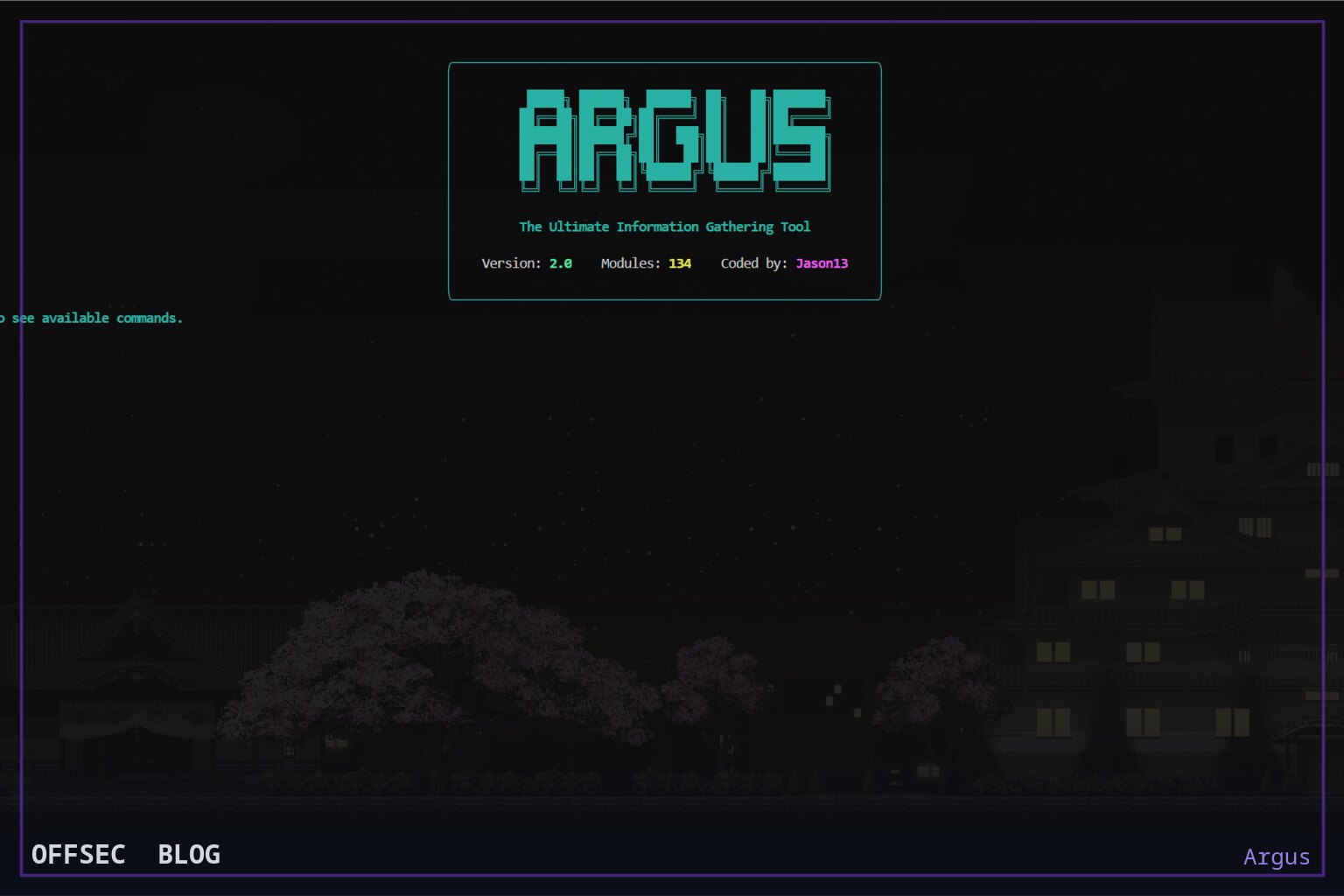
Argus packages DNS, SSL/TLS, web, and threat-intelligence reconnaissance into a single interactive Python CLI with 135 modules, built for professionals working within authorized assessments and lab environments.
| Tool | divinelabio/Argus — Python-based all-in-one information gathering and reconnaissance toolkit with an interactive module console |
| Category | Reconnaissance / OSINT framework |
| Primary Use | Consolidating DNS, WHOIS, SSL/TLS, web application, and threat-intel enumeration into one authorized assessment workflow via argus> use, set target, and run |
| Safe Use | Intended for educational and ethical use only, per the project's own disclaimer; users must have explicit permission before scanning target systems — suitable for penetration tests under contract, internal audits, and lab research |
| Telemetry Note | Generates observable network traffic per module — DNS queries, port scans, TLS handshakes, crawls, and lookups against Shodan, VirusTotal, and Censys APIs — leaving logs in target DNS servers, web access logs, WAF telemetry, and third-party API audit trails |
Argus, published under divinelabio/Argus and distributed as the argus-recon package on pip, is a Python-based reconnaissance framework that attempts to consolidate what would normally be a shelf full of single-purpose utilities into one interactive console. With roughly 4.2k stars on GitHub and an MIT license, the project describes itself as an all-in-one toolkit for information gathering, and the README backs that claim with a module catalog that runs to 135 entries across network infrastructure, web application analysis, and threat intelligence. The framing is explicitly professional: the authors position it as a tool for analysts who need consistent, repeatable assessment of networks and web applications rather than a script kiddie shortcut.
The most significant architectural decision, documented in the changelog, is the version 2.0 rewrite. Where the 1.x lineage used a crude number-based menu — pick a digit from 1 to 50 and go — the current release is a full command-line interface modeled loosely on the Metasploit-style interaction pattern that most operators already have in muscle memory. You launch argus (or python -m argus from a source checkout), list the catalog with modules or modules -d for verbose descriptions, select with use 42, configure with set target example.com and options like set threads 10, and execute with run. That shift from menu to console is what makes the scale of the catalog usable.
The command surface is broader than the basic select-and-run loop. search ssl filters the catalog by keyword, helpmod 42 pulls per-module documentation, and runall infra executes an entire category in one pass, which is the practical way to run the toolkit when scoping a large engagement. fav add 42 and runfav let you assemble a personal module set, last re-runs the previous module, and profile speed applies predefined configuration profiles. Output handling is built in rather than bolted on: viewout shows cached results, and grepout "192.168" greps across them — small ergonomics that matter when you are correlating findings across dozens of modules.
The 135 modules split into three clusters. The network and infrastructure block covers the usual DNS Records, WHOIS Lookup, TXT Records, Zone Transfer, and Reverse IP Lookup, but also reaches into more specialist territory like RPKI Route Validity, IRR Routing Registry Analyzer, BGP Route Analysis, ASN Lookup, and DNSSEC Check. There is clearly an interest in routing and resolver hygiene here — Recursive Nameserver Leak, DNS SLA Latency Monitor, DNS CAA Checker, and Network Certificate Inventory read like modules written for infrastructure audit work as much as offensive recon.
The web application block is where the toolkit gets dense. Alongside staples like CMS Detection, Technology Stack Detection, Directory Finder, Robots.txt Analyzer, and Crawler, you get purpose-built probes such as CORS Misconfiguration Scanner, Hidden Parameter Discovery, Clickjacking Test, WebSocket Endpoint Sniffer, GraphQL Introspection Probe, DOM Sink Scanner, and CSP Deep Analyzer. Notably, many of these — SSL Expiry Alert, SPF / DKIM / DMARC Validator, Privacy & GDPR Compliance, Security.txt Check — are as much continuous-monitoring checks as attack-surface mapping, which reinforces the dual-use, assessment-oriented character of the project.
The third cluster leans on external threat-intelligence APIs. Censys Reconnaissance, Shodan Reconnaissance, SSL Labs Report, VirusTotal Scan, CT Log Query, Breached Credentials Lookup, Malware & Phishing Check, and Data Leak Detection all consume third-party data, and the README documents API key configuration in config/settings.py or via environment variables such as SHODAN_API_KEY, VIRUSTOTAL_API_KEY, CENSYS_API_ID, CENSYS_API_SECRET, GOOGLE_API_KEY, and HIBP_API_KEY. Before a long session, show api_status tells you which integrations are actually live — worth checking first, since half of these modules silently degrade without credentials.
Installation flexibility is one of the project's stronger points. The zero-install path is a git clone followed by pip install -r requirements.txt and python -m argus; alternatively pip install argus-recon puts a global argus binary on your path. A Docker route is also documented, building argus-recon:latest and mounting a local results directory into the container — the sensible choice for keeping a recon environment isolated and disposable. An install.sh script exists for a fuller local setup. Note the README's clone URLs reference jasonxtn/argus, which appears to be the upstream author's handle, while the curated metadata points at divinelabio/Argus; verify which repository you are actually pulling from.
Internally, the configuration model is centralized in config/settings.py, covering request timeouts, retry logic, thread limits and concurrency, user agent strings and headers, logging levels, and export settings. Export to TXT, CSV, and JSON is a first-class feature, and multi-threading is advertised as a core improvement in 2.0. For operators, the configurable User-Agent and timeout behavior matters for both operational hygiene (don't hammer a client's assets with default settings) and for calibrating scans against fragile legacy targets during narrow test windows.
Two cautions are worth stating plainly. First, the module list includes aggressive entries — Open Ports Scan, Zone Transfer, SNMP Public Community Checker, Virtual Host Fuzzer, Rate-Limit & WAF Bypass Test — that touch third-party systems directly and can trip WAF rules or abuse detections. The README's own legal disclaimer is explicit: the tool is for educational and ethical use only, users bear sole responsibility, and you must have explicit permission before scanning anything you do not own. Second, runall combined with a broad target is a good way to generate a lot of traffic very quickly; scope discipline and thread limits exist for a reason.
From a defender's perspective, Argus is loud by design. Each module leaves a trail: DNS query volume against resolvers, connection logs from port and IP-range scanning, distinctive crawler traffic in web access logs, TLS handshake patterns, and — critically — authenticated queries against Shodan, Censys, and VirusTotal tied to whatever API account is configured. Blue teams watching for recon against their assets will see scanning and enumeration signatures, while the API integrations mean the tool's use is partially attributable through third-party audit trails. That makes it a useful teaching example for detection engineering as much as a red-team convenience.
Where Argus fits in a professional workflow is as a scoping and enrichment layer: run the infra category against an in-scope domain to build the asset picture, pull SSL Labs and CT Log data for certificate scope, check SPF / DKIM / DMARC posture, and then hand off to dedicated exploitation tooling for anything that needs depth. It is not a vulnerability scanner in the Nessus sense — most modules enumerate and characterize rather than validate exploitation — and treating its findings (a CORS flag from CORS Misconfiguration Scanner, a takeover candidate from Subdomain Takeover) as leads requiring manual verification is the correct operational posture. For authorized engagements, bug bounty programs with defined scope, and internal security audits, it is a genuinely broad consolidation play with a clean interface on top.
divinelabio/Argus.Educational analysis for authorized security professionals. Use only in controlled, authorized environments.


0 comentários:
Post a Comment
Note: Only a member of this blog may post a comment.