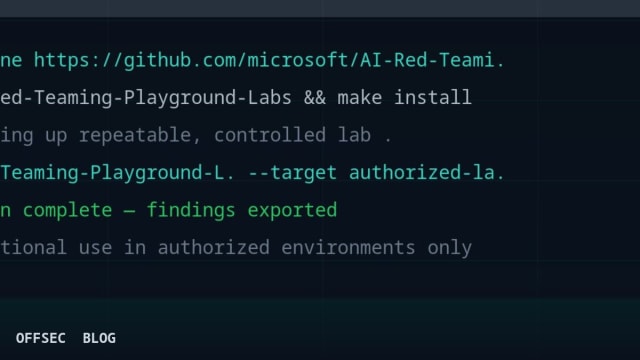
Microsoft's AI-Red-Teaming-Playground-Labs delivers self-contained lab environments and supporting infrastructure for running authorized AI red teaming exercises and training sessions.
| Tool | microsoft/AI-Red-Teaming-Playground-Labs — playground labs for AI red teaming trainings including infrastructure |
| Primary Use | Standing up repeatable, controlled lab exercises for practicing AI red teaming techniques such as prompt-injection in authorized training settings |
| Primary Use | Standing up repeatable, controlled lab exercises for practicing AI red teaming techniques such as prompt-injection in authorized training settings |
| Safe Use | Explicitly designed for authorized trainings and internal workshops; attack practice happens against lab infrastructure the operator owns and controls, never third-party systems or production AI services |
| Telemetry Note | Because exercises run entirely inside self-hosted lab infrastructure, blue teams can observe participant activity through lab-side logging of model requests, prompt content, and any supporting service logs the infrastructure exposes |
microsoft/AI-Red-Teaming-Playground-Labs is exactly what its name advertises: a collection of playground labs purpose-built for running AI red teaming trainings, complete with the underlying infrastructure needed to stand those labs up. At the time of writing the repository sits at roughly 2,081 stars, carries an MIT license, and is implemented primarily in TypeScript, which signals a web-delivered lab experience rather than a bag of Python attack scripts. Its topic tags — ai-red-team, ai-red-teaming, and prompt-injection — tell you the center of gravity: teaching people how adversarial techniques against AI systems manifest, in a sandbox where nothing real is at risk.
The value proposition deserves a moment of appreciation, because it addresses a real training bottleneck. AI red teaming is currently one of the most in-demand security skills, but you cannot ethically or legally practice it against production chatbots or third-party model APIs you have no authorization to test. A self-contained lab stack closes that gap: an instructor or self-directed learner deploys the labs on infrastructure they control, and every exercise runs against deliberately vulnerable targets spun up for the occasion. That framing is not incidental — it is the entire design premise of the project, and it keeps the work firmly in the authorized-assessment-and-education lane that professional AI red teaming occupies in the real world.
The TypeScript implementation is a meaningful architectural signal. Training labs for offensive AI work are usually delivered as interactive web applications — a chat interface backed by a deliberately flawed agent or LLM-powered service — and a TypeScript codebase fits that pattern closely. This also means the labs likely lean on the broader Node.js ecosystem, which matters for anyone planning to extend them: adding a new scenario means writing application code against the lab framework rather than bolting on external tooling. The MIT license removes any friction for organizations that want to fork the labs, customize scenarios for their own stack, or embed them into internal enablement programs.
The prompt-injection tag is the clearest indicator of the curriculum's spine. Prompt injection has become the canonical entry point for AI red team exercises because it demonstrates, in a single interaction, how untrusted input can steer a model's behavior — the conceptual descendant of classic injection classes like SQLi and XSS, but applied to natural-language surfaces. Labs structured around this technique typically walk participants through recognizing vulnerable patterns in tool-using or RAG-equipped agents, and then through the defensive counterpart: input filtering, output structured constraints, and privilege separation between what the model can read and what it can act on. Expect the labs to teach both halves of that loop, since a Microsoft-authored curriculum will emphasize measurement and mitigation alongside attack rehearsal.
The phrase "including infrastructure" in the repository description is easy to skim past but is arguably the differentiator. Anyone who has tried to run a hands-on security class knows the pain: provisioning targets, distributing environments, resetting state between cohorts, and keeping everything isolated from production networks. By shipping the infrastructure alongside the exercises, the project turns what would be a multi-day setup chore into a repeatable deployment. For a training lead, that repeatability is the whole game — you want every cohort to hit an identical, deterministic starting state, and you want to be able to tear it all down when the session ends so no deliberately vulnerable service lingers on your network.
From a defensive perspective, these labs are just as useful to blue teams as to red teams. Understanding how prompt injection and related AI abuse patterns actually look at the request level is a prerequisite for writing detections for them, and a lab environment is the only place you can generate that telemetry safely and at will. A SOC building monitoring for an organization's internal AI tooling can run the lab exercises, capture the resulting logs from the lab-side services, and use that corpus to tune alerts for anomalous prompt patterns, tool-invocation abuse, or attempts to manipulate retrieval-augmented pipelines. The fact that all of this happens on infrastructure the defender owns makes it a clean telemetry source with zero bystander risk.
Operating it responsibly comes down to scope discipline. The labs are deliberately vulnerable by design, which means they should never be exposed to the public internet or to shared corporate networks without access controls. Treat a deployed lab the way you would treat a deliberately vulnerable web application from any training suite: bound to an internal interface, behind authentication if multiple people need access, and destroyed or rebuilt between sessions. Because the repository is MIT-licensed and open, there is no licensing ambiguity about running it inside an enterprise, but the operational hygiene around standing up intentionally weak targets remains the operator's responsibility.
There are honest limitations to note, and they stem from what the repository metadata does and does not tell us. The README content was not available in the source material for this analysis, so specifics — the exact number of labs, the deployment mechanism, whether scenarios target retrieval pipelines, agent tool use, or both — must be verified directly in the repository rather than assumed. What the metadata does establish is the project's identity, its corporate stewardship under Microsoft, its topic focus, its language, and its community traction. That is enough to situate it, but a prospective adopter should read the lab documentation before planning a course around it.
Where this fits in the broader landscape is also worth stating plainly. Microsoft has been one of the most visible institutional voices pushing AI red teaming as a formal discipline, and this project reads as the enablement arm of that position — the thing you hand to practitioners so the discipline can actually be taught. For security engineers looking to build AI assessment competence, for training leads who need a turnkey workshop stack, and for defenders who want realistic AI-attack telemetry to tune against, AI-Red-Teaming-Playground-Labs lowers the barrier to entry considerably, provided it is deployed and exercised strictly within authorized, self-owned environments.
microsoft/AI-Red-Teaming-Playground-Labs.Educational analysis for authorized security professionals. Use only in controlled, authorized environments.
Related coverage


0 comentários:
Post a Comment
Note: Only a member of this blog may post a comment.