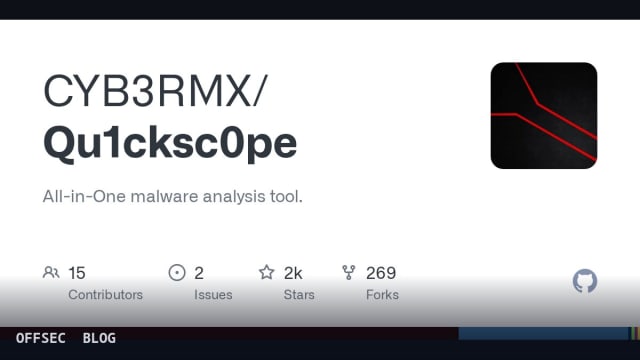
Qu1cksc0pe is an all-in-one static malware analysis framework that triages exe, elf, apk and osx samples for threat analysts working in authorized labs.
| Tool | CYB3RMX/Qu1cksc0pe — all-in-one static malware analysis and threat categorization tool (GPL-3.0, ~2057 stars) |
| Category | Malware analysis / static analysis framework |
| Primary Use | Triage of suspicious exe, elf, apk and osx binaries in a sandbox or analyst workstation, including ransomware and packer detection |
| Safe Use | Intended exclusively for authorized malware analysis: defensive research, incident response, detection engineering and controlled lab environments |
| Telemetry Note | Purely a defensive analysis utility; because it is signature-driven and static, its detections are local and leave no footprint on victim infrastructure — defenders care about it as an asset, not an indicator |
Qu1cksc0pe, published at CYB3RMX/Qu1cksc0pe, positions itself as an all-in-one malware analysis utility, and the repository's metadata tells you a great deal about how seriously it takes that claim. The primary language is listed as YARA, which is unusual and immediately signals the tool's detection backbone: rather than being a generic script wrapper, it leans on structured YARA rules to categorize samples. Combined with a python3 topic tag and broad platform coverage spanning windows, linux, osx and apk, this is a triage-first instrument aimed at analysts who need a fast, repeatable first pass over unknown binaries before committing to deeper manual reversing.
The scope of supported formats is the tool's clearest differentiator. Analysts regularly juggle separate utilities for exe inspection, elf disassembly preliminaries, apk unpacking and osx Mach-O review; Qu1cksc0pe folds these into one workflow, which matters in incident response scenarios where you never know what architecture the next suspicious artifact targets. The topic list explicitly includes suspicious-files and static-analysis, confirming that the tool operates on files at rest rather than instrumenting execution. That static-first philosophy keeps it usable on hardened analyst workstations without a full detonation sandbox.
Two capability areas deserve particular attention: ransomware and packer detection. Ransomware identification is called out as a first-class topic, suggesting the bundled rule sets include families and behavioral string markers relevant to extortion operations — a genuine time-saver when triaging a seized sample during an authorized incident response engagement. Packer detection is arguably even more valuable operationally, because knowing that a binary is packed redirects the entire analysis strategy: the analyst knows up front that raw strings output and naive signature matching will underreport, and that unpacking must precede family attribution.
The strings topic confirms that classical indicator extraction is part of the pipeline. For a triage tool, string analysis remains one of the highest-yield, lowest-cost techniques: embedded URLs, registry paths, mutex names, PDB fragments and debug artifacts frequently survive packing mistakes or shallow obfuscation. When Qu1cksc0pe surfaces such indicators, analysts can pivot to threat-intelligence enrichment — obviously with defanging discipline, converting any live hxxp:// style endpoints into reportable IOCs rather than clicking through to them.
An interesting and relatively modern addition is the presence of both mcp and mcp-server topics, indicating that Qu1cksc0pe exposes itself as a Model Context Protocol server. In practical terms, this means the tool's analysis functions can be invoked programmatically by LLM-driven assistants or automated analyst pipelines, turning what was traditionally an interactive CLI workflow into a composable service. For detection engineering teams, that opens the door to batch triage of sample queues where an orchestrating agent calls Qu1cksc0pe per artifact and synthesizes results — a pattern increasingly common in security operations automation.
The termux topic is a quietly practical touch. Termux support means the tool runs on Android devices themselves, which serves a niche but real audience: on-site responders, researchers in constrained environments, or analysts doing quick field checks on mobile-collected artifacts. It also reinforces the apk analysis capability — being able to inspect an Android sample on an Android device, in airplane mode, is a sensible containment posture for mobile malware triage. Cross-platform availability across desktop linux, windows and termux suggests the codebase avoids hard platform dependencies, consistent with a python3 implementation.
Licensing and community signals support adoption in professional settings. The repository is licensed under GPL-3.0, which permits free use and modification but requires derivative rule sets or forks to remain open if distributed — relevant for organizations considering embedding Qu1cksc0pe into internal tooling that might later be shared. With roughly 2057 stars at the time of this writing, the project has demonstrable traction in the malware-analysis community, which correlates with rule-set freshness: YARA rule quality decays quickly, and an active contributor base is the main defense against stale family coverage.
From an authorized-workflow perspective, Qu1cksc0pe slots in at the very front of the analysis pipeline. The typical progression runs: acquire sample safely, hash it, run static triage for format, packing and family hints, then decide whether deeper dynamic analysis in an isolated sandbox is warranted. Qu1cksc0pe compresses the third step. It is emphatically not a detonation platform, and professionals should treat its categorizations as hypotheses to confirm — string and rule matches are indicators, not verdicts, and sophisticated adversaries test against public rule sets. Corroborating its output with disassembly, sandbox observation and external intelligence remains standard due diligence.
For defenders and blue teams, the tool has a second-order value beyond direct sample analysis: understanding what Qu1cksc0pe detects tells you what adversaries know analysts will look for. Detection engineers can study which markers the tool keys on — mutexes, packer signatures, ransomware-note strings — and build telemetry around the same classes of indicators in their EDR stacks. The threat-analysis topic captures this dual role: the tool is both a consumer of threat knowledge and a source of structured detection ideas.
One caution for practitioners: the project README was not available at the time of this analysis, so the exact command syntax, rule-set update mechanism and output format should be verified directly from the repository before operational use. Standard hygiene applies regardless — run analysis tooling on dedicated, isolated workstations, keep samples in controlled directories, and never execute suspicious binaries outside a properly isolated environment. Within those constraints, Qu1cksc0pe's combination of multi-format coverage, YARA-driven categorization, ransomware and packer awareness, and modern mcp integration makes it a worthwhile front-line component in an authorized malware analysis toolkit.
CYB3RMX/Qu1cksc0pe.Educational analysis for authorized security professionals. Use only in controlled, authorized environments.
Related coverage


0 comentários:
Post a Comment
Note: Only a member of this blog may post a comment.