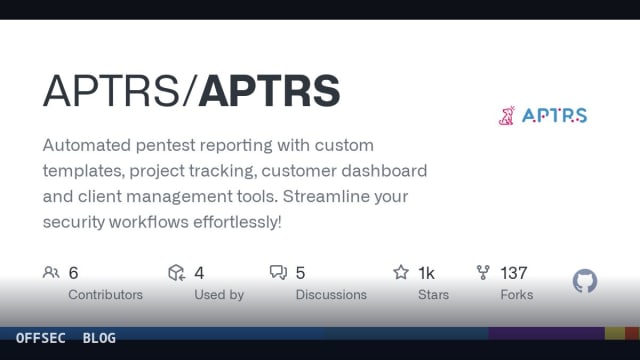
APTRS is a Python/Django platform that automates PDF, DOCX and Excel pentest report generation and manages projects, vulnerabilities and customers for authorized security teams.
| Tool | APTRS/APTRS — Automated Penetration Testing Reporting System built with Python, Django and TypeScript |
| Category | Reporting and engagement management platform |
| Primary Use | Generating PDF, DOCX and Excel pentest reports from customizable templates while tracking projects, vulnerabilities and retests |
| Safe Use | Intended for penetration testers and security organizations documenting authorized, contractually scoped assessments of systems they are permitted to test |
| Telemetry Note | Purely a documentation and workflow application; it touches no target infrastructure, so defenders would never observe it on the network — its footprint is entirely within the consulting side |
APTRS, short for Automated Penetration Testing Reporting System, attacks one of the least loved parts of the offensive security trade: the report. It is a Python and Django-based platform, with a TypeScript frontend per the repository metadata, that lets consultants generate PDF, DOCX and Excel deliverables directly instead of hand-assembling documents at the end of an engagement. The README frames it as a tool for penetration testers and security organizations, and that framing matters — everything the platform does sits firmly on the documentation and project-management side of an authorized assessment, not on the exploitation side.
The feature list reads like a condensed backlog of every pain point in a consultancy's reporting workflow. APTRS manages vulnerabilities as structured data, maintains a reusable vulnerability database, keeps all projects in one place, handles customers and companies, and tracks project status, schedules and retests. On top of that it offers dynamically composed proof-of-concept sections, descriptions and recommendations inside the generated reports. The core insight is that findings should live in a database, not in a Word file, so that the same vulnerability knowledge compounds across engagements instead of being retyped each time.
One of the more interesting architectural choices is template flexibility. Reports can be built from custom Docx templates or from HTML/CSS, and the README emphasizes that both PDF and DOCX templates are easily customized. This matters operationally because consultancies live and die by branding and client-specific formatting requirements; a reporting tool that locks you into a fixed layout usually dies in the first sales meeting. By treating the template as a swappable artifact, APTRS separates the content model — vulnerabilities, projects, customers — from the presentation layer.
The customer-facing angle is also worth pausing on. APTRS ships a customer dashboard where clients can log in, view their projects and download reports themselves. That is a deliberate move toward making the platform a delivery portal rather than just an internal authoring tool, cutting out the email-a-zip-file step that still plagues many teams. For internal security organizations, the same mechanism doubles as a way to give stakeholders self-service visibility into remediation status and retest outcomes across their portfolio.
Deployment is container-first. The quick-install path is a familiar git clone of https://github.com/APTRS/APTRS, copying env.docker to .env, editing it, and running docker-compose up. The README attaches a warning to this section, telling users to review the documentation for security configuration of the ENV and alternative installation methods — an unusually candid acknowledgment that the defaults are for evaluation, not production. Anyone standing up APTRS for real client work should treat that warning as mandatory reading rather than a footnote.
That caution is reinforced by the live demo the project hosts at live.aptrs.com, which ships with default credentials (sourav.kalal@aptrs.com and a deliberately self-shaming password literal). The existence of a public demo is genuinely useful for evaluating the interface before committing, but it also telegraphs the obvious lesson: an APTRS instance aggregates your clients' vulnerability data, so hardened deployment, changed credentials and proper access control are not optional. The project's own Security section asks for responsible disclosure via its Security Policy, which is a healthy sign for a tool whose entire content is sensitive by definition.
The engineering hygiene visible in the README is above average for this category. Continuous integration covers Django builds, frontend test and build pipelines, Docker image builds, and publication to the GitHub Container Registry via ghcr-latest workflows. Code quality is tracked through Codacy and SonarCloud badges — including a dedicated vulnerabilities metric and security rating — and there is a CodeQL workflow for automated code scanning. For a tool that will hold confidential assessment data, the fact that static analysis and security posture are wired into CI is a meaningful trust signal, even if badges are not guarantees.
Version requirements are modest and clearly stated: Python 3.9+ on the backend and NodeJS 18+ for the frontend, with badges indicating support across osx, linux and windows. The MIT license and the contributor roster — maintained by Sourav Kalal with code contributions from DJ Scruggs, Alexandre ZANNI and Hitesh Patra — round out the picture of an actively maintained community project rather than a single-author experiment. At over a thousand stars and with topics like security-automation and pentest-report, it clearly addresses a felt need in the industry.
Where APTRS fits in an authorized workflow is straightforward: after testing is done and findings are validated, the consultant feeds structured vulnerability data and project metadata into the system, picks or customizes a template, and produces the client-facing deliverable. Nothing in the tool's documented feature set touches target systems, scans networks or executes payloads — it is the paperwork layer of the engagement. That makes it equally relevant to internal red and blue teams that need consistent, auditable records of findings and remediation over time.
From a defensive and operational perspective, there is little to critique in the concept and a few practical watch items in the implementation. The ENV configuration the README warns about deserves scrutiny before any production deployment, the customer dashboard should sit behind appropriate authentication hardening, and reports containing proof-of-concept details should be treated as sensitive documents in transit and at rest. Handled with that discipline, APTRS is a sensible piece of open-source infrastructure for any team that produces penetration test reports regularly and wants its findings to live somewhere more durable than a folder of docx files.
APTRS/APTRS.Educational analysis for authorized security professionals. Use only in controlled, authorized environments.
Related coverage


0 comentários:
Post a Comment
Note: Only a member of this blog may post a comment.