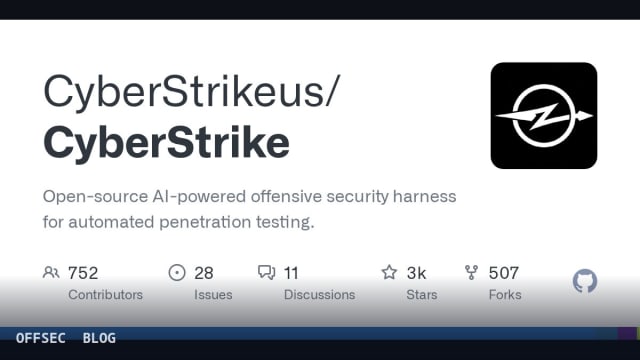
CyberStrike is an open-source AI agent harness that turns an existing LLM subscription into a methodology-driven penetration testing assistant for authorized assessments and security research.
| Tool | CyberStrikeus/CyberStrike — open-source AI-powered offensive security harness with 13+ specialized agents and 120+ OWASP test cases |
| Category | AI agent framework for penetration testing (TypeScript, AGPL-3.0) |
| Primary Use | Automating reconnaissance, vulnerability discovery, and reporting during authorized penetration tests and bug bounty work |
| Safe Use | Intended for penetration testers with written authorization, lab environments, CTF practice, and defensive research teams studying attacker methodology |
| Telemetry Note | The tool generates heavy, patterned HTTP traffic through its proxy testers and remote Bolt executors; defenders can observe its 3-gate baseline/attack/comparison request patterns as anomalous paired traffic in WAF and SIEM logs |
CyberStrike, hosted at CyberStrikeus/CyberStrike and distributed as the npm package @cyberstrike-io/cyberstrike, positions itself as the first open-source AI agent built specifically for offensive security work. Rather than acting as a thin wrapper around a chat model, it presents what the authors call an intelligence layer: a body of injected domain context — OWASP testing methodology, vulnerability patterns, and tool orchestration logic — that conditions whatever model you connect it to into a security-specialist agent. The repository has accumulated roughly 2,700 stars, is written in TypeScript, and is licensed under AGPL-3.0, which matters for organizations considering embedding or extending it in commercial pipelines.
The onboarding story is deliberately minimal. A single command — npm i -g @cyberstrike-io/cyberstrike@latest && cyberstrike — installs globally and drops you into a terminal UI that asks for your LLM provider and API key on first run. From there the operator describes the target scope and the agent handles reconnaissance, vulnerability discovery, exploitation, and reporting autonomously. Notably, the project leans on existing subscriptions: if you already pay for Claude Code, OpenAI, or GitHub Copilot, the intelligence layer rides on top of that plan without separate API spend, a cost model that will appeal to independent consultants and small assessment teams.
Provider support is the broadest I have seen in this category. CyberStrike ships 23 bundled SDK providers and reaches 150+ providers and 5,300+ models through the models.dev catalog, spanning Anthropic, OpenAI, Google Gemini, Amazon Bedrock, Azure OpenAI, Google Vertex AI, xAI, Groq, Mistral, DeepSeek, Cerebras, Cohere, OpenRouter, and Together AI. For teams with data-residency or air-gap constraints, fully offline operation is supported via Ollama, LM Studio, or vLLM with local GGUF or HuggingFace models, meaning nothing leaves the assessment machine. Any OpenAI-compatible endpoint also works, so private gateways are fair game.
The intelligence layer itself does four concrete things according to the README. Schema normalization forces structured output regardless of provider quirks, which is the unglamorous engineering that makes multi-provider agents viable. A context guard prevents prompt leakage and keeps the agent anchored to the current test phase rather than drifting into chat-style speculation. Provider auto-detection identifies the endpoint and configures the optimal transport. And tool orchestration chains security tools based on live findings instead of fixed scripts — the difference between an agent that reacts to what it observes and a cron job with a model attached.
The agent roster is where the methodology claims become concrete. Switching with Tab, the operator moves between the general-purpose cyberstrike agent (reconnaissance through reporting), a web-application agent that follows OWASP WSTG, a mobile-application agent that uses Frida and Objection under MASTG/MASVS, a cloud-security agent covering AWS, Azure, and GCP IAM misconfigurations against CIS benchmarks, and an internal-network agent focused on Active Directory, Kerberos abuse, lateral movement, and pivoting. Each agent carries its own domain methodology rather than sharing one generic prompt, which is the architectural decision that most distinguishes this from commodity LLM wrappers.
The proxy-tester subsystem deserves particular attention from a quality standpoint. Eight specialized testers run automatically against intercepted traffic: IDOR, Authorization Bypass, Mass Assignment, Injection (SQL, command, LDAP, template), Authentication, Business Logic (price manipulation, race conditions, workflow bypass), SSRF, and File Attacks (path traversal, unrestricted upload). For bug bounty hunters and web assessment teams, this maps almost one-to-one onto the finding categories that dominate modern payouts, and automating the first pass over a proxied session is a legitimate productivity multiplier.
What impressed me most in the README is the epistemic discipline around confirmation. Each tester follows a 3-gate protocol: execute a baseline request, execute the attack, compare responses. A finding is reported only when there is a measurable, reproducible difference — never on model speculation — and duplicate findings sharing the same endpoint and attack vector are suppressed across the session. This directly attacks the false-positive problem that plagues LLM-driven security tooling, where a confident model hallucinates a vulnerability and a human burns an hour verifying it. The deduplication logic also means long sessions produce cleaner reports rather than accumulating noise.
Remote execution is handled by Bolt, a companion component you deploy on one or many remote servers, paired via Ed25519 keys and controlled from the local terminal. A single CyberStrike instance can orchestrate dozens of Bolt servers, each with its own toolkit, network position, and attack-surface access — effectively a lightweight C2-style topology for your own authorized infrastructure. In practice this lets an assessment team keep heavyweight tooling on a cloud box positioned inside the test network segment while the operator works from anywhere, which mirrors how mature red teams already segment their operations.
Beyond the built-in 56+ tools, the project embraces the MCP ecosystem with 176+ MCP tools available, and the marketing copy cites 7,600+ security skills and 120+ OWASP test cases overall. A web UI with remote access is available for operators who prefer a browser console over the TUI, and the docs live at docs.cyberstrike.io. The README is translated into more than two dozen languages, and there is an active Discord, both signals of a project investing in community rather than shipping a portfolio piece.
From a defensive perspective, CyberStrike is worth studying even if you never run it offensively. Its traffic patterns are distinctive: the 3-gate protocol produces paired baseline/attack requests against the same endpoints, and the proxy testers generate broad, systematic probing across input vectors. Blue teams can encode exactly those paired-request signatures into WAF and SIEM detection rules, and purple teams can use the tool in lab environments to generate realistic, methodology-driven attack traffic for detection engineering. The tool's insistence on reproducible differences also makes its findings well-suited as structured input to vulnerability management workflows.
Caveats before adoption: this is offensive tooling, and everything here presumes written authorization, defined scope, and a proper rules-of-engagement document. The AGPL-3.0 license has implications for anyone bundling it into proprietary offerings. And as with any autonomous agent, human review of findings before client delivery remains non-negotiable — the 3-gate protocol reduces speculation, but the operator owns the report. Used within those boundaries, CyberStrike is one of the more thoughtfully architected entries in the rapidly crowding AI-pentest space, and its provider-agnostic, offline-capable design makes it unusually practical for real assessment work.
CyberStrikeus/CyberStrike.Educational analysis for authorized security professionals. Use only in controlled, authorized environments.
Related coverage


0 comentários:
Post a Comment
Note: Only a member of this blog may post a comment.