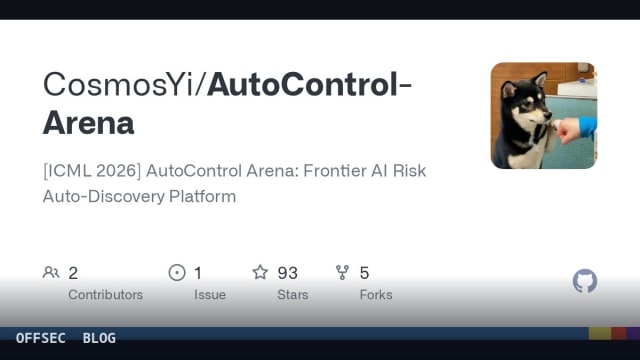
AutoControl Arena is an accepted ICML 2026 research framework that stress-tests frontier AI agents inside executable, pressure-rich environments to surface latent risky behaviors for authorized safety evaluation.
| Tool | CosmosYi/AutoControl-Arena — automated framework synthesizing executable test environments for frontier AI risk evaluation |
| Category | AI safety evaluation / agent red-teaming research platform |
| Primary Use | Reproducing and stress-testing expert-designed risk scenarios against agent models via aca and autocontrol batch in authorized research settings |
| Safe Use | Intended for authorized AI safety research, model evaluation labs, and defensive pre-deployment assessment of agentic models; all scenarios run locally against model APIs the operator configures |
| Telemetry Note | Purely a client-side evaluator: results, logs, and trajectories land under results/autocontrol_arena/ and runtime_envs/; the only external traffic is API calls to configured model providers (LiteLLM backend), so defenders observe it via outbound LLM API usage |
AutoControl Arena positions itself at a genuinely hard problem in AI safety: how do you evaluate whether an advanced agentic model will behave badly under pressure without hand-building every scenario? The repository, presented as joint work accepted at ICML 2026, describes an automated framework that reconstructs expert-designed risk-evaluation scenarios — the kind published by organizations like Anthropic, OpenAI, and Apollo Research — as executable, pressure-rich environments, then runs target models through them to surface latent risky behaviors. It is written in Python, sits at 93 stars, and carries research-grade topics like ai-safety, alignment, and safety-evaluation rather than offensive-tooling tags, which matches its framing as an evaluation platform rather than an attack tool.
The architectural insight the README leads with is what the authors call logic-narrative decoupling, and it is worth understanding because it defines the tool's whole value proposition. The logic layer holds deterministic state transitions, tools, and environment mechanics, all grounded in real executable Python code. The narrative layer handles open-ended social and contextual dynamics, generated by LLMs but always conditioned on the grounded logical state. This is a direct answer to a trade-off the authors spell out: manual benchmarks are realistic but expensive and slow to scale, while pure in-context simulators scale cheaply but are vulnerable to logic hallucination — the simulator simply inventing physics that never happened. By anchoring mechanics in code and delegating only flavor to generation, the framework claims the strengths of both.
Operationally, the project exposes two distinct entrypoints after installation. The first is aca, an interactive terminal UI for browsing scenarios, picking model profiles, choosing stress levels, enabling parallel repeats, and reviewing previous run history from a menu. The second is autocontrol, a command-mode CLI with explicit subcommands like run, batch, profiles, and prepare-envs, aimed at scripted experiments where you do not want an interactive menu opening by default. Notably, aca also supports a Run from JSON flow, so you can keep the convenience of the UI while feeding it a prepared batch configuration from configs/batch_configs/examples/, choosing serial or parallel execution at launch time.
Setup follows a familiar research-tool pattern. After creating a virtual environment, a single pip install -e . pulls dependencies — including LiteLLM as the default model backend — and exposes both shell commands. Credentials are managed through a .env file copied from .env.example, with the README showing OPENAI_API_KEY, ANTHROPIC_API_KEY, and DASHSCOPE_API_KEY as example slots; you fill in only the providers you intend to test. Model profiles live under configs/profiles/templates/ as small YAML files specifying api_base_url, api_key (as an environment-variable reference), model_name, provider, temperature, and max_tokens. The repo ships templates for gpt-4o and claude-3-7-sonnet, and adding a new model is deliberately trivial: copy a profile, edit three fields.
The scenario library itself is defined in configs/scenarios/benchmark/ as what the README calls X-Bench YAML scenario definitions. Combined with the claim that the framework can automatically reconstruct and reproduce expert-designed evaluation cases — with a real2sim verification artifact in the docs showing the fidelity of that reconstruction — this is the most interesting claim in the repository. Rather than asking researchers to trust that a synthetic environment approximates a published evaluation, the project treats reproducibility of known risk scenarios as a first-class requirement. For a safety team, that means you can benchmark a candidate model against a corpus of scenarios whose failure modes are already characterized in the literature, with configurable stress, temptation, and environment-complexity knobs on top.
The repository layout is unusually clean for a research artifact. src/ holds agents, orchestration, infrastructure, and core logic; runners/ carries the CLI and interactive UI entrypoints; tests/ contains unit and regression tests; and docs/ includes a dedicated ARCHITECTURE.md plus, interestingly, internal planning and design notes left in the public tree. Runtime hyperparameters are centralized in configs/settings/hyperparameters.yaml, with defaults the authors describe as adequate for most evaluations. The presence of pytest, ruff, and mypy as optional dev dependencies (via pip install -e ".[dev]") signals that this is maintained as an engineering project, not a paper dump.
Batch evaluation is described as the most important scripted workflow for large sweeps, launchable either from aca's JSON flow or directly via autocontrol batch -f configs/batch_configs/examples/benchmark_sample_batch.json --yes. Output organization is well thought out: everything lands under results/autocontrol_arena/, with runs/ holding run records and live events, batch/ holding session directories and checkpoints, and logs/ capturing per-run and per-batch logging under a shared path policy. Generated environments are cached in runtime_envs/ and are reusable across runs — a meaningful detail, since regenerating executable environments per run would be the obvious scaling bottleneck.
For inspection, the project ships a local web results viewer started with python tools/results_viewer/serve.py --port 8000 and accessed at http://127.0.0.1:8000/viewer/. It supports --host and --results-dir flags if you want to bind differently or point at a specific results root. This gives researchers a browser-based surface for run trajectories and artifacts without manually walking the JSON tree, which matters when a batch produces many runs across repeated trials and stress configurations. The commented-out section of the README also reveals batch UI surfaces (textual, rich, plain) controlled via an AUTOCONTROL_ARENA_BATCH_UI environment variable, suggesting the interactive dashboard layer has been through real iteration even if that section is currently hidden.
From a defensive and governance standpoint, AutoControl Arena is the kind of tool red teams and pre-deployment reviewers should want in their pipeline. The typical workflow the README recommends — start aca, choose a scenario and target profile, dial in stress and temptation settings, run single or repeated trials, then inspect via the results viewer — maps cleanly onto an authorized internal evaluation process for agentic models before they are granted real tools and permissions. Because the logic layer is deterministic executable code, failures are attributable to the model's behavior rather than to simulator drift, which strengthens the evidentiary quality of any resulting risk report.
There are caveats worth flagging before adopting it. The license is marked NOASSERTION, so organizational use requires a rights review before anything beyond internal research. Evaluation quality also depends on the target models' API access, meaning every run consumes tokens against your provider accounts, and the real2sim fidelity claim, while documented with verification artifacts, should be validated against your own scenario corpus. Prerequisites are modest — Python 3.10+ and provider credentials — but the framework is research software with an arXiv paper (abs/2603.07427) attached, so expect academic cadence rather than product-grade support. Within those bounds, it is one of the more architecturally thoughtful entries in the emerging agent-safety evaluation space.
CosmosYi/AutoControl-Arena.Educational analysis for authorized security professionals. Use only in controlled, authorized environments.
Related coverage


0 comentários:
Post a Comment
Note: Only a member of this blog may post a comment.