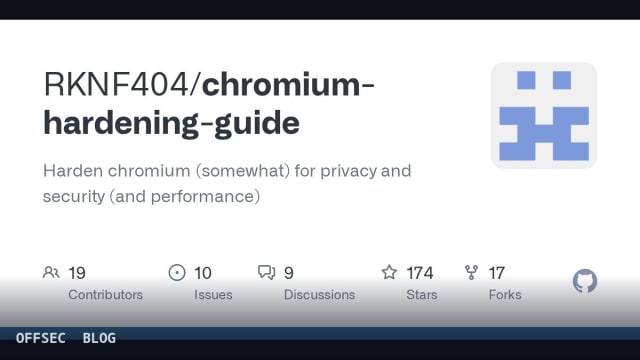
A community-maintained hardening guide that applies Vanadium- and Trivalent-derived chromium flags and toggles to reduce browser attack surface for privacy-conscious, authorized users.
| Tool | RKNF404/chromium-hardening-guide — configuration guide for hardening (theoretically) any Chromium-based browser |
| Category | Browser hardening / security configuration documentation |
| Primary Use | Applying curated chromium flags, toggles, and settings to shrink attack surface and improve privacy on workstations used in authorized security work |
| Safe Use | Purely defensive: hardening your own browsers and, in authorized engagements, advising clients on endpoint browser baselines |
| Telemetry Note | Nothing to observe — it is documentation and configuration; changes it recommends reduce, not generate, browser telemetry and fingerprinting surface |
RKNF404/chromium-hardening-guide is not a scanner, an exploit framework, or even a traditional executable — it is a curated hardening guide that the author explicitly scopes to "(theoretically) any Chromium browser." That framing matters more than it first appears: rather than shipping patched browser builds like the projects it draws from, it takes the configuration knowledge embedded in hardened forks and translates it into flags and toggles you can apply to the stock Chromium-based browser you already run. For security professionals, that makes it a reference artifact — a baseline you can diff your own or a client's browser configuration against during authorized assessments.
The README is refreshingly honest about its provenance. The author states plainly that "some of the flips and toggles come from other projects such as Vanadium or Trivalent." Vanadium is the hardened Chromium build maintained by the GrapheneOS project, and Trivalent is secureblue's hardened fork. Both are widely respected in the privacy and security community for aggressive, well-reasoned attack-surface reduction — Vanadium in particular has driven upstream changes around site isolation, memory tagging, and state partitioning. What this guide does is extract the policy decisions those projects bake into compiled builds and express them as user-applicable configuration, which is a genuinely useful intermediate layer between stock browsers and full fork adoption.
Structurally, the repository is a documentation project rather than a codebase, even though GitHub classifies its primary language as Python — likely because the build tooling or helper scripts that render the guide are written in it. The actual content lives on a GitHub Pages site the README links as the "main page," meaning the repo functions as the source of truth and the published site as the consumption surface. This two-tier layout is worth noting operationally: when you cite the guide in a client deliverable, cite the repository state at a specific commit, not the live site, since the hosted version can drift as recommendations evolve.
The guide's scope — "theoretically any Chromium browser" — deserves scrutiny. Chromium-derived browsers (Chrome, Edge, Brave, Chromium itself, and countless others) share the same underlying flags system, typically surfaced through chrome://flags or command-line switches, plus enterprise policy mechanisms like managed preferences. A toggle that works on one Chromium build usually transfers to another, but not always: forks strip or rename flags, and some hardening measures depend on compile-time options that a downstream vendor may have disabled. The word "theoretically" in the README is doing real work here, and experienced operators should treat each recommendation as something to verify against the specific browser build in question rather than apply blindly.
What can we infer about the content itself? The topics attached to the repository — browser-security, browser-settings, browserconfig, browsers, chromium, chromium-browser, security — confirm the configuration-baseline character. Given the Vanadium and Trivalent lineage, the recommendations almost certainly cluster around the areas those projects prioritize: reducing or disabling high-risk web platform features, tightening sandboxing and isolation behavior, limiting fingerprinting and cross-site tracking surfaces, and pruning background functionality that widens the attack surface without corresponding user value. Performance is explicitly in scope too, per the repository's own description mentioning it alongside privacy and security — a sensible stance, since hardening guides that destroy usability get abandoned by users.
The maintenance posture is modest but real. The repository sits at 174 stars, which is respectable traction for a pure documentation project with no installable artifact, and it is licensed under the MS-PL (Microsoft Public License), a permissive, weakly copyleft-style license that permits reuse of the guide's content with attribution. The README actively solicits feedback through GitHub discussions for troubleshooting and general questions, and issues for suggestions — a healthy intake model for configuration guidance, where browser releases regularly deprecate flags and invalidate old advice. The author also offers direct Discord contact for those who have it, indicating an individual-maintained rather than organizational project.
For defenders and authorized security teams, the practical application is twofold. First, as a personal baseline: analysts, red teamers, and incident responders spend their days interacting with hostile web content, and a hardened daily-driver browser is cheap risk reduction — arguably the cheapest available. The browser remains one of the most exposed components on any workstation, and it processes attacker-controlled input by design. Second, as a consulting artifact: when an engagement includes endpoint hardening recommendations, a sourced, community-reviewed guide like this provides defensible citations for browser policy decisions, especially where the client cannot adopt a full hardened fork for compatibility or management reasons.
It is equally important to calibrate expectations. A configuration guide cannot patch vulnerabilities, cannot substitute for a browser maintained with current security updates, and cannot protect against a compromise at the OS or extension layer. The guide's own parenthetical — harden chromium "(somewhat)" — signals that the author understands the limits of configuration-level hardening against a threat model that includes sandbox escapes and supply-chain compromise. Treat it as one layer in a defense-in-depth stack: keep the browser auto-updated, run it on a patched OS, restrict extensions, and use a separate dedicated VM or disposable environment for genuinely untrusted browsing rather than trusting flags alone.
Verification discipline is the other half of responsible use. Because flags and toggles inherit their rationale from Vanadium and Trivalent, the serious operator should trace individual recommendations back to those upstream projects, where the reasoning, changelogs, and sometimes lengthy discussions justify each compile-time or runtime decision. This is exactly the kind of provenance check that separates a professional hardening engagement from cargo-cult configuration copying, and the guide's explicit attribution makes that tracing feasible. Where a toggle's purpose is unclear, test it in a lab VM before rolling it into a baseline for others.
In sum, RKNF404/chromium-hardening-guide occupies a useful niche: it democratizes the hardening knowledge concentrated in GrapheneOS's Vanadium and secureblue's Trivalent for anyone running stock Chromium-family browsers, with an accessible hosted guide, an issue-driven feedback loop, and permissive MS-PL licensing. It is not a tool you run; it is a checklist of judgment calls you evaluate. For authorized professionals building defensible browser baselines — their own or a client's — that is precisely the kind of resource worth keeping bookmarked and re-reviewing after every major browser release.
RKNF404/chromium-hardening-guide.Educational analysis for authorized security professionals. Use only in controlled, authorized environments.
Related coverage


0 comentários:
Post a Comment
Note: Only a member of this blog may post a comment.