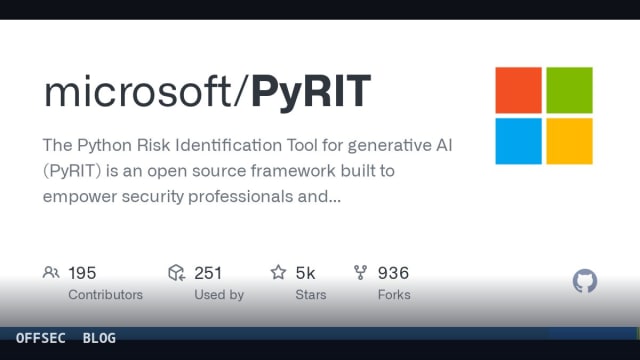
Microsoft's PyRIT is an open-source Python framework that automates red-teaming and risk identification for generative AI systems, built for authorized AI security assessments.
| Tool | microsoft/PyRIT — open-source Python framework for identifying risks in generative AI systems |
| Category | AI red teaming / security automation framework |
| Primary Use | Automating risk identification and adversarial testing of generative AI applications during authorized security assessments |
| Safe Use | Intended for authorized AI red-teaming engagements, internal responsible-AI evaluations, and defensive research on systems you own or are contracted to test |
| Telemetry Note | As an assessment framework rather than malware, PyRIT generates high volumes of adversarial prompts against the target endpoint; defenders can observe unusual prompt patterns and rate anomalies in LLM application logs |
PyRIT, hosted at microsoft/PyRIT, is Microsoft's open-source answer to a problem that conventional security tooling handles poorly: how do you systematically probe a generative AI system for the ways it can misbehave? The repository's own topic tags — ai-red-team, generative-ai, red-team-tools, and responsible-ai — frame the project precisely. It is a Python framework for automating the adversarial testing of AI systems, positioned squarely within Microsoft's broader responsible-AI engineering practice rather than as an offensive weapon. At roughly 4,500 stars and released under the permissive MIT license, it has become one of the reference projects in the emerging AI red-teaming niche.
The timing matters. Traditional vulnerability scanners and fuzzers operate against well-defined interfaces with well-defined failure modes — a crash, a memory disclosure, an authentication bypass. generative AI systems fail differently: they can produce harmful content, leak information embedded in their training or retrieval corpora, or be manipulated through carefully phrased prompts into violating their own usage policies. Human red teamers can explore these failure surfaces, but they do not scale. A framework like PyRIT exists to close that gap, converting what would be manual, artisanal probing into a repeatable, automated pipeline that an authorized assessor can run consistently across releases of a model or an application.
Architecturally, the README for this snapshot is sparse, so the analysis here leans on what the repository metadata establishes directly. The project is written entirely in Python, which is the pragmatic choice for this problem space: the ecosystem around model APIs, tokenization, and evaluation tooling is Python-first, and any team building AI systems is almost certainly already operating in that runtime. The MIT license is worth noting for enterprise adoption — security and responsible-AI teams can vendor the framework into internal tooling without licensing friction, which is often the deciding factor for whether an assessment tool actually gets deployed inside a large organization.
The ai-red-team and red-team-tools topics sit alongside responsible-ai, and that juxtaposition is the key to reading this project correctly. This is not tooling built to attack third-party AI services; it is tooling built by a vendor that ships its own AI products and needs to find their weaknesses before adversaries and misusers do. The workflow implied by the framework is pre-deployment and pre-release: you point it at the AI system you are developing or are contractually authorized to assess, and it enumerates risk categories and stress-tests the system's guardrails against them. That is the same discipline network security learned decades ago with fuzzers and scanners — automate the adversarial search so humans can focus on interpreting results.
For an operator, the practical value of a framework like PyRIT over ad-hoc scripting is consistency and coverage. One-off red-teaming scripts tend to test whatever the author thought of that morning; a maintained framework encodes a broader taxonomy of risk and a systematic way to iterate over it, and it benefits from community contributions that continuously expand the attack surface it exercises. Because the project is public on GitHub with a substantial star count, practitioners can also audit exactly what the tool does before running it against any environment — a non-trivial property when the tooling itself will be sending crafted adversarial input to systems you care about. Reviewing the code and the default configuration before an engagement is basic operational hygiene.
Where does this fit in an authorized workflow? Realistically, at two points in the AI development lifecycle. First, during development, as a regression gate: run the risk-identification suite against each model or application change and diff the results, so newly introduced guardrail weaknesses surface immediately. Second, during formal assessments, where an authorized red team uses the framework to enumerate the ways an AI application can be induced to violate its security, safety, or privacy requirements before it ships. In both cases the operator's skill is not in the individual prompts the framework generates — it is in scoping the assessment, choosing the risk categories relevant to the deployment context, and triaging the outputs into findings that matter.
Defenders should understand this class of tooling even if they never run it, because it shapes what AI-facing telemetry should capture. An automated red-teaming framework produces volume: many requests, patterned adversarial input, iteration against the same endpoints from the same source. If your LLM-backed application logs only successful transactions, you are blind to exactly the activity that reveals both automated testing and, later, real adversarial probing. Instrumentation that records prompt throughput, source attribution, and policy-violation flags turns the existence of tools like PyRIT from a threat into a detection opportunity.
There are honest caveats. With no README content in this snapshot, this analysis cannot confirm specific interfaces, supported model providers, or current capabilities, and interested readers should verify details directly against the repository before committing to it. Automation also does not replace judgment: automated risk identification finds the failure modes it was designed to look for, and novel misuse of an AI system will still require creative human analysis. What PyRIT represents is the industrialization of a discipline that is barely two years old — the recognition that securing generative AI requires the same automated, repeatable adversarial testing that every other layer of the stack already receives, done under authorization, in service of systems that fail safely.
microsoft/PyRIT.Educational analysis for authorized security professionals. Use only in controlled, authorized environments.
Related coverage


0 comentários:
Post a Comment
Note: Only a member of this blog may post a comment.