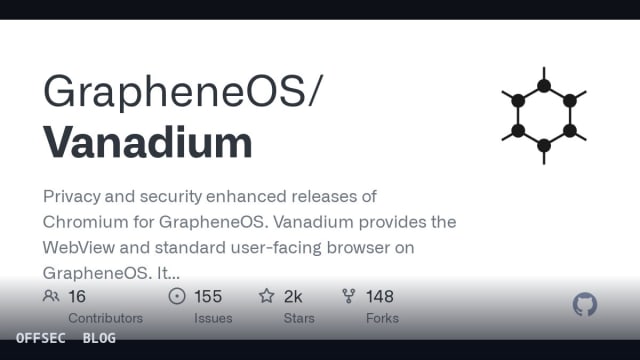
Vanadium is a privacy and security hardened variant of Chromium that serves as both the default browser and the system WebView on GrapheneOS, distributing hardening across the OS layer rather than the browser alone.
| Tool | GrapheneOS/Vanadium — privacy and security hardened releases of Chromium providing the WebView and default browser for GrapheneOS |
| Category | Hardened browser / mobile OS component (defensive security) |
| Primary Use | Providing a hardened Chromium-based browser and system WebView for privacy-focused Android deployments on GrapheneOS |
| Safe Use | Purely defensive tooling: used by security-conscious professionals, researchers studying browser hardening, and authorized testers documenting mobile security baselines in their own labs |
| Telemetry Note | Vanadium is a defensive hardening project, not an attack tool; from a defender's perspective its presence simply indicates a GrapheneOS device, and its design reduces rather than generates telemetry |
Vanadium occupies an unusual niche in the security tooling landscape because it is not an offensive tool at all — it is a defensive engineering artifact, a privacy and security hardened variant of Chromium that ships as both the standard browser and the system WebView for GrapheneOS. For readers who spend their days in reconnaissance frameworks and exploit tooling, projects like this are worth studying closely: they represent the exact class of target hardening that changes attacker economics on mobile platforms. Understanding how a project like Vanadium is architected tells you a great deal about what a well-resourced defensive posture looks like at the browser layer.
The repository, GrapheneOS/Vanadium, lists a modest but substantial footprint of roughly 2199 stars, with Python as the primary repository language — consistent with a build-and-patch orchestration project rather than a fork containing full browser source. Its declared topics (android, browser, chromium, grapheneos, privacy, security, webview) frame it precisely: this is an Android platform component, not a general desktop browser distribution. The license field reads NOASSERTION, which is common for projects that aggregate upstream Chromium licensing rather than applying a single top-level license.
The README is short but dense with architectural intent. The central design decision it communicates is that Vanadium deliberately avoids reinventing hardening that the underlying operating system already provides. The document explicitly cites the example of memory allocation: GrapheneOS already ships a hardened malloc implementation, so Vanadium does not bundle its own replacement. This division of labor — OS-level primitives handled by the OS, browser-level behavior handled by the browser — is the project's defining characteristic and distinguishes it from portable hardened browsers that must carry their own mitigations because they cannot assume anything about the host platform.
That coupling buys something concrete, and the README states it plainly: because Vanadium can rely on GrapheneOS to fix compatibility problems in the operating system itself, it can deploy aggressive security features that would cause unacceptable breakage if shipped on other operating systems. In other words, the tight integration is not a convenience — it is an enabler for stricter defaults. Hardening measures that a cross-platform browser vendor must gate behind flags or ship watered down, Vanadium can enable outright, knowing that application compatibility issues can be resolved at the OS layer where the team controls both sides of the contract.
The dual role as browser and WebView matters more than it might first appear. On Android, the system WebView is the rendering engine embedded by countless third-party applications to display web content — login flows, help pages, in-app browsers. By hardening the WebView in addition to the standalone browser, GrapheneOS extends the hardened Chromium attack-surface reductions to a large fraction of web-facing code on the device, including code paths inside apps the user did not choose for their security properties. From a defensive analysis standpoint, this is one of the more systematic answers to the problem that per-app web content is otherwise a blind spot in mobile hardening.
For professionals evaluating the project, the README's references are the real substance. It points to three external resources: the official build documentation at grapheneos.org/build under the browser and webview section, the Vanadium section of the GrapheneOS features overview, and the web browsing section of the usage guide. Anyone assessing the actual hardening deltas — the specific flags, sandbox changes, and feature removals relative to upstream Chromium — will need to consult those documents, since the repository README intentionally stays at the architectural level. This is a common pattern for distribution-style projects where the repo holds the build machinery and the published documentation carries the policy detail.
In an authorized workflow, where does something like Vanadium fit? The most direct fit is as a baseline browsing environment on research devices used during engagements — a hardened client reduces the risk of an analyst's own browser becoming a liability while interacting with hostile content in a controlled lab. It is also a reference point for mobile security assessments: when documenting the security posture of Android fleets, understanding what GrapheneOS and Vanadium change relative to stock Android and stock Chromium provides a concrete upper bound on what mobile browser hardening can achieve. For teams building internal device standards, it is a useful benchmark even if the organization ultimately standardizes elsewhere.
The build process itself is documented upstream rather than in the repository. The README directs builders to the official GrapheneOS build documentation for the browser and WebView components, which means the project expects you to be building within the GrapheneOS ecosystem tooling rather than compiling Vanadium in isolation for arbitrary Android devices. This is consistent with the architecture: since the hardening depends on OS-level support such as the hardened allocator, a standalone build on an unmodified Android system would not reproduce the documented security properties. Anyone evaluating Vanadium should treat it as inseparable from its host OS.
There are practical caveats worth noting for operators. Because the repository is primarily build orchestration in Python around upstream Chromium, it tracks a fast-moving upstream: Chromium security releases are frequent, and the value of Vanadium depends on keeping pace with them. The project's integration model also means its guarantees do not transfer — porting the patches to another OS or a custom ROM without the underlying GrapheneOS primitives would produce something weaker than the documented feature set. The NOASSERTION license status is a further signal that downstream redistribution requires careful attention to the layered licensing inherited from Chromium and the GrapheneOS project.
From a pure documentation perspective, the README is honest about being a pointer rather than a manual, and that restraint is informative. It tells you the maintainers consider the hardening story to live at the platform level, documented holistically across the OS features and usage guides, rather than in a per-tool README. For an editorial assessment, that coherence — one team owning the OS, the allocator, the browser, and the WebView, with a single documentation corpus — is arguably the project's most interesting property, and one that few other hardened browser efforts can claim.
As an educational subject, Vanadium is a clean case study in layered defense: memory-safety mitigations at the allocator level, browser sandboxing and feature reduction at the Chromium level, and permission/persistence model hardening at the GrapheneOS level, each handled where it is cheapest and most effective. Security professionals who usually approach hardening from the attack side will find the repository a useful entry point into that layered model, with the upstream documentation providing the depth. It is defensive infrastructure in the most literal sense, and it rewards study for exactly that reason.
GrapheneOS/Vanadium.Educational analysis for authorized security professionals. Use only in controlled, authorized environments.
Related coverage


0 comentários:
Post a Comment
Note: Only a member of this blog may post a comment.