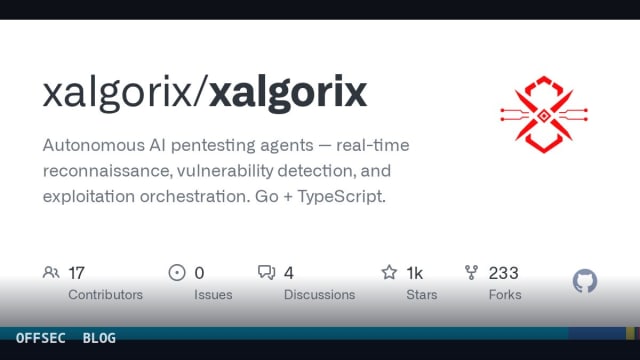
xalgorix is a self-hosted, Apache-2.0 AI pentesting platform where an autonomous LLM agent runs a full methodology and an independent verifier re-exploits findings for authorized assessments.
| Tool | xalgorix/xalgorix — self-hosted AI penetration testing platform with an autonomous LLM agent and independent finding verification |
| Category | Autonomous AI security testing / vulnerability assessment platform |
| Primary Use | Running a 22-phase pentest methodology against in-scope assets, with findings re-exploited by an independent verifier before reporting |
| Safe Use | For authorized penetration tests, bug bounty programs within scope, and vulnerability assessment of systems you own or have explicit written permission to test |
| Telemetry Note | As a scanner it generates heavy, signature-rich traffic from its embedded toolset (nmap, nuclei, ffuf, sqlmap, masscan); defenders will see recon and scanning patterns consistent with those tools, plus LLM API calls to the configured provider |
xalgorix positions itself around a sharp claim: most scanners detect, but xalgorix proves. The project, written in Go and TypeScript and licensed under Apache-2.0, is a self-hosted AI penetration testing platform that combines an autonomous LLM-driven agent with an independent verifier that re-exploits every finding before it reaches the report. The intent is to address the classic triage problem in vulnerability assessment: a pile of unverified, low-confidence findings that a human still has to validate. By making verification an architectural step rather than an optional review, the tool aims to hand operators proof instead of maybes. With close to a thousand stars on GitHub and an active release cadence, it sits squarely in the current wave of agent-driven offensive tooling.
The architecture, as the README reveals, is layered rather than monolithic. An autonomous LLM agent works through a comprehensive 22-phase testing methodology, orchestrating browser automation, terminal tooling, and a large embedded offensive-security stack. Behind it sits the verifier — a separate component that re-exploits each candidate finding before it is reported. This separation matters from a trust perspective: the finding generator and the finding prover are distinct, which reduces the likelihood that a hallucinated or context-dependent result survives to the final report. Everything runs on your infrastructure, and findings and reports stay local, which is a meaningful property for engagements with data-residency or confidentiality constraints.
The bring-your-own-model posture is one of the more operator-friendly design decisions. During setup with xalgorix --setup, you choose a provider, confirm a model, and supply an API key, which is stored privately in ~/.xalgorix.env with mode 0600. The README recommends a current frontier model with strong reasoning, long-context performance, and reliable tool calling, while noting that smaller or local models remain supported but may require more supervision during long autonomous scans. Fully local operation via Ollama needs no API key at all — a notable option for teams whose engagement rules prohibit sending target-derived data to third-party model providers. Provider and model settings can be changed at any time under Settings → LLM in the web dashboard.
Deployment flexibility is clearly a priority. Beyond the one-line install script, the project ships a Docker image with an extensive preinstalled toolset — nmap, nuclei, httpx, subfinder, katana, ffuf, gobuster, sqlmap, masscan, dalfox, feroxbuster, and more — with package managers (apt, go, cargo, pipx, npm) left available so the agent can auto-install anything missing at runtime. The image is published for both amd64 and arm64, and a docker-compose.yml handles port mapping and persistent storage. The dashboard runs locally on 127.0.0.1:9137, and a first-run random admin password is printed to the container logs unless you set XALGORIX_USERNAME and XALGORIX_PASSWORD yourself.
The Docker security posture deserves scrutiny, because the README is unusually candid about it. The recommended invocation uses --privileged, and the authors explain why: Docker's default sandbox drops capabilities such as NET_ADMIN and applies a seccomp filter, which breaks low-level tooling — iptables and route manipulation, ARP-based MITM, tun/tap VPN setups, ptrace-based debuggers, and masscan interface tuning. The container is meant to be treated as a disposable, network-isolated scanning sandbox running as root, with an explicit warning never to expose the dashboard publicly without authentication. A least-privilege alternative is offered: --cap-add=NET_ADMIN --cap-add=NET_RAW --cap-add=SYS_PTRACE --security-opt seccomp=unconfined. For professionals accustomed to hardening scanning infrastructure, this transparency is welcome, and the guidance to treat the container as disposable aligns with sensible lab practice.
Machine-to-machine access is handled with more care than many similar projects. Instead of reusing dashboard credentials, automation gets a dedicated Authorization: Bearer token via XALGORIX_API_TOKEN, or a comma-separated rotation set through XALGORIX_API_TOKENS. These tokens authorize only /api/* routes and the scan-event WebSocket — never the dashboard UI or operator-only settings routes — never create browser sessions, and never touch the dashboard login rate limiter. Tokens are matched against stored SHA-256 digests with constant-time comparison, which is the correct primitive for this comparison and an indicator that the authors have thought about token-extraction and timing side channels rather than treating auth as an afterthought.
The web workflow is built around live telemetry: scan events stream over a WebSocket, and the dashboard provides an overview view, scan detail, and findings management with CVSS scoring built in. Reporting is a first-class feature, with branded PDF report generation aimed at consulting deliverables, and integrations including AgentMail and Discord are listed in the overview. For a bug bounty or assessment workflow, the combination of live telemetry plus verified findings plus exportable reports covers most of the pipeline between scan start and client-facing output. The README's use-case framing is consistent throughout: authorized security testing, vulnerability assessment, and bug bounty workflows — with an explicit important note to use the tool only on systems you own or have explicit permission to test.
Beyond the scanning engine, the project ships a free GitHub App that comments a security review on every pull request — covering injection, broken auth and IDOR, SSRF, secrets, and unsafe patterns — updating in place on new commits and re-runnable with an @xalgorix review comment. No workflow file or API key is required. There is also a code-scanning mode that works without a running target at all, which extends the tool from network-facing assessment into static review territory. A managed Xalgorix Cloud offering runs the same engine without local install, with model, out-of-band callbacks, and scheduling handled for the user; the commercial tie-ins are prominent in the README but the self-hosted repo remains fully functional under Apache-2.0.
From a defensive perspective, xalgorix is a loud tool by design. Its traffic profile will reflect its underlying stack: high-rate reconnaissance from subfinder and masscan, template-driven probing from nuclei, directory brute forcing from ffuf and gobuster, and behavioral testing from sqlmap and dalfox. Blue teams running detection engineering labs will find it a useful generator of realistic, multi-tool scan telemetry for tuning WAF rules and rate-based alerts. The outbound LLM API calls to the configured provider are another observable — and another data-flow consideration when target-derived strings could transit a third-party model endpoint, reinforcing the value of the Ollama local option for sensitive engagements.
The licensing and project health signals are reasonable for adoption evaluation: Apache-2.0 permits commercial use and modification, the repo is bilingual in stack (Go backend, TypeScript frontend), and a build-from-source path exists via git clone and make build with Go 1.26+ and Node.js. The sponsor block — a residential proxy vendor with HTTP(S) and SOCKS5 support — reflects the tool's support for proxy protocols, which operators doing authorized region-behavior testing of their own applications may find relevant. As with any autonomous offensive agent, the operational rule is unchanged: scope it tightly, run it in an isolated sandbox, keep it pointed at assets you are contractually permitted to test, and treat its verified findings as the start of a professional report rather than the end of an assessment.
xalgorix/xalgorix.Educational analysis for authorized security professionals. Use only in controlled, authorized environments.
Related coverage


0 comentários:
Post a Comment
Note: Only a member of this blog may post a comment.