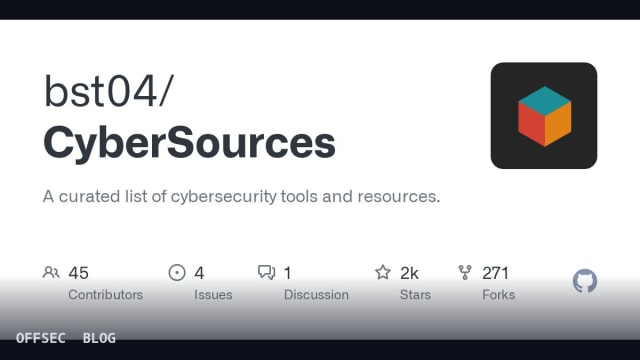
CyberSources is a curated, MIT-licensed directory that catalogs security tools, OSINT resources, and training materials for professionals building skills and workflows in authorized environments.
| Tool | bst04/CyberSources — a curated, community-driven index of cybersecurity tools and learning resources |
| Category | Curated resource directory / awesome-list |
| Primary Use | Discovering and cross-referencing tools for OSINT, pentesting, forensics, and defensive work during authorized assessments and study |
| Safe Use | Intended for authorized security professionals, students, and blue-team researchers assembling toolchains for sanctioned engagements, labs, and continuous learning |
| Telemetry Note | As a static Markdown directory it generates no network telemetry itself; the outbound links it aggregates are third-party services whose own logging applies |
Not every repository that matters in security is an executable. bst04/CyberSources is a curated directory — an awesome-list-style index hosted on GitHub under the MIT license — that consolidates tools, sites, and educational material across the full breadth of the discipline. With roughly 2,455 stars and topics tagged cybersecurity, resources, and tools, it has clearly resonated with practitioners who need a single jumping-off point rather than a browser full of stale bookmarks. The project frames itself as a hub for professionals, enthusiasts, and learners alike, and the structure of the README backs that claim up.
What the repository actually delivers is a heavily nested table of contents implemented in Markdown, with anchor links organizing hundreds of entries into thematic domains. The top-level split runs from OSINT through Pentesting, Cryptography, Forensic & Malware Analysis, Anonymity and Security Tools, Utility & Miscellaneous, AI Tools, Specialized Tools, and Hardware & Operating Systems, before closing with a large Learning & Training Resources section and a Social and Media block. Each of those categories is further subdivided — the OSINT branch alone breaks out into Username Search, Email Search, Phone Number Search, GEOINT, Photo/Images, and per-platform subpages for Instagram, LinkedIn, TikTok, Discord, Telegram, and X/Twitter, among others.
The pentest section follows the same pattern, enumerating Post Exploitation, Deobfuscators, Decompilers, Disassembler and debuggers, Web, Network, RFID, WiFi, Bluetooth, Reconnaissance, Bug Bounty, Binary Explotation, and CCTV. For an operator scoping an authorized engagement, this taxonomy is arguably more useful than a search engine: it maps capability areas rather than keywords, which makes it easier to notice a gap in your toolchain — realizing, for instance, that you have nothing queued for Steganalysis or Execution logging and tracing before a forensic engagement starts.
The individual entries are presented as two-column tables pairing a tool name and hyperlink with a one-line description. In the OSINT section, entries range from well-known staples like OSINT Framework, Maigret, NexFil, and Mitaka — a browser extension the README credits with easing OSINT search and scan workflows — to niche services like Pim Eyes for facial-recognition reverse image search and ClatScope, described as a 42-feature utility pulling geolocation, DNS, WHOIS, phone, email, and breach data. The mix of open-source GitHub projects and commercial or hosted web services is a deliberate editorial choice, and it is worth noting that the descriptions are the curators' own, not vendor-neutral guarantees.
A defensive reader will find the Forensic & Malware Analysis and Specialized Tools branches particularly relevant. The former covers Forensic tooling, Hex editors, execution logging and tracing, and Malware Analysis; the latter includes SIEM, Playbooks, Cryptocurrency tracing, and Cracking resources. Because many entries link out to live third-party services, the directory is best treated as a starting point for due diligence rather than an endorsement — verifying the provenance, license, and network behavior of anything you actually deploy remains the practitioner's responsibility, especially for tools that handle credential material or breach data.
The Anonymity and Security Tools section takes a defensive-personal angle, cataloging Password Managers, VPNs, Privacy and Anonymity utilities, and a Delete Your Trace subsection. Meanwhile the AI Tools branch — split into AI Programming and AI Cybersecurity — reflects how quickly the curators are cycling in current trends, something older static directories frequently fail to do. A Learning & Training Resources wing covering Courses, Certifications, Tutorials, practice webs, CTFs, learning paths, and project-based study makes the repo genuinely dual-purpose: half field reference, half syllabus.
Community infrastructure surrounds the list itself. The README promotes a Discord community the project says exceeds 2,000 members, a companion subreddit at r/cybersources, and a companion website linked from the banner. There is also a visible sponsor relationship with Hudson Rock, whose free infostealer-intelligence tools are promoted in the header — a normal open-source funding model, but one readers should mentally tag when evaluating the neutrality of any given inclusion. A Stars History, Collaborate, and Credits block closes the document, signaling that contributions and attribution are part of the maintenance model.
From an editorial-completeness standpoint, a few rough edges show. The table of contents contains typos such as Binary Explotation, and the OSINT table itself lists OSINT Framework twice — artifacts of a fast-moving, community-fed list rather than signs of abandonment. The absence of a populated language field in the repository metadata is expected, since the artifact is documentation, not code. What matters is freshness of the entries, and the presence of recently surfaced tools like DataSurgeon, Deep Dork Web, and Jev Social suggests the curators are actively reviewing pull requests.
Where this fits in an authorized workflow is straightforward: CyberSources is the pre-engagement map, not the weapon. An analyst planning a scoped assessment can walk the Reconnaissance and Bug Bounty sections to shortlist tooling, cross-check the Deobfuscators and Decompilers entries when triaging an artifact, or send junior team members down the Learning Path and CTFs subsections as structured onboarding. Blue teams get equal value from the SIEM, Playbooks, and threat-intelligence entries like The Threat Codex and AboutIntel, which the README describes as platforms for monitoring and prioritizing OSINT and threat intelligence.
The main caveat for professional use is that a directory of this scale cannot vouch for every destination, and several linked services — facial recognition lookups, breach aggregators, ransomware-leak crawlers like Breach House — sit in legally sensitive territory depending on jurisdiction and purpose. The responsible pattern is to route anything touching personal data through your engagement's authorization scope and data-handling policy, and to prefer the open-source GitHub entries, which can be audited before use. Used that way, CyberSources earns its stars: it is a well-organized, actively maintained index that turns the chaos of security tooling into something a professional can actually navigate.
bst04/CyberSources.Educational analysis for authorized security professionals. Use only in controlled, authorized environments.
Related coverage


0 comentários:
Post a Comment
Note: Only a member of this blog may post a comment.