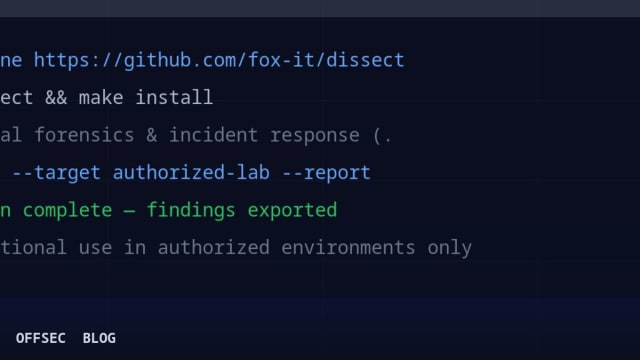
dissect is a Python-based digital forensics and incident response framework from Fox-IT that gives authorized analysts uniform access to disk images and forensic artifacts regardless of container, filesystem, or OS.
| Tool | fox-it/dissect — meta package that installs the full Dissect DFIR framework and toolset with compatible versions |
| Category | Digital forensics & incident response (DFIR) framework |
| Primary Use | Analyzing forensic artifacts such as Runkeys, Prefetch, MFT, and Windows Event Logs directly inside images (E01, VMDK, QCoW) via target-query and target-shell |
| Safe Use | Intended for authorized incident response engagements, forensic examinations of systems you are mandated to investigate, lab research, and defensive analysis |
| Telemetry Note | Purely a read-side analysis toolkit; on endpoints, the companion acquire collector reads data and writes lightweight containers, a locally observable artifact responders should account for in scope documentation |
dissect is a digital forensics and incident response framework developed by Fox-IT, part of NCC Group, and it approaches one of the oldest pain points in the discipline: the sheer diversity of containers, filesystems, and operating systems an examiner faces during an engagement. Rather than chaining together a dozen single-purpose utilities, dissect provides a single analytical surface where an image in E01, VMDK, or QCoW format, sitting on NTFS, ExtFS, or FFS, from a Windows, Linux, or ESXi system, is all addressed the same way. The repository at fox-it/dissect currently carries around 1155 stars and is licensed under AGPL-3.0, which matters for teams integrating it into commercial workflows and internal tooling.
Structurally, the fox-it/dissect repository is a meta package rather than a monolithic codebase. Installing dissect via pip install dissect pulls in a constellation of version-matched modules — dissect.ntfs, dissect.extfs, dissect.eventlog, dissect.regf, dissect.volume, dissect.hypervisor, dissect.evidence, and many more — each of which implements a specific parser or file format. The README is explicit that each individual project can also be used standalone or in combination to build entirely new tooling for a particular engagement. That composability is the architectural thesis of the framework: parsers are libraries first, CLI tools second.
The user-facing tools that tie the modules together are target-query and target-shell. The README's central example is telling: instead of extracting files from a forensic container, mounting a VMDK, retrieving the $MFT, and feeding it to a separate parser before you can even begin building a timeline, you can run target-query -f mft <PATH_TO_YOUR_IMAGE> and start working with parsed MFT entries directly. target-query applies named analysis functions (the -f flag) against a target image, while target-shell drops you into an interactive environment for exploratory analysis of the same target.
The range of artifacts the framework surfaces includes Runkeys, Prefetch files, and Windows Event Logs, per the README, and the module list hints at considerably more depth. dissect.regf handles registry hives, dissect.eventlog and dissect.cim cover event log and WMI repository formats, dissect.shellitem parses shell item structures, and dissect.thumbcache deals with Windows thumbnail caches. Filesystem coverage is remarkably broad: beyond NTFS and ExtFS, the project list includes dissect.apfs, dissect.btrfs, dissect.fat, dissect.ffs, dissect.jffs, dissect.qnxfs, dissect.squashfs, dissect.vmfs, and dissect.xfs.
That filesystem breadth translates into genuine cross-platform reach for an IR team. An examiner comfortable with dissect can move from a compromised Windows endpoint to a Linux server to an ESXi hypervisor host without retooling, because the abstraction layer normalizes the underlying structures. The dissect.fve module (full-volume encryption) and dissect.hypervisor and dissect.vmfs modules further suggest that virtualization infrastructure — increasingly a pivot point in real intrusions — is a first-class citizen rather than an afterthought.
Collection is addressed by a closely related project, acquire, which the README describes as deployable on endpoints to create lightweight forensic containers of those machines. Notably, it can also be deployed on a hypervisor to create lightweight containers of all running virtual machines there, without worrying about file locks — a significant operational advantage, since live VM disks are otherwise awkward to capture consistently. The output of acquire feeds straight back into target-query and target-shell, though the README notes other tools can consume the containers too. acquire and flow.record are listed as related projects that are deliberately not installed by the meta package.
The dissect.cstruct module deserves a note because it reflects the framework's engineering quality: rather than hand-rolling structure parsing in every module, the team built a shared C-struct definition language that all format parsers can leverage. Similarly, dissect.util and dissect.archive provide common plumbing. This is the kind of internal consistency you want to see in forensic tooling, where parser correctness is the entire product — a bug in an NTFS or eventlog parser can silently corrupt a timeline and mislead an investigation.
For evaluation before committing, the project offers an interactive playground at try.dissect.tools where the tooling can be exercised in a browser, which is a low-friction way for an IR team lead to assess fit. Documentation lives at docs.dissect.tools, including an introduction page, a detailed overview page, and a contributing guide. There is also a Discord server for community support, which signals an active, reachable development team rather than an abandoned dump of parsers.
From a development and quality perspective, the project uses tox for both packaging and testing. Running tox -e build from the repository root produces source and wheel distributions in the dist/ directory, while a bare tox invocation runs linting and unit tests in a self-contained environment against the default installed Python version. Dissect requires Python, with supported versions documented in the Getting Started section, and contributions are welcomed through the published development guide — relevant for any team that finds a format gap and wants to upstream a parser.
In an authorized workflow, dissect slots in cleanly after collection: an analyst with a mandate over an environment uses acquire or receives images through existing forensic processes, then uses target-query functions to rapidly triage persistence mechanisms, execution traces, and event log activity across heterogeneous systems. Because the framework works directly against images without requiring mounts or extraction, it also reduces the footprint of the analysis workstation itself and keeps evidence handling simpler, with fewer intermediate copies of sensitive data floating around. For defenders and researchers, the same parsers are valuable for building detection logic and understanding artifact semantics on their own systems.
The obvious caveats are the AGPL-3.0 license, which requires careful review before embedding Dissect components into anything distributed externally, and the meta-package model, which means version pinning behavior is managed for you — convenient, but worth verifying against the documented version matrix when reproducibility of an examination matters. Overall, dissect represents one of the more mature open-source DFIR investments available, backed by a commercial incident response practice at Fox-IT, and its modular parser library design makes it as much a foundation for custom tooling as a standalone analyst product.
fox-it/dissect.Educational analysis for authorized security professionals. Use only in controlled, authorized environments.


0 comentários:
Post a Comment
Note: Only a member of this blog may post a comment.