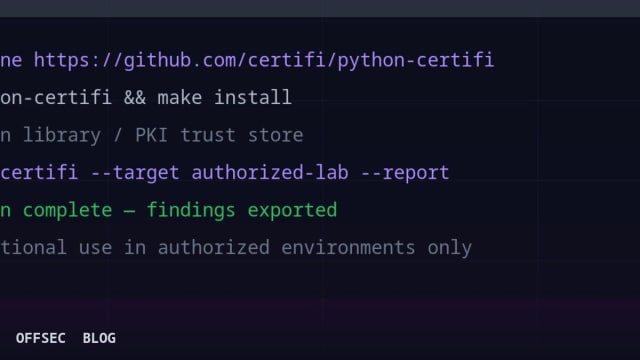
certifi ships a carefully curated bundle of Root Certificates that Python applications use to validate SSL certificates and verify the identity of TLS hosts.
| Tool | certifi/python-certifi — a carefully curated collection of Root Certificates for validating the trustworthiness of SSL certificates when verifying TLS host identities |
| Category | Python library / PKI trust store |
| Primary Use | Providing Python applications with a reliable CA bundle for TLS certificate validation in requests, pip, and other SSL-dependent tooling |
| Safe Use | Purely defensive infrastructure: used in authorized development, assessment tooling, and lab environments to ensure correct certificate chain validation |
| Telemetry Note | certifi is a passive library — it performs no network calls itself and leaves no operational telemetry; defenders observe it only as a dependency in Python environments |
Most security practitioners interact with certifi every day without ever noticing it. The repository certifi/python-certifi describes itself plainly: a carefully curated collection of Root Certificates for validating the trustworthiness of SSL certificates while verifying the identity of hosts in TLS. That single sentence hides a surprisingly consequential role, because certificate validation is the mechanism that turns an encrypted channel into an authenticated one. Without a trustworthy root store, TLS becomes opaque transport that anyone with a rogue certificate — or a corporate interception proxy — can sit in front of.
The project is written in Python and lives on the master branch, currently holding roughly a thousand stars on GitHub, which is modest by dependency-world standards but belies its actual footprint. certifi is one of the most installed packages in the entire Python ecosystem precisely because it sits underneath widely used HTTP libraries. When a requests call succeeds against an https:// endpoint, the trust decision about which certificate authority vouched for that server is almost always delegated to the bundle certifi ships. In effect, the package is a private mirror of the WebPKI root set, packaged so that Python code does not depend on whatever CA configuration happens to exist on the host operating system.
The design rationale is worth spelling out for operators. Operating-system CA stores vary wildly across distributions, containers, and base images, and minimal container images frequently ship with no CA bundle at all. By vendoring a curated set of roots, certifi makes certificate validation deterministic and reproducible: the same code running in an Alpine container, a CI runner, or a developer laptop evaluates the same trust anchors. For assessment teams building tooling that must behave identically across environments, that determinism is not a convenience — it is a correctness guarantee that prevents false positives when a validation failure is caused by a missing system store rather than a genuinely misconfigured server.
The word "curated" in the project description is the load-bearing term. Root stores are not static artifacts; certificate authorities are distrusted following compromises or compliance failures, and new roots are added as the WebPKI evolves. A stale root bundle is a quiet liability in two directions: it may trust a CA that the broader community has revoked, and it may reject chains from legitimately issued certificates whose roots postdate the bundle. Keeping certifi current is therefore a hygiene task in the same category as patching dependencies — and indeed, several notable supply-chain and interception incidents in the Python world have been addressed by shipping updated certifi releases that removed specific distrusted roots.
From a defensive perspective, certifi is best understood as an attack-surface reducer rather than a tool that generates activity of its own. It performs no network communication, executes no exploits, and leaves no telemetry trail; its entire behavior is the passive provision of a PEM-encoded trust bundle that SSL/TLS libraries consume at handshake time. Defenders auditing Python environments should nonetheless inventory its version, because a pinned or frozen certifi in a long-lived container image is a common way for distrusted CAs to linger in production trust paths months after the community has moved on.
There is also a flip side that red team operators and detection engineers should understand conceptually. Because certifi deliberately bypasses the operating-system trust store, corporate TLS inspection appliances that rely on a locally installed root CA will produce validation failures inside Python tooling unless that root is explicitly added. This is a frequent source of confusion during authorized internal assessments: a tool fails to connect, the operator disables verification entirely with verify=False, and the assessment quietly degrades from encrypted-and-authenticated to encrypted-only. Understanding where the trust bundle comes from is the difference between a justified exception and a dangerous habit.
Installation follows the standard packaging path — pip install certifi — and the package exposes its bundle location programmatically via import certifi; certifi.where(), which returns the filesystem path to the CA bundle. That single accessor is the integration point most libraries rely on: rather than hardcoding a path or assuming OpenSSL's default locations, well-behaved Python HTTP clients pass the output of certifi.where() into their SSL context. It is a deliberately minimal API surface, which is appropriate for a component whose value lies entirely in the freshness and correctness of its data rather than in features.
For teams building security tooling, the lesson of certifi is architectural. Trust-anchor management is a data problem disguised as a library problem, and the project's discipline — shipping an opaque, versioned bundle rather than a configuration framework — is what makes it composable. Tool authors who hardcode verification settings or silently fall back to disabled verification create exactly the failure modes certifi exists to prevent. Treating the package as a pinned, monitored dependency, with updates reviewed like any other security-relevant change, keeps the trust layer of your Python stack aligned with the broader PKI community.
In an authorized workflow, certifi is invisible scaffolding: it makes the HTTPS checks in your scanners, enrichers, and reporting pipelines trustworthy by default. It is neither offensive nor defensive in posture — it is the substrate both sides stand on when they argue about whether a certificate should be believed. A thousand stars undersells a package that effectively defines what "trusted" means for a large fraction of Python traffic, and any professional building or auditing Python-based security tooling should know exactly which version their environments carry and why.
certifi/python-certifi.Educational analysis for authorized security professionals. Use only in controlled, authorized environments.
Related coverage


0 comentários:
Post a Comment
Note: Only a member of this blog may post a comment.