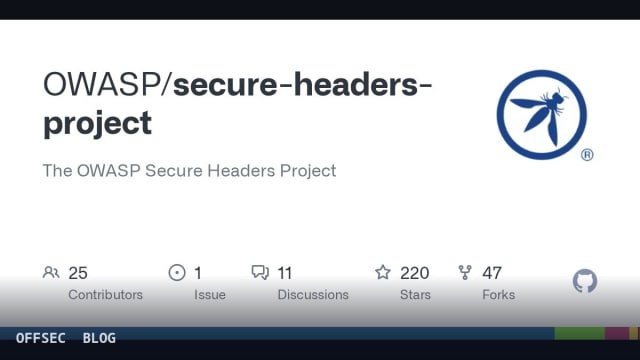
The OWASP Secure Headers Project bundles a markdown master knowledge base, a validator tests suite, and usage statistics covering HTTP response security headers for authorized application security work.
| Tool | OWASP/secure-headers-project — OWASP knowledge base, validator, and statistics ecosystem for HTTP response security headers |
| Category | Application security documentation and configuration validation |
| Primary Use | Benchmarking and validating an application's HTTP response security headers configuration against OSHP recommendations during authorized reviews |
| Safe Use | Designed for defenders, developers, and authorized security teams hardening their own or client-owned applications; purely defensive documentation and validation content |
| Telemetry Note | Nothing to observe — this is reference content and a tests suite; it generates no traffic and leaves no footprint beyond normal git clone repository access |
The OWASP/secure-headers-project, also known as OSHP, occupies an unusual niche in the tooling landscape: rather than being a scanner or exploit framework, it is a curated ecosystem of documentation, validation logic, and usage statistics centered on HTTP response security headers. The repository is the content source for the project's public site at https://secure-headers-project.owasp.org, with the canonical markdown living in the mainsite/ directory and rendered through GitHub Pages. For professionals who spend their days reasoning about Content-Security-Policy, Strict-Transport-Security, and friends, this is the reference layer that many commercial scanners quietly borrow from, and it carries OWASP production project status with an Apache-2.0 license and roughly 220 stars.
Architecturally, the project is explicitly decomposed into three cooperating subprojects, and the README is refreshingly precise about the boundaries. The mainsite is described as the master data in markdown — the single source of truth that humans actually edit and that everything else derives from. The validator lives under subprojects/validator/ and is described as a Venom tests suite that validates an HTTP security response headers configuration against the OSHP recommendation set. The statistics subproject under subprojects/statistics/ tracks usage of the headers the project documents, giving teams empirical context for how widely a given header has actually been adopted in the wild.
The repository layout mirrors that philosophy. The base directory holds the main site content, subprojects/ contains the validator and statistics work in their own folders, the logo/ directory stores the project artwork (also mirrored in the OWASP/owasp-swag repository), and a ci/ directory holds materials used by the GitHub Actions workflows that generate and update derived content. This is a documentation project engineered like a software product, with generated artifacts clearly separated from hand-authored master data.
The automation layer deserves attention because it reveals how the project maintains accuracy at scale. Workflow files follow a strict naming convention, [project_call_name]_[action]_[target].yml, where the action component is limited to validate, monitor, or generate. The README lists nine workflows with health badges, including mainsite_generate_headers-json-files.yml which presumably converts the markdown header descriptions into machine-readable JSON, mainsite_validate_external-links.yml which guards against link rot in the technical references, and statistics_generate_datasource.yml which feeds the statistics subproject. There is even mainsite_monitor_oshp-gha-workflows.yml, a workflow that monitors the other workflows — a level of self-referential hygiene that signals serious maintenance discipline.
For an authorized assessment workflow, the practical value proposition is twofold. First, the mainsite gives you defensible, human-vouched guidance on what each header does, why it matters, and how to configure it — the kind of citable rationale you want in a client report rather than a blog paraphrase. Second, the validator gives you a repeatable tests suite, built on the Venom test runner, that lets you express 'does this application's header configuration meet the OSHP baseline' as a checkable assertion instead of manual inspection. That transforms header review from a one-off eyeball exercise into something you can wire into CI or re-run across environments during a hardening engagement.
The JSON generation workflow is a subtle but important detail for tool builders. Because the master markdown is programmatically converted into structured header data, other projects can consume OSHP recommendations as a datasource instead of scraping HTML or maintaining their own header lists. If you are building an internal linter, a proxy check, or a report generator for authorized reviews, that generated JSON is the integration point the maintainers have deliberately created for exactly this purpose.
Unusually for a documentation project, the README includes an explicit policy on generative AI usage, and it is worth quoting the substance of. GenIA is limited to spell-checking, script or proof-of-concept assistance, brainstorming, documentation search, and validating technical understanding. The rule is categorical: GenIA must never author the technical description, security rationale, or recommended configuration text for a published header — a human must write and vouch for that content. They even built a custom Claude Code command, validate-md-content, invocable as /validate-md-content [markdown-file-to-validate], to lint content against predefined rules. In an era where security guidance is increasingly LLM-laundered, this provenance policy is a genuine differentiator and a reason to trust the content over anonymously generated alternatives.
The contributor and governance picture is also documented: the project is led by Ricardo Iramar and Dominique Righetto, with pre-GitHub-migration contributions credited to Alexandre Menezes, Adam Averay, and Jim Manico. Issues and discussions are both active GitHub features for engagement, and content editing is standardized around Visual Studio Code with a provided project.code-workspace file and recommended extensions in .vscode/extensions.json. These are small signals, but collectively they indicate a project with onboarding infrastructure, not just a pile of markdown.
There are limitations worth naming plainly. The README does not document a quick command-line invocation path for the validator — you get directory pointers and the knowledge that it is a Venom tests suite, so expect to read subprojects/validator/ directly to understand how to point it at your target. Getting the content locally is the standard move: git clone https://github.com/OWASP/secure-headers-project gives you the full markdown master, the subprojects, and the ci/ materials in one repository. This is a read-and-integrate project more than an install-and-run one.
Where this fits defensively is straightforward: HTTP response headers remain one of the cheapest, highest-leverage hardening layers available to web teams, and misconfiguration is endemic. OSHP gives defenders the canonical what-and-why, the validator gives them the how-do-I-check, and statistics gives them the is-anyone-else-actually-doing-this. For purple-team exercises, secure-SDLC gates, or pre-deployment review of your own applications, it is the reference most of us should have been using all along — and the telemetry footprint is zero, because it is content and tests, not an active scanner. Everything here is inherently safe by construction: documentation about defensive headers and a suite that checks your own configuration, with nothing in the repository that facilitates compromise of systems you do not own.
OWASP/secure-headers-project.Educational analysis for authorized security professionals. Use only in controlled, authorized environments.
Related coverage


0 comentários:
Post a Comment
Note: Only a member of this blog may post a comment.