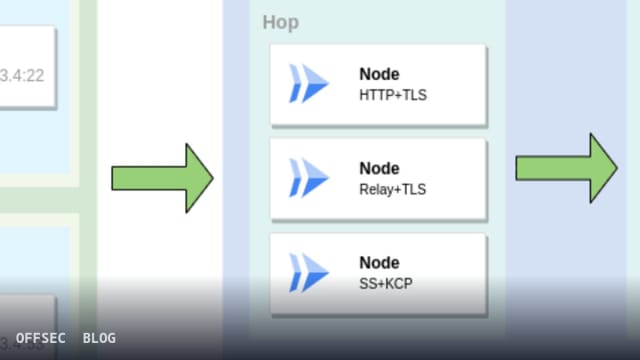
A tunneling Swiss-army knife for authorized professionals: gost builds multi-hop forwarding chains, port forwards, and reverse proxies across HTTP, SOCKS5, SSH, QUIC and more, with observability built in.
| Tool | go-gost/gost — GO Simple Tunnel, a multi-protocol tunnel, proxy, and port-forwarding tool written in Go |
| Category | Network tunneling and proxy framework |
| Primary Use | Building multi-hop forwarding chains, TCP/UDP port forwarding, and reverse-proxy tunnels for authorized assessments and lab networks |
| Safe Use | Deploy only on systems and networks you own or are explicitly authorized to test, such as internal labs, range exercises, and documented penetration test infrastructure |
| Telemetry Note | gost exposes Prometheus monitoring metrics and ships a systemd service unit with /etc/gost/gost.yml, so defenders can watch for its process, config paths, and metric endpoints on managed hosts |
gost — short for GO Simple Tunnel — is one of those rare infrastructure tools that manages to be simultaneously a network engineer's utility and a security professional's relay workbench. Written in Go and MIT-licensed, the project has accumulated over 7,500 stars on GitHub, and the repository topics read like a transport-layer taxonomy: http, http2, http3, quic, kcp, dtls, icmp-tunnel, shadowsocks, socks5, socks4a, ssh, websocket, tun2socks, tuntap, dns, grpc, reverse-proxy, and tunnel. That breadth is the core design thesis: rather than being a single-protocol tunnel, gost is a framework where nearly any listener, handler, and dialer can be composed into a forwarding topology.
The README, primarily in Chinese with an English companion, organizes the feature set into a checklist that reveals the architecture. There is multi-port listening, multi-level forwarding chains, multi-protocol support, TCP/UDP port forwarding, reverse proxy and tunnel modes, and TCP/UDP transparent proxying. Beyond raw relaying, gost handles DNS resolution and DNS proxying, TUN/TAP device integration with TUN2SOCKS, load balancing via selectors, routing control through bypass rules, admission control, rate limiting, a plugin system, Prometheus metrics, dynamic configuration, and a Web API. Each of those checkboxes links to the project's documentation site at gost.run, which functions as the real manual.
Conceptually, the project frames three primary usage modes. The first is forward proxying: gost acts as a proxy service for network access, and multiple protocols can be chained together into a forwarding chain — the multi-level chain feature is what distinguishes it from simpler proxies. The second is port forwarding, mapping one service's port to another, again optionally routed through a composed chain of protocols. The third is reverse proxying, where tunnel and NAT-traversal style functionality exposes internal services to public access — a capability that is enormously useful in authorized internal-lab contexts and equally a reason the tool warrants defensive awareness.
The forwarding chain abstraction deserves emphasis because it is the architectural heart of the tool. Instead of treating SSH over WebSocket or SOCKS5 over QUIC as special cases, gost models listeners, handlers, and dialers as composable nodes; a chain can hop through several such nodes before reaching its destination. For an operator building authorized test infrastructure — say, simulating layered egress paths in a purple-team exercise — this composability means the tool can emulate realistic multi-stage relay topologies without custom scripting. For defenders, the same property means gost traffic can surface in unexpected protocol combinations, which is exactly why its Prometheus metrics support matters for monitoring your own deployment.
Installation is handled across every common channel. Binary releases are published on GitHub, and the project provides DEB and RPM system packages for amd64, amd64v3, and arm64 architectures — the amd64v3 build requiring an AVX2-capable CPU. A notable operational detail from the README: the packages ship a systemd service that is not auto-enabled. You create /etc/gost/gost.yml (with an example at /usr/share/doc/gost/examples/gost.yml) and then run sudo systemctl enable --now gost; if no configuration file exists, the service silently skips rather than erroring. That fail-quiet behavior is worth remembering when auditing whether the service actually started on a lab host.
For container-first environments, gost publishes a Docker image runnable as docker run --rm gogost/gost -V, and source builds follow the standard Go path of cloning the repository and running go build inside cmd/gost. There is also an install.sh script fetched via curl from the repository's master branch, supporting either the latest release or a user-selected version. Nothing in the tooling is exotic; the operational friction is deliberately low, which is consistent with the project's maturity.
The ecosystem extends beyond the core binary. A native GUI client, go-gost/gostctl, and a WebUI, go-gost/gost-ui, provide friendlier management surfaces, and a third-party Shadowsocks Android plugin, hamid-nazari/ShadowsocksGostPlugin, integrates gost into mobile workflows. The existence of a full Web API with dynamic configuration means a running instance can be reconfigured without restart — powerful for authorized operations, but also a property defenders should note when inventorying management endpoints on their networks.
From a defensive-research standpoint, several features cut both ways. Bypass-based routing control, admission control, and limiter features give administrators fine-grained governance over who may use a relay and how much traffic it will carry — genuinely operational hygiene features. Prometheus metrics and the Web API make gost far more observable than ad-hoc tunnels, which is a positive for any sanctioned deployment. Conversely, protocol diversity spanning icmp-tunnel, kcp, quic, and shadowsocks means gost can be shaped to blend into ordinary traffic profiles, so blue teams evaluating detection coverage should account for it when modeling relay tooling in their labs.
The documentation investment is substantial and current: gost.run hosts the wiki, a YouTube channel covers tutorials, and there are Telegram and Google Groups communities, plus an archived v2 documentation site at v2.gost.run. The v2/v3 split indicates an active rewrite history rather than an abandoned project — an important distinction when choosing infrastructure tooling you may need to debug mid-exercise.
Where does gost fit in a professional workflow? For authorized penetration testers, it is a candidate for building the relay and pivot layers of a documented test infrastructure, particularly when the target environment's egress constraints call for protocol multiplexing. For network engineers, the port-forwarding, transparent proxy, and load-balancing features stand on their own. For defenders, studying gost is worthwhile precisely because it catalogs, in one open-source codebase, the design patterns of modern tunneling: chain composition, protocol stacking, NAT traversal, and dynamic control planes. As with any relay tool, the ethical boundary is deployment scope — gost belongs on infrastructure you own or are contractually authorized to operate, and its own monitoring features make it easier to keep such deployments accountable.
go-gost/gost.Educational analysis for authorized security professionals. Use only in controlled, authorized environments.
Related coverage


0 comentários:
Post a Comment
Note: Only a member of this blog may post a comment.