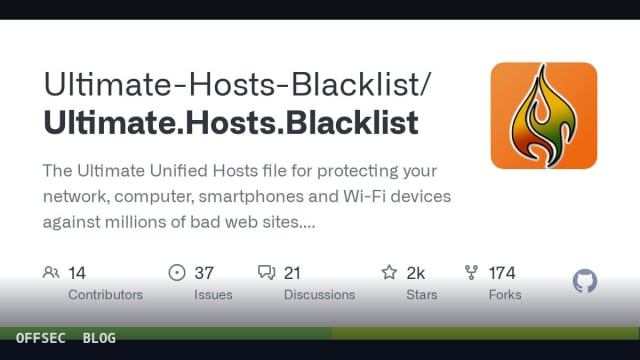
A curated, daily-updated unified hosts file that blocks roughly 922,827 known-bad domains and 148,849 malicious IPs for defenders, admins, and families on authorized networks.
| Tool | Ultimate-Hosts-Blacklist/Ultimate.Hosts.Blacklist — one of the largest curated, unified hosts files for blocking malicious, adware, and unwanted domains |
| Category | Defensive blocklist / DNS filtering |
| Primary Use | Deploying a daily-updated hosts file or hosts.deny/superhosts.deny list on Linux systems, or feeding domains.list into Pi-hole/dnsmasq for network-wide blocking |
| Safe Use | Purely defensive: hardening your own hosts, labs, and authorized corporate networks against malware, ransomware, adware, and content categories |
| Telemetry Note | Leaves no network telemetry of its own; defenders observe it as DNS sinkholing to 0.0.0.0 and as hosts-file modifications on endpoints — blocked lookups vanish from resolver logs |
Ultimate.Hosts.Blacklist occupies a distinctive niche in the defensive tooling ecosystem: rather than detecting or analyzing threats, it makes them unreachable. The project aggregates feeds from what it describes as multiple upstream sources, tests them regularly, and merges everything into a single monolithic hosts file that is refreshed daily. At the version documented in the README, V2.3812.2026.10.03, the counts are genuinely impressive: 922,827 bad domains in the hosts file, 148,849 bad IPs in hosts.deny, and a combined 1,071,676 entries in superhosts.deny. This is defensive infrastructure, not offensive tooling, and it slots naturally into hardening baselines for labs, family networks, and authorized corporate estates.
The mechanics are deliberately primitive and therefore robust. A hosts file is a plain-text hostname-to-IP map consulted by essentially every operating system before DNS, meaning a listed domain resolves locally and the request never leaves the machine. The project's entries point bad domains at 0.0.0.0, which the README explicitly recommends over the traditional 127.0.0.1 loopback — a sensible choice, since 0.0.0.0 fails fast instead of generating connection attempts against your own localhost. The README is also candid about the format's core limitation: hosts files cannot express wildcards, so 0.0.0.0 *.doubleclick.net simply doesn't work. Every malicious variant must be enumerated explicitly, which is precisely the labor the project automates through aggregation and deduplication.
Format flexibility is one of the project's quiet strengths. Beyond the core hosts file — offered in both Unix (LF) and Windows (CRLF/DOS) line-ending variants — the repository publishes hosts.deny and superhosts.deny for TCP-wrappers-style IP blocking, domains.list formatted for Pi-hole ingestion, a dotted-format variant targeting dnsmasq, and ips.list for IP-based filtering. That last pair matters operationally: on a home or small-office network, feeding domains.list into a Pi-hole gives you central enforcement without touching individual endpoints, sidestepping the hosts-file maintenance problem entirely. All raw files are available from both the GitHub repository and an official mirror at hosts.ubuntu101.co.za, which spreads load and provides resilience if GitHub rate-limits your update jobs.
The update cadence is documented with unusual precision. The central GitHub repository refreshes daily around 19:05–19:15 UTC, the API and search engine follow by roughly 19:20, and the mirror and DNS servers complete the pipeline between 19:30 and 19:40. For an operator, this matters because it defines the freshness window of your protection: anything pulled before roughly 19:40 UTC reflects the previous day's merge. Cron-driven updaters should be scheduled accordingly, and the project ships linux-hosts-updater.sh, linux-hosts.deny-updater.sh, and linux-superhosts.deny-updater.sh precisely so this can run unattended.
Installation is straightforward on Linux, where the repo provides matched installer/uninstaller/updater triplets for each file type. A typical Linux deployment is essentially one command against the raw file — for example fetching https://hosts.ubuntu101.co.za/hosts into /etc/hosts via the provided linux-hosts-installer.sh — after which the updater script keeps it current. The Windows story is different, and the README is emphatic about it: the maintainers explicitly recommend that Windows users skip the hosts file and use the project's DNS servers instead, flagging the large file as problematic on that platform.
Those DNS resolvers are the second half of the architecture. The project operates two anycast-style nameservers, safedns.allover.co.za (88.198.70.38, IPv6 2a01:4f8:140:5021::38) and safedns2.allover.co.za (88.198.70.39, IPv6 2a01:4f8:140:5021::39), both answering on ports 53 and 5353. They are described as non-logging, refreshed daily after the list build, and engineered so both servers are never taken down simultaneously, with maintenance windows kept under 120 seconds and announced in a public GitHub maintenance thread. For defenders who prefer not to route family or guest traffic through commercial resolvers, a static-IP, no-log option with a published changelog is a defensible choice — though as with any third-party resolver, you are trusting the operator's claims.
Governance is where this project shows its maturity. Because it spans a whole GitHub organization rather than a single repo, contributions and disputes are routed through a documented matrix: general questions to this repository's discussions, infrastructure issues to dev-center, list additions to the blacklist repo, and — critically — removal requests to a dedicated whitelist repo. That last channel is the hallmark of a blocklist that takes false positives seriously. With nearly a million blocked domains, collateral damage is inevitable; an operator rolling this out broadly should read the whitelist workflow first and budget for handling breakage reports when a legitimate service gets caught in the net.
The categorization ambitions go beyond pure security. The repository's topics include malware, ransomware, adware, petya, and clickjacking, but also porn, violence, drugs, alcohol, child-protection, and family — signaling that the list blends threat intelligence with content filtering. For a corporate deployment this mixing is worth auditing: security-driven blocks are rarely controversial, but content-category blocks can conflict with business needs or acceptable-use policies. Conversely, for a home lab or family network, getting both from one daily-maintained file is a genuine convenience.
From a defensive telemetry perspective, deploying this list has observability consequences you should plan around. Sinkholed lookups never reach an upstream resolver, so blocked domains disappear from external DNS logs rather than generating alertable events — the signal is the absence of a connection. Endpoint visibility comes instead from local resolver logs, Pi-hole query logs if you use domains.list centrally, or EDR rules watching for modifications to /etc/hosts. In an authorized enterprise context, monitoring hosts-file integrity remains essential anyway, since attackers also love editing that file; knowing the legitimate baseline this list produces helps distinguish your own hardening from hostile redirection.
The engineering around the project is visible in its structure: written largely in Shell, MIT-licensed, with roughly 1,620 stars and a decade-deep commit history implied by the version numbering scheme. The daily rebuild pipeline, mirrored distribution, public API/search engine, and operated DNS infrastructure suggest a small but serious production system rather than a hobby list. For security engineers building layered defense-in-depth — endpoint hardening, network filtering, and DNS policy — Ultimate.Hosts.Blacklist is a low-cost, high-coverage data source that is trivially composable with tools you already run, and its per-file variants mean you can adopt it at whichever layer fits your architecture without reformatting anything yourself.
Ultimate-Hosts-Blacklist/Ultimate.Hosts.Blacklist.Educational analysis for authorized security professionals. Use only in controlled, authorized environments.
Related coverage


0 comentários:
Post a Comment
Note: Only a member of this blog may post a comment.